Allanblackia parviflora
A. Chev.
Vegetable tallow tree, Ouotera
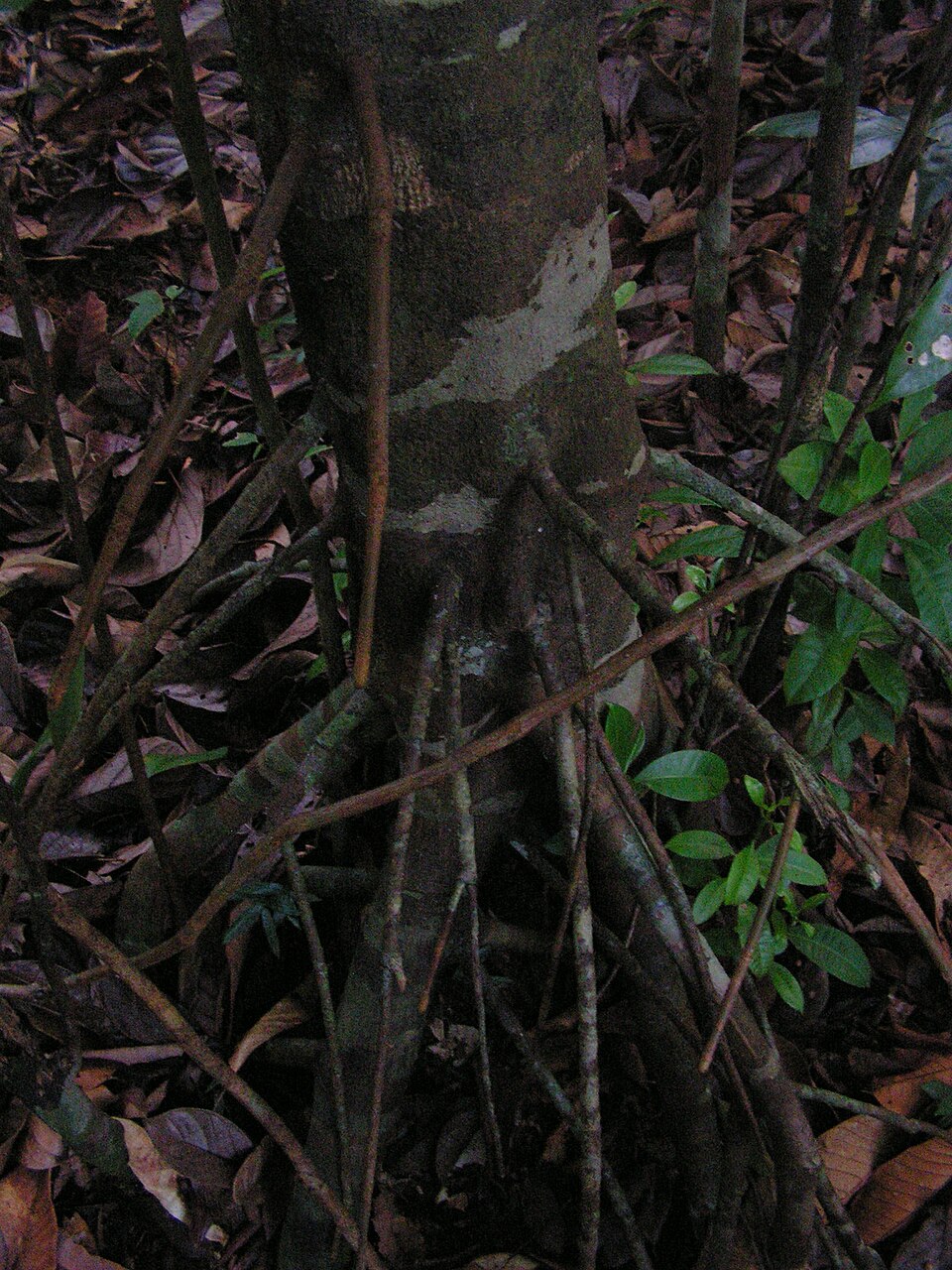
iNaturalist· cc-by-nc
(c) Carel Jongkind, some rights reserved (CC BY-NC), uploaded by Carel Jongkind
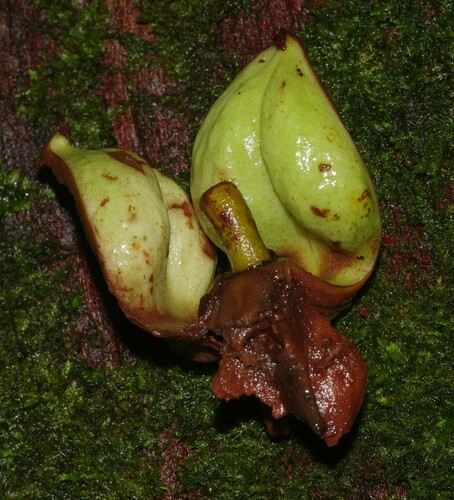
iNaturalist· cc-by-nc
(c) Carel Jongkind, some rights reserved (CC BY-NC), uploaded by Carel Jongkind
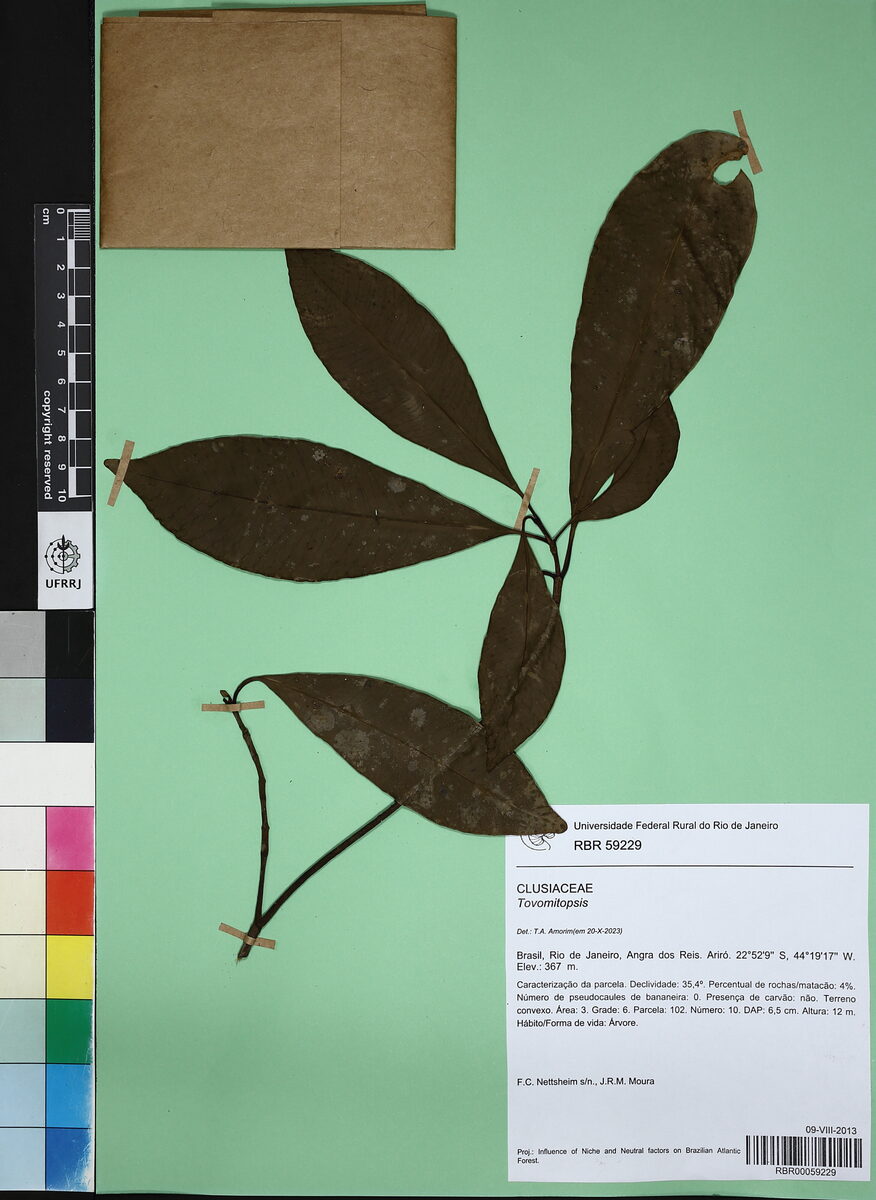
wikimedia· cc-by-sa
Wikimedia Commons - Ckattah
Summary
Source: WikipediaAllanblackia parviflora is a medium-sized deciduous forest tree belonging to the family Clusiaceae.
Description
An evergreen tree. It grows 30 m high. The trunk can be 80 cm across. The leaves are simple. The flowers are pale red or a yellowish-white. The fruit is a pod with large seeds. They are irregular in shape with flattened surfaces. They are red-brown and 2-4 cm long by 2 cm wide.
Edible Uses
The seed yields a fat known as 'allanblackia fat' or 'beurre de bouandjo' in Congo, used in food preparation. The kernel makes up about 60% of the seed and contains around 72% fat, composed of approximately stearic acid (45–58%) and oleic acid (40–51%), with only traces of other fatty acids. Its high melting point of 35°C makes it suitable as a raw material — without further transformation — for improving the consistency of margarines, cocoa butter substitutes, and similar products. The international food industry has taken growing interest in it for this purpose. To process the fat, seeds are dried and crushed, the mass is mixed with water and boiled until the fat separates and floats to the surface, where it is scooped off. Hydraulic and screw press equipment is also now used. To reach the seeds, fruits are stored under a cover of leaves until the pulp disintegrates, then crushed between the hands and rubbed clean. The seeds themselves are eaten in times of food scarcity. The slimy fruit pulp can be made into jams and jellies. The fruit is large — up to 30cm long by 10cm in diameter — and contains upward of 100 seeds held within a translucent mucilage.
Medicinal Uses
A decoction of the inner bark is taken to treat diarrhoea, dysentery, and stomach aches, and is used as a mouthwash to relieve toothache pain. The bark is anodyne and, when pounded, is rubbed on the body to relieve painful conditions. A decoction of bark or leaves is taken for asthma, bronchitis, and cough. Sap squeezed from the bark contributes to a medicine for urethral discharge; sap from a crushed mixture of the bark combined with that of Mammea africana, maleguetta, and sugar-cane is taken for the same purpose. A decoction of the whole fruit is used to relieve elephantiasis of the scrotum, though this may be based on the Theory of Signatures given the fruit's size and shape. A prenylated xanthone named allanxanthone A has been isolated from the bark, along with 1,5-dihydroxyxanthone and 1,5,6-trihydroxy-3,7-dimethoxyxanthone; these showed moderate in-vitro cytotoxicity against the KB cancer cell line. Bark and root material has been reported to contain abundant flavonoids, some tannins, and traces of steroids and terpenes. An alkaloid has also been reported in the fruit sap — a derivative of tryptophan related to eseroline found in the Calabar bean (Physostigma venenosum) — and is described as mildly stimulatory.
Known Hazards
None reported.
Distribution
It is a tropical plant. It grows in the wetter areas of the rainforests. It suits humid locations.
Where It Grows
Africa, China, Côte d'Ivoire, Ghana, Guinea, Guinée, Ivory Coast, Liberia, Sierra Leone, West Africa,
Cultivation
Found in the wild on strongly leached, acid soils with a pH in the range 3.8 - 4.1. The tree has brittle branches and requires a position sheltered from strong winds. The degree of maturity of fruits on the tree can not be estimated; therefore mature fruits are left to drop to the ground and are then collected. The fat from the seeds of Allanblackia parviflora is very similar in composition to that of Allanblackia floribunda and Allanblackia stuhlmannii.
Propagation
Seed – germination can take 24–30 months and germination rates are very low. Storing fruits for a few months on damp sites, covered with banana leaves and partially buried, along with scarification of the seed coat, improve germination rates only slightly. Methods of propagation by cuttings and grafting are currently being developed.
Other Uses
Seed oil is used in soap making and the cosmetics industry. Twigs are used as candlesticks, and smaller twigs serve as chew-sticks and toothpicks. The inner bark contains a sticky yellow resin. The heartwood is pale red or brown, clearly demarcated from the whitish sapwood. The wood is fairly hard, resinous, and moderately heavy. It is said to be resistant to termites but is not particularly durable overall. It is fairly easy to work and finishes well, producing an attractive figure when quarter-sawn. Though of little commercial importance, it has appeared on the market in Liberia as 'lacewood' and is suitable for carpentry. It is used in hut-building for walls, doors, window-frames, and planks. Small trees are also cut for poles and used as mine pit-props and bridge-piles.
Production
The kernel is 62% of the nut. The nuts store well and can be transported.
Notes
Guttiferae/Clusiaceae are mostly confined to the tropics and subtropics.
Synonyms
References (4)
- A Chev. Veg. Ut. Afr. Trop. Franc.Les Végétaux utiles de l'Afrique tropicale français 5:163. 1909
- INFOODSUpdatedFGU-list.xls
- PROTABASE
- Wiersema, J. H. & Leon, B., 2013, World Economic Plants. A Standard Reference CRC Press. 2nd Ed. p 32