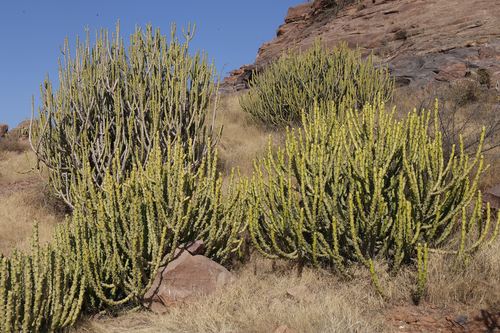
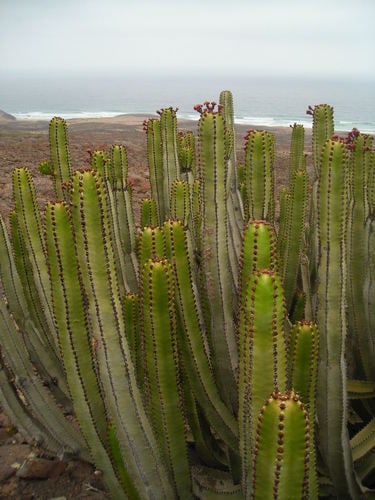
Erythrococca menyharthii
(Pax) Prain
Northern red-berry
iNaturalist· cc-by
(c) Robert Taylor, some rights reserved (CC BY), uploaded by Robert Taylor
iNaturalist· cc-by-nc
(c) dennera, some rights reserved (CC BY-NC)
Description
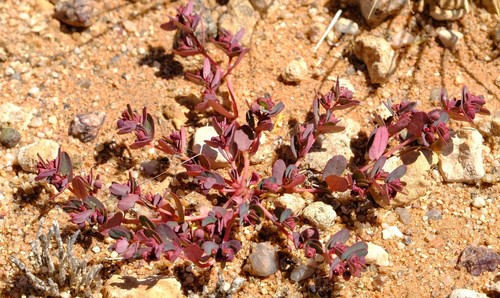
A straggly shrub. It grows 1-3 m high. It has a lose open crown. The bark is pale grey, smooth and flaking. The wood is soft. Young growth has soft hairs. The leaf blades are 2-10 cm long by 1-6 cm wide. They are oval or sword shaped. The male flower clusters are 1-5 cm long. The female flower clusters are 1-3 cm long. The fruit are 4 mm long by 9 mm wide. It can have 3 lobes. They are red when ripe. The seeds are 3-4 mm across.
Edible Uses
The leaves are eaten as a green vegetable and added to soups. The fruit are eaten fresh.
Traditional Uses
The leaves are eaten as a green vegetable. They are also added to soups. The fruit are eaten fresh.
This uses section is brief — help expand it
Medicinal Uses
The roots are ground and eaten with honey as a treatment against cough. The leaf sap is applied as drops in the eye to act as an anti-venom after attacks by spitting snakes.
Distribution
It is a tropical plant. It grows in sandy soils and Kalahari sands. It grows 300-1,050 m altitude. It can grow in arid places.
Where It Grows
Africa, Angola, Botswana, Central Africa, East Africa, Eswatini, Kenya, Mozambique, Namibia, South Africa, Southern Africa, Swaziland, Tanzania, Zambia, Zimbabwe,
Cultivation
A dioecious species, both male and female forms need to be grown if fruit and seed are required.
Synonyms
Also Known As
Dipoko, Modijwane, Muntyonto, Ninaghovo, Noordelike rooibessie, Poko
References (19)
- Flora Zambesiaca. http://apps.kew.org/efloras
- Fowler, D. G., 2007, Zambian Plants: Their Vernacular Names and Uses. Kew. p 25
- Fox, F. W. & Young, M. E. N., 1982, Food from the Veld. Delta Books. p 197
- Grivetti, L. E., 1980, Agricultural development: present and potential role of edible wild plants. Part 2: Sub-Saharan Africa, Report to the Department of State Agency for International Development. p 70
- Grubben, G. J. H. and Denton, O. A. (eds), 2004, Plant Resources of Tropical Africa 2. Vegetables. PROTA, Wageningen, Netherlands. p 299
Show all 19 references Hide references
- Long, C., 2005, Swaziland's Flora - siSwati names and Uses http://www.sntc.org.sz/flora/
- Magwede, K., van Wyk, B.-E., & van Wyk, A. E., 2019, An inventory of Vhavenḓa useful plants. South African Journal of Botany 122 (2019) 57–89
- Mannheimer, C. A. & Curtis. B.A. (eds), 2009, Le Roux and Muller's Field Guide to the Trees and Shrubs of Namibia. Windhoek: Macmillan Education Namibia. p 258
- Matlhare, T., et al, Vegetables in Botswana. p 21 Bioversity website.
- Okigbo, B.N., Vegetables in Tropical Africa, in Opena, R.T. & Kyomo, M.L., 1990, Vegetable Research and development in SADCC countries. Asian Vegetable Research and development Centre. Taiwan. p 38
- Oyen, L.P.A., 2008. Erythrococca bongensis Pax. [Internet] Record from Protabase. Schmelzer, G.H. & Gurib-Fakim, A. (Editors). PROTA (Plant Resources of Tropical Africa), Wageningen, Netherlands. < http://database.prota.org/search.htm>. Accessed 16 October 2009.
- Peters, C. R., O'Brien, E. M., and Drummond, R.B., 1992, Edible Wild plants of Sub-saharan Africa. Kew. p 110
- Royal Botanic Gardens, Kew (1999). Survey of Economic Plants for Arid and Semi-Arid Lands (SEPASAL) database. Published on the Internet; http://www.rbgkew.org.uk/ceb/sepasal/internet [Accessed 16th April 2011]
- Ruiters-Welcome, A. K., 2019, Food plants of southern Africa. Ph.D. thesis. Univ. of Johannesburg p 54
- Schmidt, E., Lotter, M., & McCleland, W., 2007, Trees and shrubs of Mpumalanga and Kruger National Park. Jacana Media p 278
- Scudder, 1971,
- Swaziland's Flora Database http://www.sntc.org.sz/flora
- Welcome, A. K. & Van Wyk, B.-E., 2019, An inventory and analysis of the food plants of southern Africa. South African Journal of Botany 122 (2019) 136–179
- World Checklist of Useful Plant Species 2020. Royal Botanic Gardens, Kew