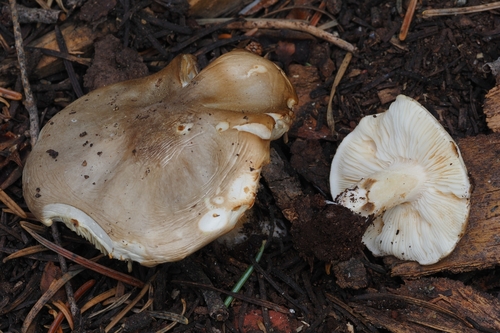
Armillaria gallica
Marxm.
Honey mushroom
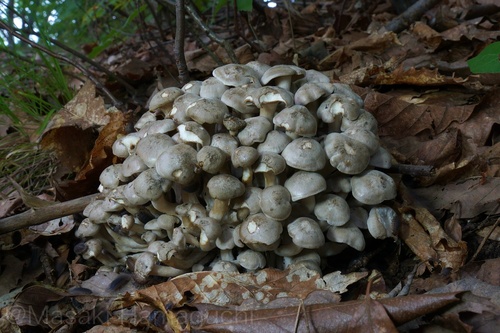
iNaturalist· cc-by
(c) Rocky Houghtby, some rights reserved (CC BY)
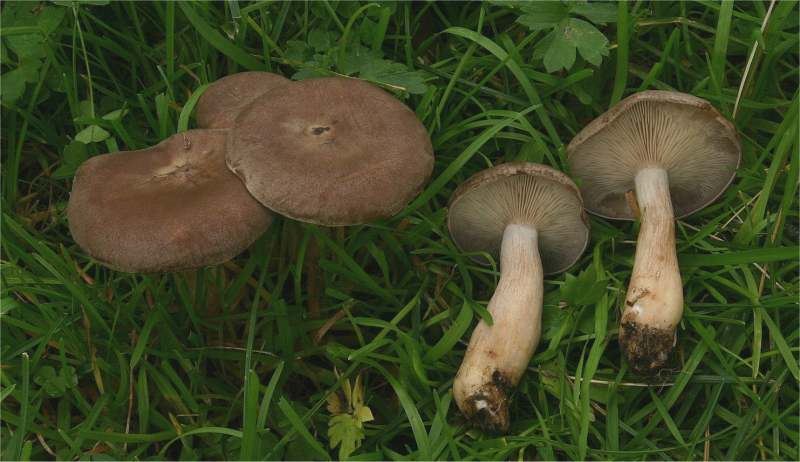
iNaturalist· cc-by-nc
(c) Connie Walker, some rights reserved (CC BY-NC), uploaded by Connie Walker
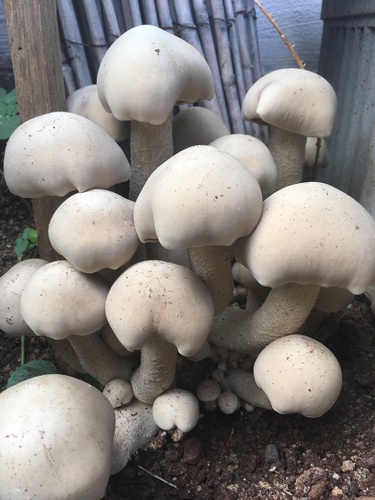
iNaturalist· cc-by-nc-sa
(c) AnneTanne, some rights reserved (CC BY-NC-SA)
Summary
Source: WikipediaArmillaria gallica (synonymous with A. bulbosa and A. lutea) is a species of honey mushroom in the family Physalacriaceae of the order Agaricales. The species is a common and ecologically important wood-decay fungus that can live as a saprobe, or as an opportunistic parasite in weakened tree hosts to cause root or butt rot. It is found in temperate regions of Asia, North America, and Europe. The species forms fruit bodies singly or in groups in soil or rotting wood. The fungus has been inadvertently introduced to South Africa. Armillaria gallica has had a confusing taxonomy, due in part to historical difficulties encountered in distinguishing between similar Armillaria species. The fungus received international attention in the early 1990s when an individual colony living in a Michigan forest was reported to cover an area of 15 hectares (37 acres), weigh at least 9.5 tonnes (9,500 kg; 21,000 lb), and be 1,500 years old. This individual is popularly known as the "humongous fungus", and is a tourist attraction and inspiration for an annual mushroom-themed festival in Crystal Falls. Recent studies have revised the fungus's age to 2,500 years and its size to about 400 tonnes (400,000 kg; 880,000 lb), four times the original estimate. Armillaria gallica is a largely subterranean fungus, and it produces fruit bodies that are up to about 10 cm (3.9 in) in diameter, yellow-brown, and covered with small scales. On the underside of the caps are gills that are white to creamy or pale orange. The stem may be up to 10 cm (3.9 in) long, with a white cobwebby ring that divides the color of the stem into pale orange to brown above, and lighter-colored below. The fungus can develop an extensive system of underground root-like structures, called rhizomorphs, that help it to efficiently decompose dead wood in temperate broadleaf and mixed forests. It has been the subject of considerable scientific research due to its importance as a plant pathogen, its ability to bioluminesce, its unusual life cycle, and its ability to form large and long-lived colonies.
Description
A temperate mushroom in the family Tricholomataceae.
This description is brief — help expand it
Edible Uses
The mushroom fruiting body is edible.
Distribution
It is a temperate plant.
Where It Grows
Africa, East Africa, North America, Rwanda, USA,
Dangerous Lookalikes
This plant can be confused with the following toxic species. Always verify identification carefully before consuming any wild plant.
Deadly Galerina (Funeral Bell)
Galerina marginata
Alan Rockefeller
Honey mushroom
Armillaria gallica
(c) Rocky Houghtby, some rights reserved (CC BY)
Deadly Galerina (Funeral Bell): Rusty-brown spore print, smooth brown cap, thin fragile ring, grows in smaller clusters.
Honey mushroom: White spore print, brown-black scales on cap, prominent white ring on stem, grows in large clusters.
Synonyms
References (3)
- Degreef, J., et al, 2016, Wild edible mushrooms, a valuable resource for food security and rural development in Burundi and Rwanda. Biotechnol. Agron. Soc. Environ. 2016 20(4), 441-452 (As Armillaria lutea)
- efta-online.org, Edible Fungi of Tropical Africa, Jardin botanique Meise (As Armillaria lutea)
- Ostry, M. E., et al, 2010, Field Guide to Common Macrofungi in Eastern Forests and Their Ecosystem Functions. USDA Forest Service General Technical Report NRS-79 p 21