Solanum nigrescens
M. Martens & Galeotti
Hierba mora
iNaturalist· cc-by-nc
(c) kevomc, some rights reserved (CC BY-NC), uploaded by kevomc
iNaturalist· cc-by-nc-sa
(c) Royal Tyler, some rights reserved (CC BY-NC-SA), uploaded by Royal Tyler
iNaturalist· cc-by-nc
(c) Alicia Rodríguez-Hernández, some rights reserved (CC BY-NC), uploaded by Alicia Rodríguez-Hernández
Description
A herb. It is a sprawling plant and the stems become more woody at the base. It grows 1-1.5 m tall.
This description is brief — help expand it
Edible Uses
The leaves are cooked and eaten in soups, stews, and omelettes. The ripe fruit are eaten. The flowers are made into a drink.
Traditional Uses
The leaves are cooked and eaten in soups, stews, and omelettes. The ripe fruit are eaten.
This uses section is brief — help expand it
Medicinal Uses
An infusion of the plant is used to treat allergies,fevers, headaches, whooping cough, colds and flu. An infusion or the juice of the plant is used to soothe the nerves, relieve pain and lower fever, it also treats kidney diseases and infections. The infusion of the plant (with the exception of the root) is used to induce sweating, and attenuates the effects of neurasthenia. The whole plant, macerated, is applied to the forehead to treat sinusitis and headaches. An infusion of the plant is used to treat dandruff, the inflammations of wounds and bruises. An infusion of the plant is applied as a wash to treat the inflammation caused by mites. An infusion of the leaves and the stem is used to calm the nerves. The leaves are used to prepare a tea that cures ‘fright’ in children. The juice of the leaves is used to treat fevers and bronchitis. A cold leaf tea is useful for treating stomach pains and bowel inflammations. Cooked leaves are used as a mouth disinfectant after tooth extraction An infusion of the leaves is used as a wash to treat wounds, sores, swelling and skin conditions. A poultice of the leaves is applied to injuries bruises and wounds, and applied topically to relieve menstrual cramps. An infusion of the leaves and fruits is used to relieve flu. The fruit and leaves, in infusion, are used to perform vaginal washes; mixed with a drink (brandy), they are used to treat erysipelas (red spots on the legs), pain and inflammation An infusion of the crushed leaves and fruits is used to treat wounds and inflamed sores. An infusion of the flowers is drunk as a general stimulant, to induce sweating, to treat the pain of the kidneys and to relieve hang-overs. The infusion is drunk to treat the colds, flu, stomach inflammation, diarrhea and to relieve flu symptoms in babies. An infusion, applied as a wash, relieves skin infections The fruit is used to treat headaches and, ground and mixed with water, kills intestinal parasites. An infusion of the fruit is used to treat flu and colds The macerated fruit is applied to wounds as a healing agent. An infusion of the seeds, with lemon, is used to treat fevers. Marinated seeds are used to treat swollen bellies. The seeds, in poultice, are used to heal wounds. An infusion of the macerated seeds is applied as a wash to treat the inflammation caused by mites. The plant (part not specified) is used as a narcotic.
Known Hazards
Although providing many well-known foods for people, including the potato, tomato, pepper and aubergine, most species in this genus also contain toxic alkaloids. Whilst these alkaloids can make the plant useful in treaing a range of medical conditions, they can also cause problems such as nausea, vomiting, salivation, drowsiness, abdominal pain, diarrhoea, weakness and respiratory depression. Unless there are specific entries with information on edible uses, it would be unwise to ingest any part of this plant.
Distribution
A tropical plant. It grows between 1,500-3,900 m above sea level in Arizona.
Where It Grows
Bolivia, Brazil, Caribbean, Central America, Chile, Colombia, Dominican Republic, Ecuador, Guatemala, Guyana, Haiti, Jamaica, Lesser Antilles*, Mexico*, North America, South America*, Venezuela, West Indies*,
Cultivation
Solanum nigrescens has a wide geographical range, from the warm temperate regions of southeastern N. America to the tropics of S. America. Plants will often flower in their first year from seed.
Propagation
Seed - sow in trays in a nursery. Prick out the seedlings into individual pots when they are large enough to handle and grow them on fast. Plant them out when 10cm or more tall. Cuttings of half-ripe wood. Very easy, the cuttings root within a couple of weeks.
Other Uses
The fruit is used as a dye. The plant, in infusion, is used to treat dandruff. The plant is used as a disinfectant for the house. With the infusion of the plant body baths are performed.
Other Information
It is commonly eaten in Mexico in the rainy season. It is sold in local markets.
Notes
There are about 1400 Solanum species.
Nutrition
| Part | Moisture | kJ | kcal | Protein | Vit A | Vit C | Iron | Zinc |
|---|---|---|---|---|---|---|---|---|
| Leaves | — | — | — | — | 120 | 9 | — | — |
Also Known As
Erva-moura-acu, Filie morado, Hierba buena, Hierba mora, Jitomate, Kipin muyu, Mortino, Piklli, Purple quelite, Quelite de mora, Tomate rojo, Warmi hierbamora
References (19)
- Arellanes, Y., et al, 2013, Influence of traditional markets on plant management in the Tehuacan Valley. Journal of Ethnobiology and Ethnomedicine 9:38
- Bull. Acad. Roy. Sci. Bruxelles 12(1):140. 1845
- Cruz, I. M., et al, 2015, Edible fruits and seeds in the State of Mexico. Revista Mexicana de Ciencias Agricolas. Vol. 6. Num. 2 pp 331-346
- FAO, 1993, Valor Nutritivo Y Usis en Alimantacion humana de Algunis Cultivos Autoctonos Subexplotados de Mesoamerica. FAO, Santiago, Chile. p 63
- Farfan B., et al, 2007, Mazahua Ethnobotany and Subsistence in the Monarch Butterfly Biosphere Reserve, Mexico. Economic Botany 61(2) pp 173-191
Show all 19 references Hide references
- Gonzalez-Insuasti, M. S. and Caballero, J., 2007, Managing Plants Resources: How Intensive Can it be? Human Ecology, 35:303-314
- Gonzalez-Insuasti, M. S., et al, 2011, Intra-cultural Differences in the Importance of Plant Resources and Their Impact on Management Intensificaton in the Tehuacan Vallet, Mexico. Human Ecology 39:191-202
- Kermath, B. M., et al, 2014, Food Plants in the Americas: A survey of the domesticated, cultivated and wild plants used for Human food in North, Central and South America and the Caribbean. On line draft. p 821
- Kinupp, V. F., 2007, Plantas alimenticias nao-convencionais da regiao metropolitana de Porto Alegre, RS, Brazil p 103
- Manzanero-Medina, G. I., et al, 2020, Ethnobotany of food plants (quelites) sold in two traditional markets of Oaxaca, Mexico. South African Journal of Botany. 130 (2020) 215-223
- Pascual-Mendoza, S. et al, 2021, Traditional knowledge of edible plants in an indigenous community in the Sierra Norte of Oaxaca, Mexico. Plant Biosystems - An International Journal Dealing with all Aspects of Plant Biology
- Pena, F. B., et al, 1998, Los quelites de la Sierra Norte de Puebla, Mexico: Inventory Y Formas de Preparacion. Bol. Soc. Bot. Mexico 62:49-62
- Piedra-Malagón, E. M., et al, 2022, Edible native plants of the Gulf of Mexico Province. Biodiversity Data Journal 10: e80565 p 31
- Pio-Leon, J. F., et al, 2017, Prioritizing Wild Edible Plants of potential new crops based on Deciduous Forest traditional knowledge by a Rancher community. Botanical Sciences 95(1): 47-59
- Plants of Haiti Smithsonian Institute http://botany.si.edu/antilles/West Indies
- Roa, J. A. G. & Boada, D. S. G., 2018, Fundación para el Fortalecimiento de la Fruticultura y Plantas Alimenticias no Convencionales en Colombia.
- Segura, S., et al, 2018, The edible fruit species in Mexico. Genet Resour Crop Evol (2018) 65:1767–1793
- Torre, de la, L., et al, 2008, Enciclopedia de las Plantas Útiles del Ecuador. Herbario QCA. Pontificia Universidad Católica del Ecuador. p 593
- Vazquez-Garcia. V., 2008, Gender, ethnicity, and economic status in plant management: Uncultivated edible plants among the Nahuas and Popolucas of veracruz, Mexico. Agriculture and Human Values 25: 65-77
More from Solanaceae
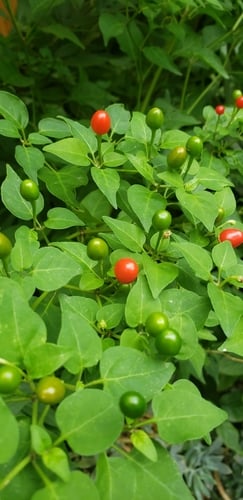
Capsicum annuum var. abbreviatum
Wrinkled peppers
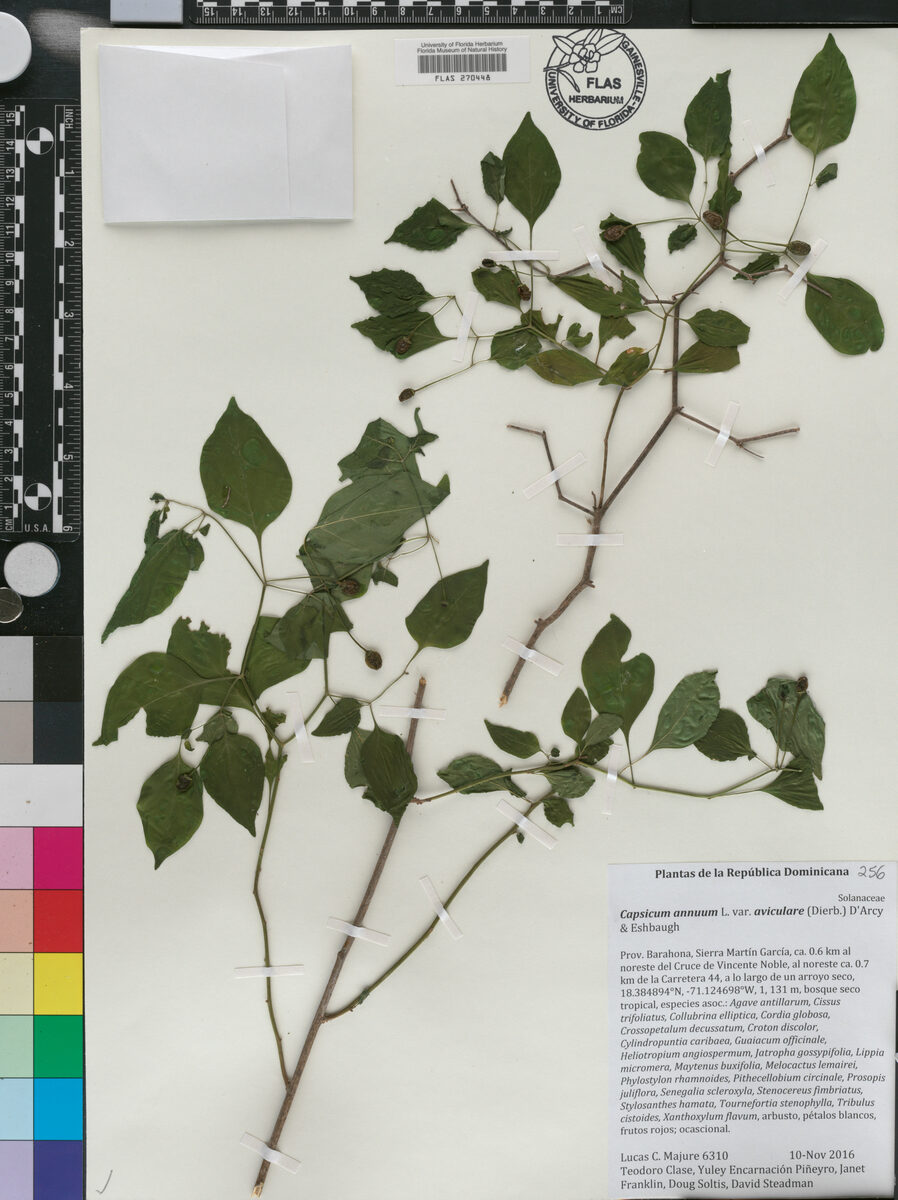
Capsicum annuum var. aviculare - (Dierb.) D'Arcy & Eschbaugh
Cayenne Pepper
Capsicum annuum var. cerasiforme
Cherry peppers
Capsicum annuum var. conoides
Cone peppers, Tabasco
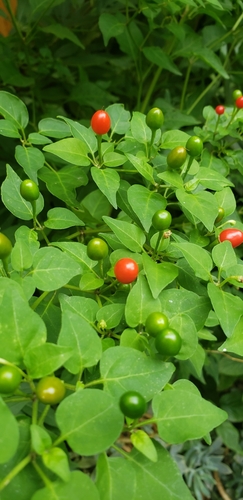
Capsicum annuum var. fasciculatum
Cluster pepper, Red cone pepper
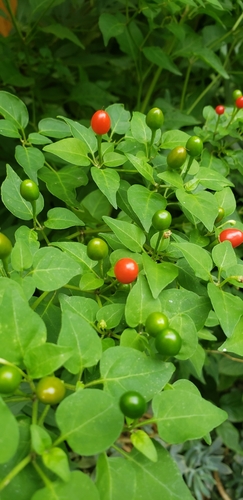
Capsicum annuum var. glabriusculium
Bird pepper