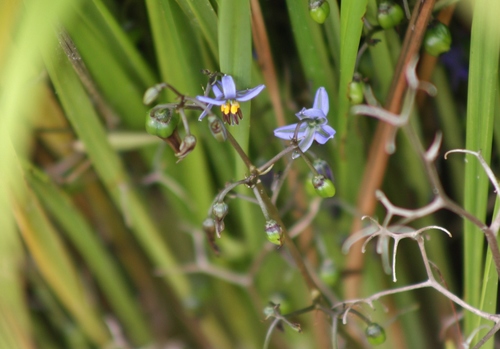
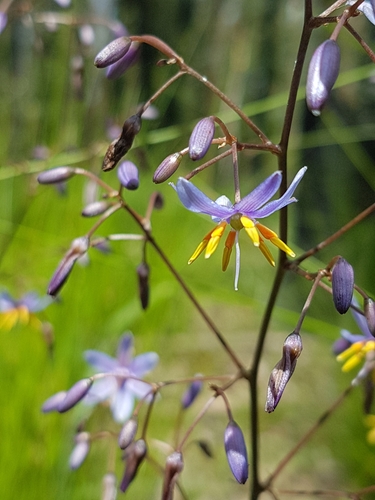
Asphodelus tenuifolius
Cav.
Annual asphodel
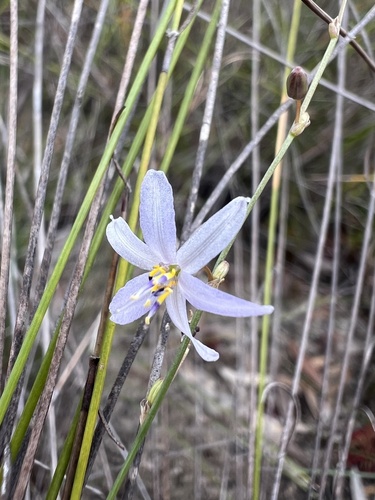
iNaturalist· cc-by-nc
(c) John Pereira, some rights reserved (CC BY-NC), uploaded by John Pereira
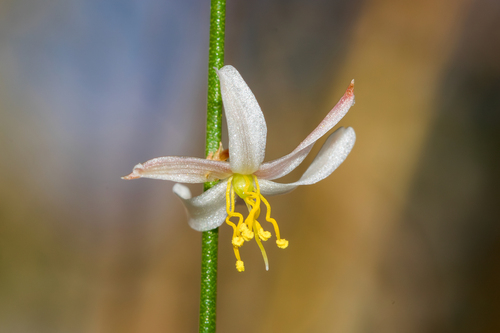
iNaturalist· cc-by-nc
(c) Paige Duvenage, some rights reserved (CC BY-NC), uploaded by Paige Duvenage
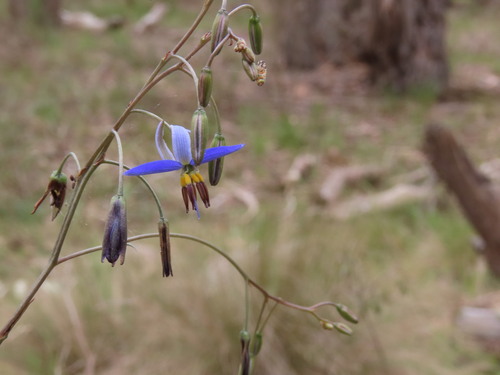
iNaturalist· cc-by-nc
(c) Ron Frumkin, some rights reserved (CC BY-NC), uploaded by Ron Frumkin
Summary
Source: WikipediaAsphodelus tenuifolius is a species of plant in the asphodel family Asphodelaceae. It is native to North Africa, Southern Europe, the Middle East and South Asia. It has been introduced to Australia and the Mascarene Islands. It is generally present from the Canary Islands, across the Mediterranean to the Middle East and Afghanistan. It has a fibrous root system.
Description
An annual herb. It has several fleshy roots. It grows 10-50 cm high. The leaves are narrow and hollow and cylinder shaped. They are less than 5 mm across. The flowers are bell shaped and on the upper part of the flower stalk that arises from the leaves at the base. The flowers are white or pink. The tepals are 4-7 mm long. The fruit capsule is 3-4 mm long. It has a brown vein down the middle.
Edible Uses
The seeds are eaten raw and are also used to make a dried milk product. The plant is consumed raw or cooked, with seeds and aerial parts processed into flour for making cakes and porridge. It serves as a famine food.
Traditional Uses
The seeds are eaten raw. They are also used to make a kind of dried milk. The plant is eaten raw and cooked. The seeds are aerial parts are processed into flour and used to make cakes and porridge.
Distribution
It grows in tropical and Mediterranean places. It grows in grassland and sandy and rocky places. In India it grows up to 2,100 m above sea level. It grows in the desert. It can grow in arid places. It grows in the Sahara.
Where It Grows
Africa, Algeria, Asia, Bahrain, Egypt, Europe, India, Kuwait, Libya, Mediterranean, Middle East, Morocco, North Africa, Pakistan, Qatar, Saudi Arabia, South Africa, Southern Africa, Tunisia, United Arab Emirates, UAE, Western Sahara,
Other Information
It is a famine food.
Notes
There are 12 Asphodelus species. Also put in the family Asphodelaceae.
Synonyms
Also Known As
Barwag, Berag, Berwag, Jangali lahsun, Oogakay, Piazakey, Piazi, Pyajh, Tazia, Taziya
References (20)
- Al-Sodany, Y. M., et al, 2013, Medicinal Plants in Saudi Arabia: I. Sarrwat Mountains at Taif, KSA. Academic Journal of Plant Sciences 6 (4): 134-145
- Ambasta S.P. (Ed.), 2000, The Useful Plants of India. CSIR India. p 60
- Anales Ci. Nat. 3:46. 1801
- Barkatullah, et al, 2009, Ethnobotanical studies of plants of Charkotli Hills, Batkhela District, Malakand, Pakistan. Front. Biol. China 2009, 4(4): 539–548
- Barkatullah & Ibrar, M., 2011, Plants profile of Malakand Pass Hills, District Malakand, Pakistan. African Journal of Biotechnology Vol. 10(73) pp. 16521-16535
Show all 20 references Hide references
- Blamey, M and Grey-Wilson, C., 2005, Wild flowers of the Mediterranean. A & C Black London. p 469
- Dop, M. C., et al, 2019, Identification and frequency of consumption of wild edible plants over a year in central Tunisia: a mixed-methods approach. Public Health Nutrition: 23(5), 782–794
- GUPTA
- Jardin, C., 1970, List of Foods Used In Africa, FAO Nutrition Information Document Series No 2.p 57
- Mandaville, J. P., 2004, Bedouin ethnobotany: Plant concepts and plant use in a desert pastoral world. PhD thesis University of Arizona. p 170
- Martin, F.W. & Ruberte, R.M., 1979, Edible Leaves of the Tropics. Antillian College Press, Mayaguez, Puerto Rico. p 202
- Nassif, F., & Tanji, A., 2013, Gathered food plants in Morocco: The long forgotten species in Ethnobotanical Research. Life Science Leaflets 3:17-54
- Norton, J., et al, 2009, An Illustrated Checklist of the Flora of Qatar. UNESCO Office in Doha.
- Phillips, D.C., 1988, Wild Flowers of Bahrain. A Field Guide to Herbs, Shrubs, and Trees. Privately published. p 125
- Rivera, D. et al, 2006, Gathered Mediterranean Food Plants - Ethnobotanical Investigations and Historical Development, in Heinrich M, Müller WE, Galli C (eds): Local Mediterranean Food Plants and Nutraceuticals. Forum Nutr. Basel, Karger, 2006, vol 59, pp 18–74
- Sher, Z., Hussain, F., & Ibrar, M., 2014, Traditional knowledge on plant resources of Ashezai and Salarzai Valleys, District Buner, Pakistan. African Journal of Plant Science. Vol. 8(1), pp. 42-53, January 2014
- Sinha, R. & Lakra, V., 2007, Edible weeds of tribals in Jharkhand, Orissa and West Bengal. Indian Journal of Traditional Knowledge 6(1) January 2007 pp 217-222
- Wild edible plants of Himachal Pradesh
- World Checklist of Useful Plant Species 2020. Royal Botanic Gardens, Kew
- Zereen, A., et al, 2013, Ethnobotanical Studies of Wild Herbs of Central Punjab, Pakistan. Bangladesh J. Plant Taxon 20(1): 67-76