Asphodelus fistulosus
L.
Onion weed, Hollow-leaves asphodel
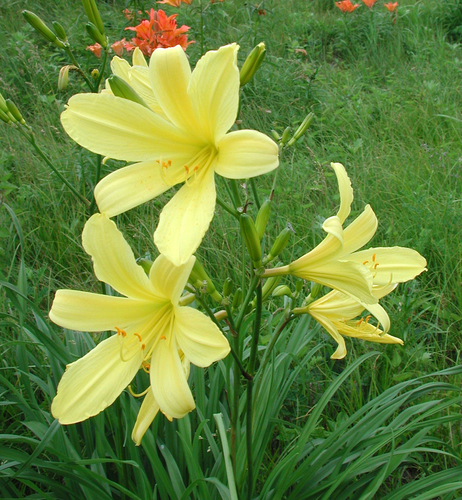
iNaturalist· cc-by-nc
(c) lamprisdimitris, some rights reserved (CC BY-NC)
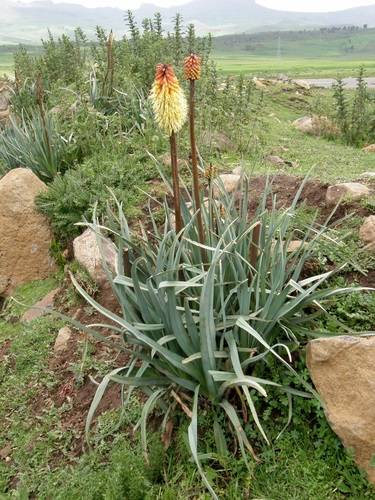
iNaturalist· cc-by-nc
(c) Богданович Светлана, some rights reserved (CC BY-NC), uploaded by Богданович Светлана
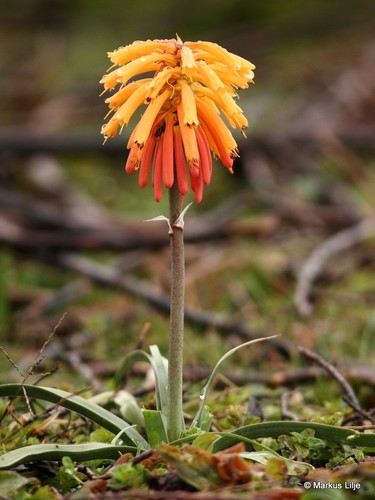
iNaturalist· cc-by-nc
(c) Taylor, some rights reserved (CC BY-NC), uploaded by Taylor
Summary
Source: WikipediaAsphodelus fistulosus is a species of plant known as hollow-stemmed asphodel, onionweed, onion-leafed asphodel, and pink asphodel. It is native to the Mediterranean region as well as the Arabian Peninsula, Transcaucasus, and Madeira. It is an invasive exotic weed in the United States, with significant infestations in California, Arizona, New Mexico, and Texas. It is listed as a Federal Noxious Weed by the United States Department of Agriculture. It is also a common weed in parts of Australia, New Zealand, and Mexico, and it thrives in any area with a Mediterranean climate. It is an annual or short-lived perennial herb growing a hollow stem up to 70 cm (28 in) tall. The root system has a series of tuber-like parts at the base of the stem. The plant takes the form of a large tuft of onion-like rounded hollow leaves up to 30 cm (12 in) long. The inflorescence is a panicle with widely spaced flowers. Each flower is 5–12 mm (0.2–0.5 in) wide with six tepals which are generally white or very pale pink with a neat central longitudinal stripe of brown to reddish-purple. The flowers are diurnal, closing at night and in overcast or low-light weather conditions. The fruit is a rounded capsule containing six seeds. Two subspecies are accepted. Asphodelus fistulosus subsp. fistulosus – Mediterranean basin, Arabian Peninsula, and Transcaucasus Asphodelus fistulosus subsp. madeirensis Simon – Madeira
Description
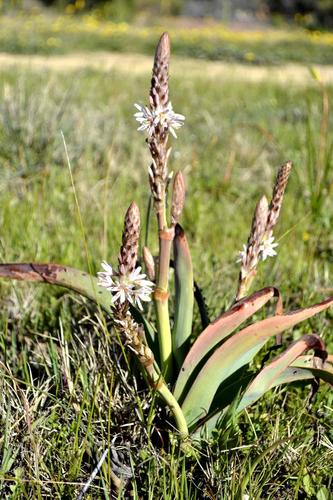
A herb which keeps growing from year to year. It is erect. It can be 60 cm high. The leaves near the base are long, hollow and like a cylinder. The flowering stems are round and hollow. The flower buds are pink. The open flowers are pink to white. There are 6 petals and orange coloured anthers. The fruit is a wrinkled capsule. It contains 3-6 black wrinkled seeds which are triangle shaped.
Edible Uses
Edible Parts: Leaves Root Edible Uses: Root - cooked. The root is fibrous according to one report whilst another says that the swollen root has radical root fibres. The plant is eaten as a vegetable, records of 'edible bulbs' seem to be erroneous.
Medicinal Uses
Diuretic Skin The seed is diuretic. It is also applied externally to ulcers and inflamed parts of the body. The seed contains oils rich in linoleic acid and are of value in preventing atherosclerosis.
Distribution
It is a Mediterranean climate plant. It grows on dry, rocky and waste places. It needs well-drained soils. It suits a shaded position. It grows in warm temperate places. It is damaged by drought and frost. Tasmania Herbarium.
Where It Grows
TEMPERATE ASIA: Cyprus, Egypt (Sinai), Israel, Jordan, Lebanon, Syria, Turkey EUROPE: Former Yugoslavia, Greece (incl. Crete), Italy (incl. Sardinia, Sicily), Spain (incl. Baleares), France (incl. Corsica), Portugal AFRICA: Spain (Canarias), Portugal (Madeira Islands), Algeria (north), Morocco, Tunisia (possibly)
Cultivation
Succeeds in ordinary garden soil, tolerating partial shade. Requires a well-drained soil. Prefers a deep rich sandy loamy soil. Prefers a sunny position in a soil that is not too rich. Grows well on hot dry banks. This species is often a short-lived perennial, though it is not very hardy in Britain. This has contributed to the mistaken belief that it is an annual. A covering of bracken overwinter is usually ample protection in most districts. Asphodelus fistulosus has become a noxious weed in California and in other places with Mediterranean climates worldwide. The flowers are sweetly scented. Plants seem to be immune to the predations of rabbits.
Propagation
Seed - sow March/April in a greenhouse and only just cover the seed. Germination usually takes place in 1 - 3 months at 15°c. When they are large enough to handle, prick the seedlings out into individual pots and grow them on in the greenhouse for at least their first winter. When the plants are large enough to handle, plant them out into their permanent positions in late spring or early summer. Division in early spring or autumn.
Other Uses
None known Special Uses Scented Plants
Synonyms
Also Known As
Asphodel, Bouzlima, Cebollino, Izian, Pink asphodel
References (26)
- Al-Sodany, Y. M., et al, 2013, Medicinal Plants in Saudi Arabia: I. Sarrwat Mountains at Taif, KSA. Academic Journal of Plant Sciences 6 (4): 134-145
- Ambasta S.P. (Ed.), 2000, The Useful Plants of India. CSIR India. p 60
- Ben Ismail, H., 2013, Edible Wild Vegetables Used in North West of Tunisia. PARIPEX - Indian Journal of Reearch 2(9) :219-221
- Bircher, A. G. & Bircher, W. H., 2000, Encyclopedia of Fruit Trees and Edible Flowering Plants in Egypt and the Subtropics. AUC Press. p 45
- Blamey, M and Grey-Wilson, C., 2005, Wild flowers of the Mediterranean. A & C Black London. p 469
Show all 26 references Hide references
- Blanco-Salas, J., et al, 2019, Wild Plants Potentially Used in Human Food in the Protected Area “Sierra Grande de Hornachos” of Extremadura (Spain). Sustainability 2019, 11, 456
- Bodkin, F., 1991, Encyclopedia Botanica. Cornstalk publishing, p 109
- Brickell, C. (Ed.), 1999, The Royal Horticultural Society A-Z Encyclopedia of Garden Plants. Convent Garden Books. p 146
- Burkill, H. M., 1985, The useful plants of west tropical Africa, Vol. 3. Kew.
- Curtis, W.M., & Morris, D.I., 1994, The Student's Flora of Tasmania. Part 4B St David's Park Publishing, Tasmania, p 380
- Dashorst, G.R.M., and Jessop, J.P., 1998, Plants of the Adelaide Plains & Hills. Botanic Gardens of Adelaide and State Herbarium. p 158
- Hall, N. et al, 1972, The Use of Trees and Shrubs in the Dry Country of Australia, AGPS, Canberra. p 264
- Hibbert, M., 2002, The Aussie Plant Finder 2002, Florilegium. p 34
- Hussey, B.M.J., Keighery, G.J., Cousens, R.D., Dodd, J., Lloyd, S.G., 1997, Western Weeds. A guide to the weeds of Western Australia. Plant Protection Society of Western Australia. p 22
- Jardin, C., 1970, List of Foods Used In Africa, FAO Nutrition Information Document Series No 2.p 57
- Lamp, C & Collet F., 1989, Field Guide to Weeds in Australia. Inkata Press. p 30
- Lazarides, M. & Hince, B., 1993, Handbook of Economic Plants of Australia, CSIRO. p 27
- Lim, T. K., 2015, Edible Medicinal and Non Medicinal Plants. Volume 9, Modified Stems, Roots, Bulbs. Springer p 13
- Martin, F.W. & Ruberte, R.M., 1979, Edible Leaves of the Tropics. Antillian College Press, Mayaguez, Puerto Rico. p 202
- Paczkowska, G. & Chapman, A.R., 2000, The Western Australian Flora. A Descriptive Catalogue. Western Australian Herbarium. p 37
- PARMENTIER,
- Plants for a Future database, The Field, Penpol, Lostwithiel, Cornwall, PL22 0NG, UK. http://www.scs.leeds.ac.uk/pfaf/
- Sp. pl. 1:309. 1753
- Tasmanian Herbarium Vascular Plants list p 68
- WATT
- World Checklist of Useful Plant Species 2020. Royal Botanic Gardens, Kew