Psydrax dicoccos
Gaertn.
Ceylon boxwood
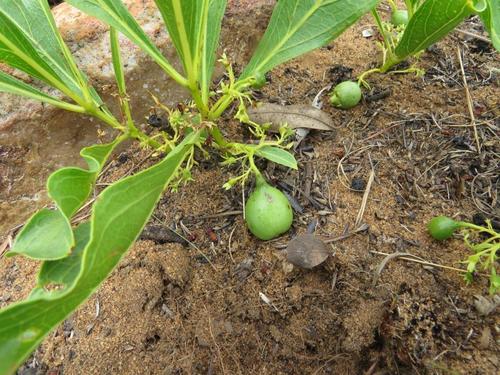
iNaturalist· cc-by-nc
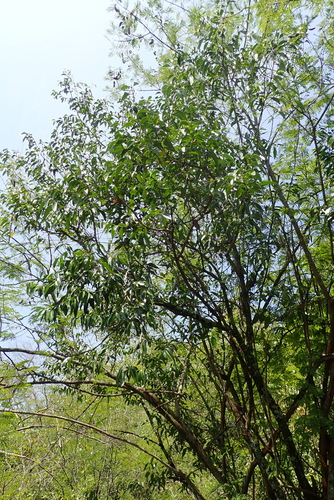
(c) Young Chan, some rights reserved (CC BY-NC), uploaded by Young Chan
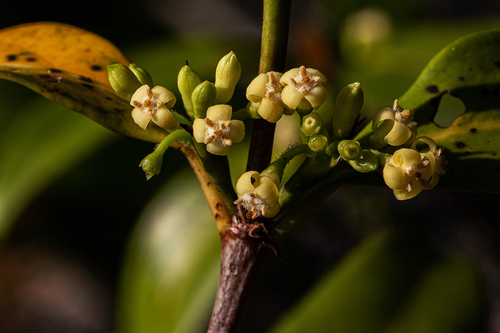
iNaturalist· cc-by-nc
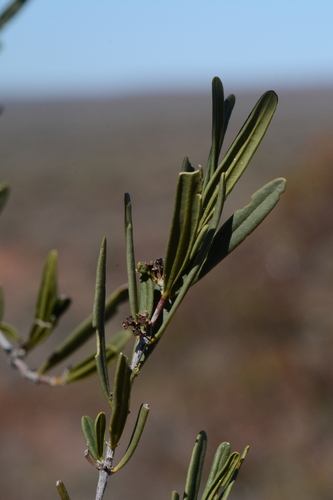
(c) Arun N, some rights reserved (CC BY-NC)
iNaturalist· cc-by
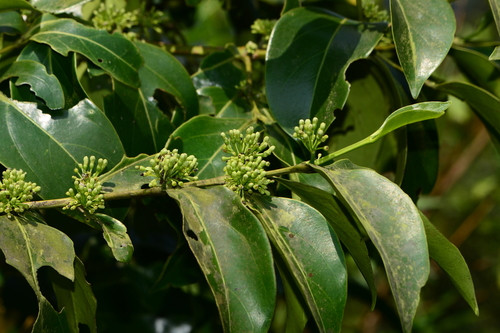
(c) T R Shankar Raman, some rights reserved (CC BY)
Summary
Source: WikipediaPsydrax dicoccos is a species of flowering plant in the family Rubiaceae. It is found from southeast China to tropical Asia.
Description
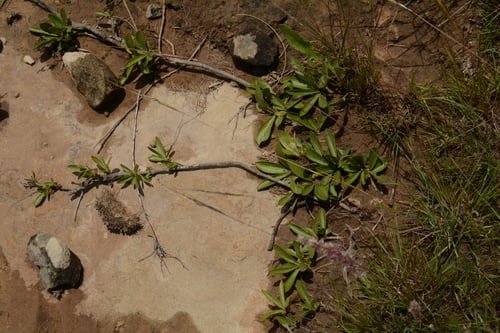
A shrub or small tree. It grows 15 m tall. The branches are compressed or 4 sided. The leaves are oval and 4-10 cm long by 2-4 cm wide. The flowers are greenish-white or pale yellow and funnel shaped. The fruit are oval and 8-10 mm across by 6-8 mm wide.
Edible Uses
The ripe fruit are eaten raw.
Traditional Uses
The ripe fruit are eaten raw.
This uses section is brief — help expand it
Distribution
A tropical plant. It grows in evergreen and moist deciduous forest between 100-600 m in southern China. It can grow up to 1,900 m above sea level in more tropical places. It is often near streams. In Yunnan.
Where It Grows
Andamans, Asia, Australia, China, Hainan, India, Indochina, Indonesia, Laos, Malaysia, Myanmar, Northeastern India, Philippines, SE Asia, Sri Lanka, Thailand, Tibet,
Cultivation
Plants can be grown from seeds.
Other Uses
The wood is white or light brown, hard, close and even grained. A fine wood, it is used for agricultural purposes, cutlery etc.
Production
In southern China it flowers January to August and fruits June to November. In India they are produced February to May.
Notes
There are about 200 Canthium species.
Synonyms
Also Known As
Arsul, Dalasinga, Garbhagoja, Hatteranike, Imburuttam, Kemejing, Kendal gamprit, Mertulang, Nakkiri, Nalla balasu, Neguni maram, Oppai, Pohon kemejing, Pohon kopen, Sippu, Techiek-king
References (12)
- Altschul, S.V.R., 1973, Drugs and Foods from Little-known Plants. Notes in Harvard University Herbaria. Harvard Univ. Press. Massachusetts. no. 4241 (As Canthium dicoccum)
- Burkill, I.H., 1966, A Dictionary of the Economic Products of the Malay Peninsula. Ministry of Agriculture and Cooperatives, Kuala Lumpur, Malaysia. Vol 1 (A-H) p 447 (As Canthium dicoccum)
- Kannan, M., et al, 2015, Ethnobotanical survey on wild edible plants of Kalrayan Hills, Salem District, Tamil Nadu, India. Global J. Res. Med Plants & Indigen. med. 4(12): 236-246 (As Canthium dicoccum)
- Khaple, A. K. et al, Population Studies of Wild Edible Fruit Tree Species in Kodagu. International Journal of Life Sciences Vol. 1 No 3. pp 48-55 (As Canthium dicoccum)
- Kuhnlein, H. V., et al, 2009, Indigenous Peoples' food systems. FAO Rome p 195 (As Canthium dicoccum)
Show all 12 references Hide references
- Misra S. & Misra M., 2016, Ethnobotanical and Nutritional Evaluation of Some Edible Fruit Plants of Southern Odisha, India. International Journal of Advances in Agricultural Science and Technology, Vol.3 Issue.1, March- 2016, pg. 1-30
- Ramachandran, V. S., 2007, Wild edible plants of the Anamalais, Coimbatore district, western Ghats, Tamil Nadu. Indian Journal or Traditional Knowledge. 6(1) pp 173-176 (As Canthium dicoccum)
- Rasingam, L., 2012, Ethnobotanical studies on the wild edible plants of Irula tribes of Pillur Valley, Coimbatore district, Tamil Nadu, India. Asian Pacific Journal of Tropical Biomedicine. (2012) S1493-S1497
- Singh, B., et al, 2012, Wild edible plants used by Garo tribes of Nokrek Biosphere Reserve in Meghalaya, India. Indian Journal of Traditional Knowledge. 11(1) pp 166-171 (As Canthium dicoccum)
- Singh, H.B., Arora R.K.,1978, Wild edible Plants of India. Indian Council of Agricultural Research, New Delhi. p 50 (As Canthium dicoccum)
- Sukarya, D. G., (Ed.) 2013, 3,500 Plant Species of the Botanic Gardens of Indonesia. LIPI p 459
- www.theplantlist.org