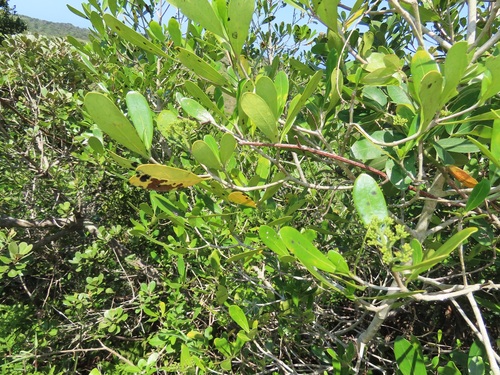
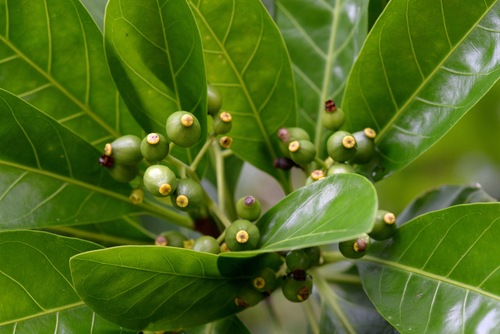
Galium mollugo
L.
Hedge bedstraw, False baby's breath, White bedstraw
iNaturalist· cc-by
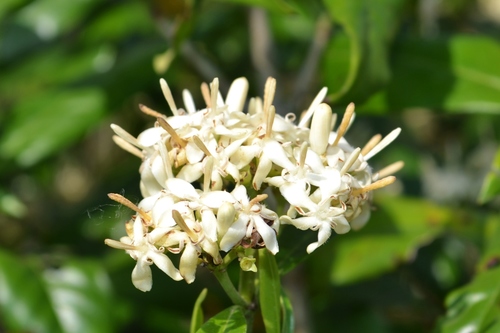
(c) Дарья Друщенко, some rights reserved (CC BY), uploaded by Дарья Друщенко
iNaturalist· cc-by
(c) aarongunnar, some rights reserved (CC BY), uploaded by aarongunnar
iNaturalist· cc-by-nc
(c) anna_efimova, some rights reserved (CC BY-NC), uploaded by anna_efimova
Summary
Source: WikipediaGalium mollugo, common name hedge bedstraw or false baby's breath, is a herbaceous perennial plant of the family Rubiaceae. It shares the name hedge bedstraw with the related European species, Galium album.
Description
A small herb. It grows 30-90 cm tall and spreads 30-50 cm wide. The stems are 4 angled and weak. They can be erect or spreading. The leaves are narrow and sword shaped. They are thin textured. They are 25 mm long. They occur in rings of 6 to 8. They have rough edges. The flowers are small and white. They have purple flecks. They occur as many flowers together at the ends of branches.
Edible Uses
The leaves can be eaten raw or cooked.
Traditional Uses
The leaves are added to herb mixtures in pistic.
This uses section is brief — help expand it
Medicinal Uses
The plant is lithontripic and vulnerary, and is also used in the treatment of epilepsy and hysteria. Both Asperuloside (a terpenoid) and Coumarin (a benzopyrone) occur in some species of Galium. Asperuloside can be converted into prostaglandins, which stimulate the uterus and affect blood vessels, making the genus of significant interest to the pharmaceutical industry.
Distribution
It is a temperate plant. It grows in grassy habitats and open woodlands. In Argentina it grows below 500 m above sea level. It suits hardiness zones 2-9.
Where It Grows
Africa, Argentina, Australia, Britain, Denmark, Europe, Greenland, Italy, Luxembourg, Mediterranean, Morocco, New Zealand, North Africa, North America, Portugal, Russia, Siberia, Slovenia, South America, Spain, Turkey, Türkiye, Uruguay,
Cultivation
Prefers a loose moist leafy soil in some shade. Tolerates dry soils but the leaves quickly become scorched when growing in full sun. This species does not thrive in a hot climate. A polymorphic species.
Propagation
Seed is best sown in situ as soon as it is ripe in late summer, though spring sowing is possible and germination may be very slow. The plant reproduces readily without assistance. Divide in spring or throughout the growing season, keeping divisions well watered. Larger clumps can be replanted directly into permanent positions; smaller clumps are best potted and grown on in a cold frame until rooting well before planting out in spring.
Other Uses
A red dye is obtained from the root, though it is very fiddly to utilize. The plant makes a good ground cover for cool shade under shrubs or in a woodland garden.
Notes
There are about 300 Galium species. There are 60 species in tropical America.
Synonyms
Also Known As
Navadna lakota, Revala, White madder
References (6)
- Blamey, M and Grey-Wilson, C., 2005, Wild flowers of the Mediterranean. A & C Black London. p 180
- Cundall, P., (ed.), 2004, Gardening Australia: flora: the gardener's bible. ABC Books. p 624
- Facciola, S., 1998, Cornucopia 2: a Source Book of Edible Plants. Kampong Publications, p 212
- Paoletti, M.G., Dreon, A.L., and Lorenzoni, G.G., 1995, Pistic, Traditional Food from Western Friuli, NE Italy. Economic Botany 49(1) pp 26-30
- Plants for a Future database, The Field, Penpol, Lostwithiel, Cornwall, PL22 0NG, UK. http://www.scs.leeds.ac.uk/pfaf/
Show all 6 references Hide references
- Sp. pl. 1:107. 1753