Abelmoschus crinitus
Wall.
Hairy okra
iNaturalist· cc-by-nc
(c) Amelia Ryan, some rights reserved (CC BY-NC), uploaded by Amelia Ryan
wikimedia· cc0
Wikimedia Commons - Lindley
wikimedia· cc0
Wikimedia Commons - Curtis, Charles M.; Drake, S. A.; Gorachaud.; Treuttel and Würtz.; Vishnupersaud.; Wallich, N.
Summary
Source: WikipediaAbelmoschus crinitus is a species of flowering plant belonging to the mallow family. It was first described by Nathaniel Wallich in 1830.
Description
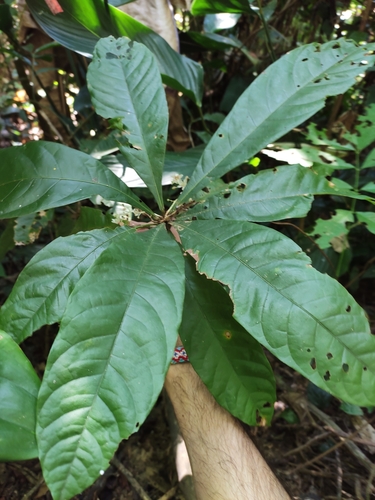
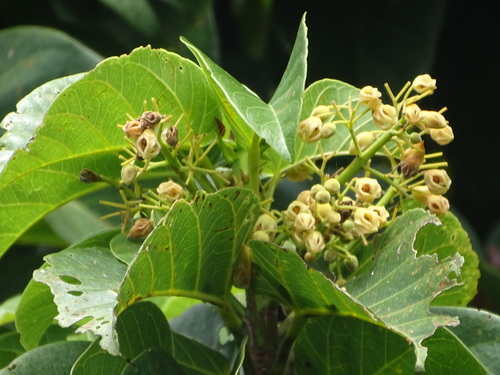
A shrub or small tree. It grows 5 m tall. There are prickles along the stem. The leaves are twice divided and there are 8-18 pairs of pinnae. There are up to 50 pairs of pinnules on each pinnae. The flowers are yellow. They are in large clusters at the ends of branches. The pods are flattened.
Edible Uses
The tuberous roots are roasted and eaten. Young fruits are eaten raw or cooked as a vegetable.
Traditional Uses
The tuberous roots are eaten. They are roasted. The young fruit are eaten raw and also cooked as a vegetable.
This uses section is brief — help expand it
Medicinal Uses
The leaves are used in the treatment of dysentery.
Distribution
A tropical plant. It grows in lowland areas subject to seasonal dry periods. In China it grows on grass slopes between 300-1300 m altitude in S China. In Yunnan.
Where It Grows
Asia, China, India, Indochina, Indonesia, Laos, Myanmar, Nepal, Pacific, Pakistan, Philippines, SE Asia, Thailand, Vietnam,
Cultivation
Abelmoschus crinitus is a lowland tropical species, usually restricted to areas subject to a pronounced dry season
Other Uses
Abelmoschus crinitus is a tertiary genetic relative of, and potential gene donor to okra, Abelmoschus esculentus (L.) Moench. Alongside other wild Abelmoschus species, it carries complete resistance to yellow vein mosaic virus
Other Information
Cultivated. They are enjoyed by children.
Notes
There are about 15 Abelmoschus species. They are tropical and subtropical.
Synonyms
Also Known As
Banbhindi, Bhedi-kandda, Bup toc, Chao mao huang kui, Gasam sanga, Gorkrakanda, Jangli bhindi, Pahadi-bendi, Taw-wah
References (13)
- Ambasta S.P. (Ed.), 2000, The Useful Plants of India. CSIR India. p 1
- Behera, K. K. et al, 2008, Wild Edible Plants of Mayurbhanj District, Orissa, India. J. Econ. Taxon. Bot. Vol. 32 (Suppl,) pp 305-314
- Flora of Pakistan. www.eFloras.org
- Jadhav, R., et al, 2015, Forest Foods of Northern Western Ghats: Mode of Consumption, Nutrition and Availability. Asian Agri-History Vol. 19, No. 4: 293-317
- Lim, T. K., 2015, Edible Medicinal and Non Medicinal Plants. Volume 9, Modified Stems, Roots, Bulbs. Springer p 2
Show all 13 references Hide references
- Misra, R. C., et al, 2013, Genetic resources of wild tuberous food plants traditionally used in Similipal Biosphere Reserve, Odisha, India. Genetic Resources and Crop Evolution. Vol. 60 No. 2. Springer
- Misra, S., 2020, Survey of edible plants for human consumption in south Odisha, India. Journal of Emerging Technologies and Innovative Research (JETIR) Vol. 7, Issue 12 p 277
- Pl. asiat. rar. 1:39, t. 44. 1830
- PROSEA handbook Volume 9 Plants yielding non-seed carbohydrates. p165
- Saxena, H. O., 1986, Observations on the Ethnobotany of Madhya Pradesh. Bull. Bot. Surv. India. Vol. 28. Nos 1-4 pp 149-156
- Singh, H.B., Arora R.K., 1978, Wild edible Plants of India. Indian Council of Agricultural Research, New Delhi. p 11
- Tang ya, Malvaceae. Flora of China. p
- Terra, G.J.A., 1973, Tropical Vegetables. Communication 54e Royal Tropical Institute, Amsterdam, p 50 (As Hibiscus cancellatus)