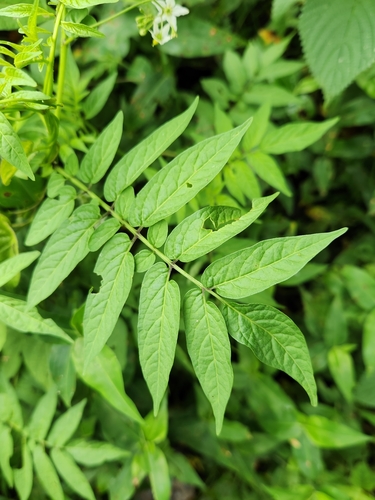
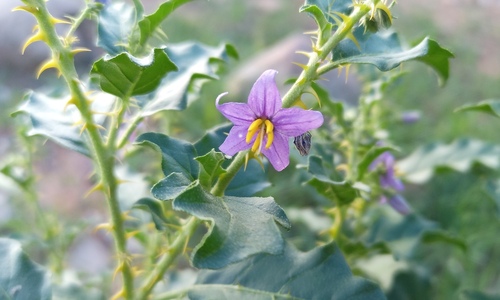
Solanum stramoniifolium
Jacq.
Hairy egg plant
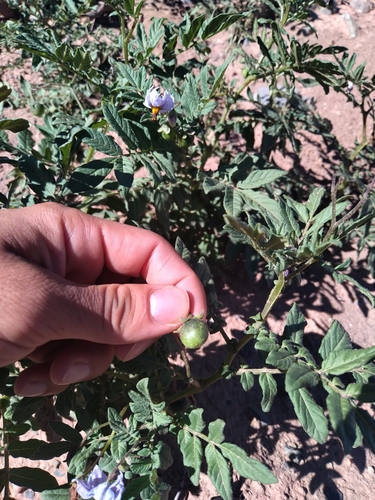
iNaturalist· cc-by-nc
(c) Mayk Oliveira, some rights reserved (CC BY-NC), uploaded by Mayk Oliveira
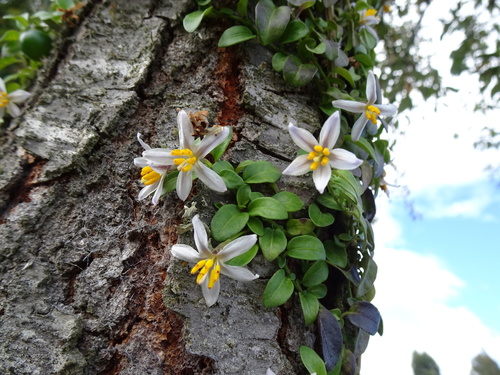
iNaturalist· cc-by-nc
(c) los patricios, some rights reserved (CC BY-NC), uploaded by los patricios
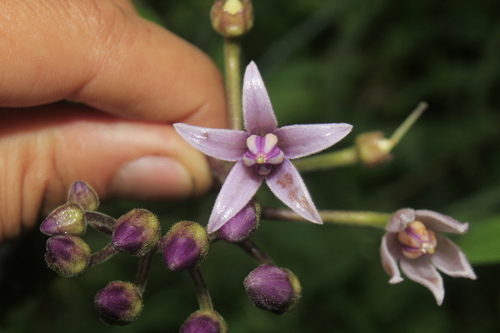
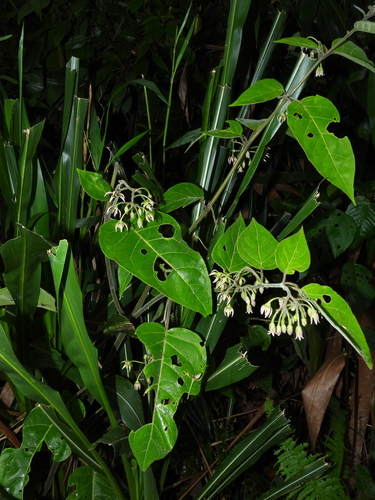
iNaturalist· cc-by-nc
(c) Emma Ellsworth, some rights reserved (CC BY-NC)
Summary
Source: WikipediaSolanum stramoniifolium is a species of flowering plant from the genus Solanum. The species was originally described by Nikolaus Joseph von Jacquin in 1781.
Description
A herb or shrub. It keeps growing from year to year. It grows about 1.5 m high. It can have spines. Forms without spines have been selected. The leaves are simple and alternate. They are broadly oval and 20 cm long by 12 cm wide and they can have lobes. The fruit are round and 2 cm across. The fruit are red. They are slightly hairy. There are several seeds.
Edible Uses
The fruit are eaten after the brown hairs are rubbed off, and are used to make chilli sauce. They are popular with children.
Traditional Uses
The fruit are used to make chilli sauce. The fruit are eaten after the brown hairs are rubbed off.
This uses section is brief — help expand it
Medicinal Uses
The leaves are crushed and applied as a poultice to severe burns..
Known Hazards
Although providing many well-known foods for people, including the potato, tomato, pepper and aubergine, most species in this genus also contain toxic alkaloids. Whilst these alkaloids can make the plant useful in treaing a range of medical conditions, they can also cause problems such as nausea, vomiting, salivation, drowsiness, abdominal pain, diarrhoea, weakness and respiratory depression. Unless there are specific entries with information on edible uses, it would be unwise to ingest any part of this plant.
Distribution
A tropical plant. In the Amazon it grows in the floodplains and the uplands. It grows up to 1,000 m above sea level.
Where It Grows
Amazon, Asia, Bolivia*, Brazil, Cambodia, Central America, Colombia, Ecuador*, Guiana, Guianas, Guyana, India, Indochina, Panama, Peru*, SE Asia, South America*, Suriname, Thailand, Venezuela,
Cultivation
The plant is tolerant of diverse soil types ranging from rich to relatively sterile sandy soils, usually on well drained substrata and not ordinarily found in swampy situations. The plant is often found as a weed within its native range, and is sporadically adventive elsewhere in the tropics.
Propagation
Seed - sow in trays in a nursery. Prick out the seedlings into individual pots when they are large enough to handle and grow them on fast. Plant them out when 10cm or more tall. Cuttings of half-ripe wood. Very easy, the cuttings root within a couple of weeks.
Other Uses
An extract of the fruit is used as an ingredient in commercial cosmetic preparations as a skin conditioner.
Production
Fruit are produced towards the ends of the rainy season.
Other Information
It is a cultivated food plant. The fruit are popular with children.
Notes
There are about 1400 Solanum species.
Synonyms
Also Known As
Buk-uk, Bulibuli, Bura bura, Buruburu plimpla, Coconilla, Cu'a tton'tto, Dog plimpla, E-To-Pa-a, Jurubeba, Juruwera'ir, Kukuna, Lulo pequeno, Ma eok, Ma-uk, Menimo, Naranjilla roja, Paremuru, Sacha naranjilla, Shiwagkush, Toahui'ca, Tomate, Tomate silvestre, Trorp mormeh, Tton'tto, Tupirillo, Uchu laran, Uvilla, Vaicho, Wichilla kukuna, Ya kakuch, Yaa kukuch
References (24)
- Bennett, B. C., 1990, Useful Plants of Amazonian Ecuador. US Agency for International Development. Fifth Progress Report. New York Botanical Gardens. p 40 (As var. inerme)
- Chatterjee, A.S. & Koma, Y.S., 1995, List of Vegetables and Edible Plants in Cambodia. JVC Trainers' training manual. Home Garden Series No. 1. JVC Cambodia p 3
- Etkin, N. L. (Ed.), 1994, Eating on the Wild Side, Univ. of Arizona. p 141
- Jiwajinda, S., et al, 2002, Suppressive Effects of Edible Thai Plants on Superoxide and Nitric Oxide Generation. Asian Pacific Journal of Cancer Prevention, Vol 3, 2002
- Kermath, B. M., et al, 2014, Food Plants in the Americas: A survey of the domesticated, cultivated and wild plants used for Human food in North, Central and South America and the Caribbean. On line draft. p 825
Show all 24 references Hide references
- Lopez-Diago, D. & Garcia, N., 2021, Wild edible fruits of Colombia. Biota ColomBiana 22 (2) p 52
- Maas, P.J. M., Useful plants of Guyana. Non-Timber Forest Products of the North-West District of Guyana Part 1. p 282
- Maas, P.J. M., Non-Timber Forest Products of the North-West District of Guyana Part 2. The 85 most important NTFP species. p 212
- Misc. austriac. 2:298.1781-1782
- NYBG herbarium "edible"
- Omawale, 1973, Guyana's edible plants. Guyana University, Georgetown p 8
- Phatlamphu, N., et al, 2021, Ethnobotany of edible plants in Muang District, Kalasin Province, Thailand, Biodiversitas Vol. 22, No. 12 pp 5432-5444
- Reis, S. V. and Lipp, F. L., 1982, New Plant Sources for Drugs and Foods from the New York Botanical Garden herbarium. Harvard. p 272 (Also as Solanum coconilla)
- Roa, J. A. G. & Boada, D. S. G., 2018, Fundación para el Fortalecimiento de la Fruticultura y Plantas Alimenticias no Convencionales en Colombia.
- Sakunpak, A. & Panichayupakaranant, P., 2012, Antibacterial activity of Thai edible plants against gastrointestinal pathogenic bacteria and isolation of a new broad spectrum antibacterial polyisoprenylated benzophenone, chamuangone. Food Chemistry 130 (2012) 826–831
- Samuels, J., 2015, Biodiversity of Food Species of the Solanaceae Family: A Preliminary Taxonomic Inventory of Subfamily Solanoideae. Resources 2015, 4. 277-322
- Singh, H.B., Arora R.K.,1978, Wild edible Plants of India. Indian Council of Agricultural Research, New Delhi. p 79
- Smith, N., et al, 2007, Amazon River Fruits. Flavors for Conservation. Missouri Botanical Gardens Press. p 244
- Solomon, C., 2001, Encyclopedia of Asian Food. New Holland. p 130
- Srichaiwong, P., et al, 2014, A Study of the Biodiversity of Natural Food Production to Support Community Upstream of Chi Basin, Thailand. Asian Social Science 10 (2):
- Torre, de la, L., et al, 2008, Enciclopedia de las Plantas Útiles del Ecuador. Herbario QCA. Pontificia Universidad Católica del Ecuador. p 596
- Van den Eynden, V., et al, 2003, Wild Foods from South Ecuador. Economic Botany 57(4): 576-603
- Van den Eynden, V., & Cueva, E., 2008, Las plantas en la alimentacion. Enciclopedia de las Plantas Utiles del Ecuador. Herbario QCA & Herbario AAU. Quito & Aarhus. 2008: 62–66
- Vasquez, R. and Gentry, A. H., 1989, Use and Misuse of Forest-harvested Fruits in the Iquitos Area. Conservation Biology 3(4): 350f