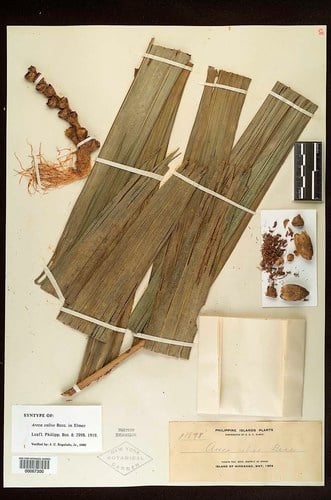
Dypsis utilis
(Jum.) Beentje & J. Dransf.
iNaturalist· cc0
no rights reserved, uploaded by Romer N. Rabarijaona
iNaturalist· cc-by
(c) Louis Aureglia, some rights reserved (CC BY)
Description
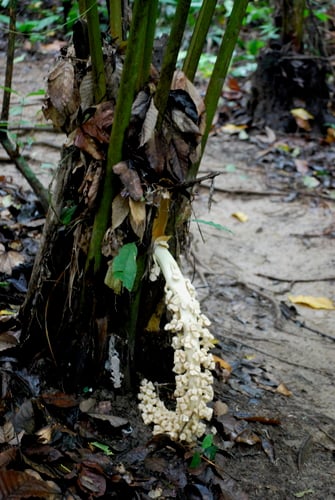
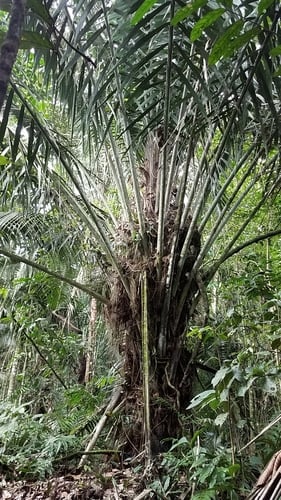
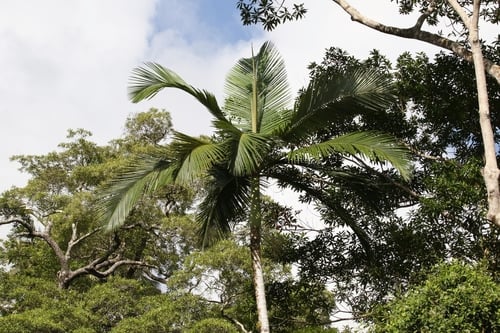
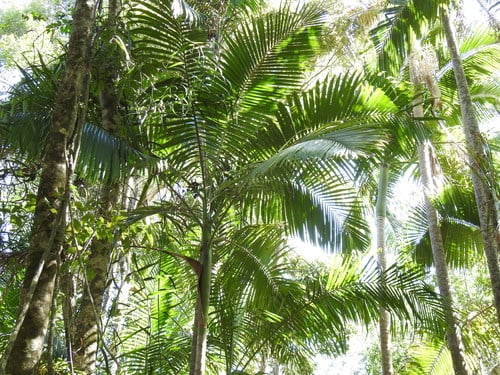
A robust palm. It can be solitary or in a clump. It grows 6-17 m high. The trunk is 25 cm across. The trunk branches 2 or 3 times at 9-11 m above the ground. The branches are closely parallel. They are 25-37 cm across. The trunks are light brown and the leaf base fibres hang from the top of the trunk. The crown forms a half circle. The leaves are 3.1-4 m long with 60-100 cm long stalks. The leaves twist in the middle meaning the leaflets become arranged at a different angle. The leaflets are 50-80 cm long and narrowly sword shaped. They are pinkish orange when new but become deep green.
Edible Uses
The fruit pulp is sweet and edible; the palm heart, bud, and other parts are also eaten as vegetables.
Traditional Uses
The fruit pulp is sweet and edible.
This uses section is brief — help expand it
Medicinal Uses
The plant (parts not specified but probably the bark and/or the fruits) is used in the treatment of headaches, jaundice and hepatitis; and also as an aid to lactation.
Distribution
A tropical plant. It grows in low mountainous rainforest. It suits humid locations. It is usually along streams and rivers. It needs plenty of water. It needs full sun after the seedling stage.
Where It Grows
Africa, East Africa, Madagascar,
Cultivation
Grows best in a sunny, very moist position.
Other Uses
A good quality fibre is obtained from the stem, formed from the inner sheaths and the edges of the petioles.
Notes
There are 140 Dypsis species. It is rare.
Synonyms
Also Known As
Vonitra, Vonitrandrano
References (8)
- Balick, M.J. and Beck, H.T., (Ed.), 1990, Useful palms of the World. A Synoptic Bibliography. Colombia p 122 (As Vonitra utilis)
- Dransfield, J. & Beentje, H., 1995, The Palms of Madagascar. Royal Botanical Gardens, Kew and The International Palm Society. p 363
- Grubben, G. J. H. and Denton, O. A. (eds), 2004, Plant Resources of Tropical Africa 2. Vegetables. PROTA, Wageningen, Netherlands. p 561
- Haynes, J., & McLaughlin, J., 2000, Edible palms and Their Uses. University of Florida Fact sheet MCDE-00-50-1 p 6
- Jardin, C., 1970, List of Foods Used In Africa, FAO Nutrition Information Document Series No 2.p 111, 169 (As Vonitra utilis)
Show all 8 references Hide references
- Johnson, D.V., 1998, Tropical palms. Non-wood Forest products 10. FAO Rome. p 114
- Riffle, R.L. & Craft, P., 2003, An Encyclopedia of Cultivated Palms. Timber Press. p 333
- World Checklist of Useful Plant Species 2020. Royal Botanic Gardens, Kew