Leopoldinia piassaba
Wallace
Piassaba
iNaturalist· cc0
no rights reserved, uploaded by w_endo
Summary
Source: WikipediaLeopoldinia piassaba, the Para piassava, piassava fiber palm or piassava palm, is a palm native to black water rivers in Amazonian Brazil and Venezuela, from which is extracted piassava, a high caliber and water resistant fiber. Piassaba fiber is made into brooms, baskets and other products. This plant is also a natural habitat of the Rhodnius brethesi which is a potential vector of Chagas disease and it is cited in Flora Brasiliensis by Carl Friedrich Philipp von Martius.
Description
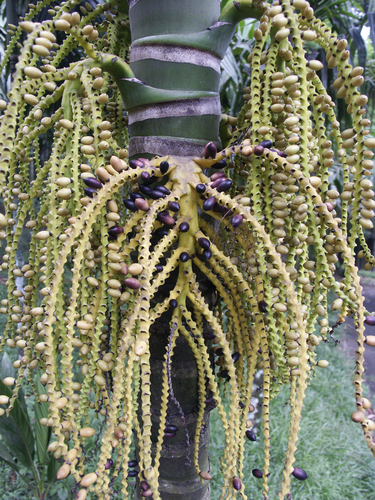
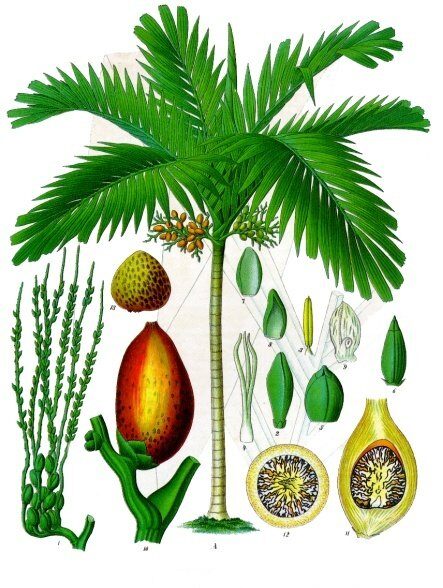
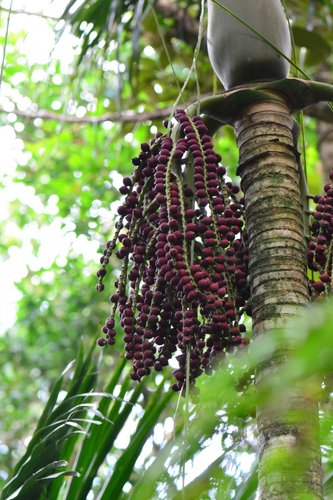
A small palm. It grows 5 m high. It has masses of long hanging brown fibres. The trunk is 12 cm wide but has 80 cm of fibres. The leaves are 4-5 m long. The leaflets are regularly and widely spaced. They are stiff and sword shaped. They are light green and 60-100 cm long. They have wavy edges. The fruit are kidney shaped and flattened. They are edible.
Edible Uses
The mesocarp of the fruits is eaten raw or made into a refreshing drink. Agitating the thin fruit flesh with water produces a popular local beverage.
Traditional Uses
The fruit are used for drinks. They are also used for making an alcoholic beverage. Caution: Alcohol is a cause of cancer.
This uses section is brief — help expand it
Medicinal Uses
None known
Distribution
A tropical plant suiting wet climates. They grow along rivers and in lowlands that are seasonally flooded. It grows in the shade.
Where It Grows
Amazon, Brazil, Colombia, South America, Venezuela,
Cultivation
Not known
Propagation
Seed.
Other Uses
A fibre known as piassaba fibre is obtained from the leaf sheath. It is used to make heavy ropes as a substitute for manila hemp (Musa textilis), and is also made into brushes, brooms, and baskets. The fibre resists rotting even after long periods of immersion in water; Brazilians historically used it to make cables for navigating the Amazon. The foliar sheaths terminate in long pendulous fibres of 0.5–1.5 metres. These initially appear as light brown ribbon-like strips 2–10cm wide, later splitting into dark brown to greyish-brown individual fibres that hang down and entirely conceal the stem, giving the tree a distinctive appearance. The leaves are used for thatching and resist rotting even after prolonged wetting, making them the most sought-after thatching material among local palms. The nuts, encased in a hard botryoidal shell 3–4cm in diameter and 5–8cm long, are a source of vegetable ivory. The shells take a fine polish. The nuts themselves are smaller and sit loose within the shells; they have delicate dark veining and are quite beautiful when turned or polished.
Notes
There are 3 Leopoldinia species.
Synonyms
Also Known As
Chiquechique, Chiquichiqui, Fibra, Maarama, Marama, Palma piassava, Piassaba, Piassaba-amazonica
References (14)
- Balick, M.J. and Beck, H.T., (Ed.), 1990, Useful palms of the World. A Synoptic Bibliography. Colombia p 50, 223,
- Etkin, N. L. (Ed.), 1994, Eating on the Wild Side, Univ. of Arizona. p 139
- Grandtner, M. M. & Chevrette, J., 2013, Dictionary of Trees, Volume 2: South America: Nomenclature, Taxonomy and Ecology. Academic Press p 346
- Haynes, J., & McLaughlin, J., 2000, Edible palms and Their Uses. University of Florida Fact sheet MCDE-00-50-1 p 7
- Henderson, A., Galeano, G and Bernal, R., 1995, Field Guide to the Palms of the Americas. Princeton. p 120
Show all 14 references Hide references
- Johnson, D.V., 1998, Tropical palms. Non-wood Forest products 10. FAO Rome. p 93
- Jones, D.L., 1994, Palms throughout the World. Smithtonian Institution, Washington. p 52
- Kermath, B. M., et al, 2014, Food Plants in the Americas: A survey of the domesticated, cultivated and wild plants used for Human food in North, Central and South America and the Caribbean. On line draft. p 479
- Lopez-Diago, D. & Garcia, N., 2021, Wild edible fruits of Colombia. Biota ColomBiana 22 (2) p 32
- Marcia, M. J., et al, 2011, Palm Uses in Northwestern South America: A Quantitative Review. Bot. Rev. (2011) 77:462-570
- Palm trees Amazon 17, t. 6. 1853
- Riffle, R.L. & Craft, P., 2003, An Encyclopedia of Cultivated Palms. Timber Press. p 364
- Roa, J. A. G. & Boada, D. S. G., 2018, Fundación para el Fortalecimiento de la Fruticultura y Plantas Alimenticias no Convencionales en Colombia.
- World Checklist of Useful Plant Species 2020. Royal Botanic Gardens, Kew