Pyropia columbina
(Montagne) W. A. Nelson
Southern laver
iNaturalist· cc-by-nc
(c) camila-rivera, some rights reserved (CC BY-NC), uploaded by camila-rivera
iNaturalist· cc-by-nc
(c) Pete Woodall, some rights reserved (CC BY-NC)
iNaturalist· cc-by-nc
(c) Pete Woodall, some rights reserved (CC BY-NC)
Summary
Source: WikipediaPyropia columbina, Southern laver, karengo in the Māori language and luche in the Spanish language, is a species of edible seaweed traditionally harvested by South Island Māori in New Zealand and Chilote people in Chile. It is closely related to Japanese Nori and Welsh laverbread. During World War 2 the Māori Battalion were supplied especially with karengo harvested in New Zealand which they chewed raw while on the march. It is widely available only in health stores, and is sprinkled raw on top of food. The type locality is the Auckland Islands, and the species authority is Montagne 1842. It is found around South America from Argentina, Chile and Peru, and around Australia and New Zealand including Macquarie Island. In the Chilean cuisine it is known as luche.
Description
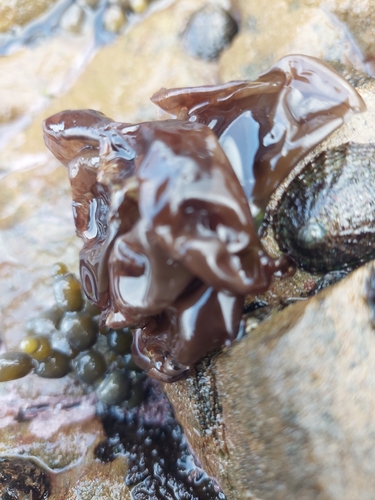
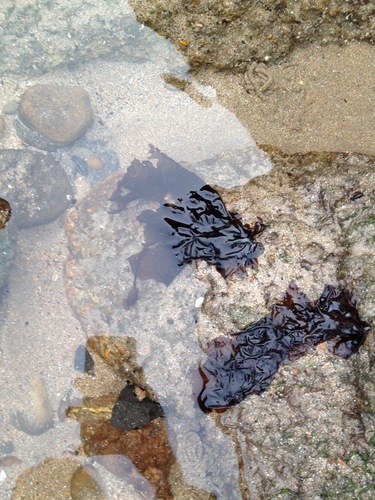
A red algae seaweed with soft, tender, chewable fronds. It grows in the high inter-tidal rocky zones of temperate regions and is widely available in health stores as an economically important species.
Edible Uses
The fronds are eaten raw or roasted in salads, stews, pastas, and with grains, mushrooms, or vegetables. It is also prepared as a relish and eaten with fish.
Traditional Uses
The fronds are soft and tender and chewable. They are used raw or roasted. It is used in salads, stews, pastas and with grains, mushrooms or vegetables. It is also prepared as a relish and eaten with fish.
Distribution
It is a temperate plant. It grows well in the high inter-tidal rocky zone.
Where It Grows
Antarctica, Argentina, Australia, Chile, Macquarie Island, New Zealand, Peru, South America, Tasmania,
Other Information
It is an economically important plant. It is widely available in health stores.
Synonyms
Also Known As
Cochayuyo, Iwa nori, Karengo, Kiwa, Luche, Parengo
References (9)
- Brooker, 1986, (As Porphyra columbina)
- Brooker, et al (As Porphyra columbina)
- Crowe, A., 1997, A Field Guide to the Native Edible Plants of New Zealand. Penguin. p 148 (As Porphyra columbina)
- Facciola, S., 1998, Cornucopia 2: a Source Book of Edible Plants. Kampong Publications, p 257 (As Porphyra columbina)
- http://www.seavegetables.com (As Porphyra columbina)
Show all 9 references Hide references
- Kiple, K.F. & Ornelas, K.C., (eds), 2000, The Cambridge World History of Food. CUP p 232, 238 (As Porphyra columbina)
- Ohni, H., 1968, Edible seaweeds in Chile. Japanese Society of Physiology Bulletin 16:52-4 (As Porphyra columbina)
- Polo, J.A., 1977, Nombres vulgares y usos de las algas en el Peru. Serie de divulgacion, Universidad Nacional Mayor de San Marcos, Museo de Historia Natural Javier Prado. Derpartmento de Botanico. No 7. Lima (As Porphyra columbina)
- Zemke-White, W. L. & Ohno, M., 1999, World seaweed utilisation: An end-of-century summary. Journal of Applied Phycology 11: 369-376 (As Porphyra columbina)