Hesperoyucca whipplei
(Torr.) Trel.
Our Lord's candle
iNaturalist· cc-by-nc
(c) mhrains, some rights reserved (CC BY-NC)
iNaturalist· cc-by-nc
(c) Kyan Russell, some rights reserved (CC BY-NC), uploaded by Kyan Russell
iNaturalist· cc-by
(c) Skyler K, some rights reserved (CC BY), uploaded by Skyler K
Summary
Source: WikipediaHesperoyucca whipplei (syn. Yucca whipplei), the chaparral yucca, our Lord's candle, Spanish bayonet, Quixote yucca or foothill yucca, is a species of flowering plant closely related to, and formerly usually included in, the genus Yucca. It is native to southwest communities of North America.
Description
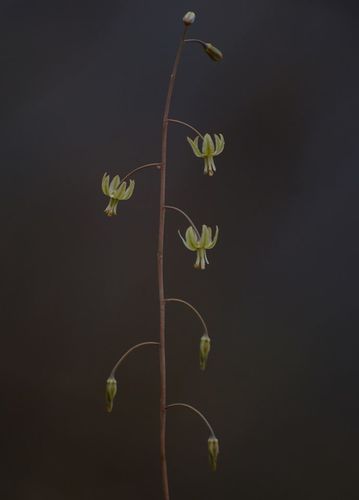
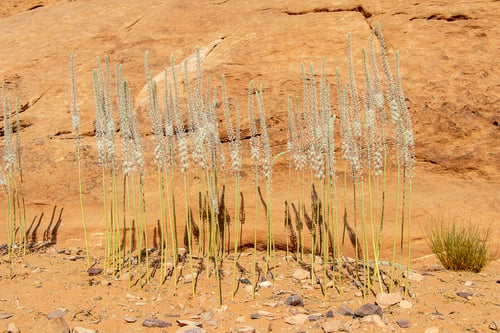
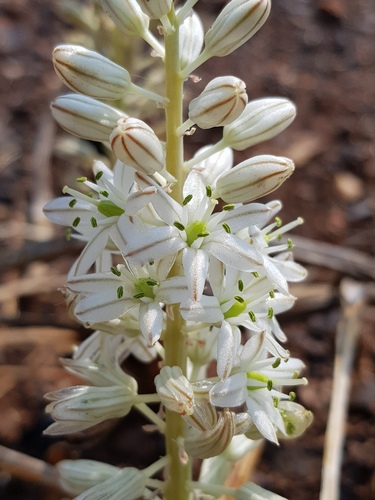
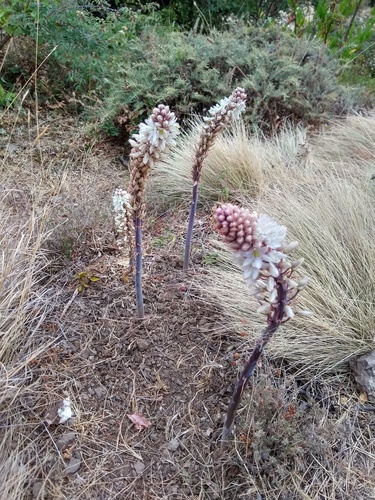
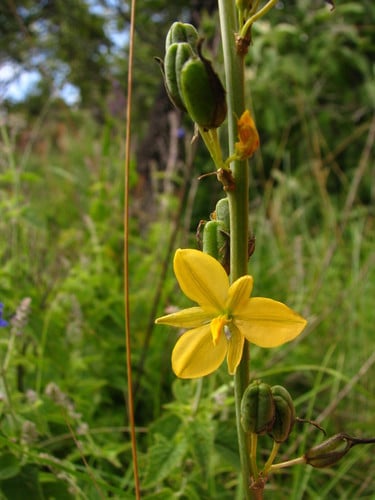
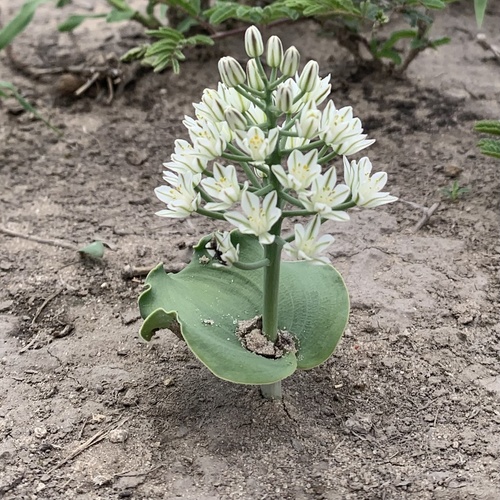
A stemless yucca plant. It grows 0.9 m high and spreads 1.2 m wide. The leaves form a spiked narrow grey-blue ring. They have spiny tips and fine teeth along the edge. The flowers form clusters 3 m high. The flowers are small and white and hang down. They can have green or purple tips.
Edible Uses
Hesperoyucca whipplei is used in xeriscaping in Southern California, but reportedly is difficult to grow outside of its native range (although it is widely available from specialist nurseries in the United Kingdom). It is extremely drought tolerant and thrives in clay soils. It has been used extensively by Native Americans. Yucca species such as Y. whipplei have been documented to have been used as a fiber and food source by Native Americans in the Southwest cultural region, prior to European settlement. Archaeological evidence shows that use of yucca species extends to approximately 5,000 years ago within groups such as the Serrano of the San Bernardino Mountains and San Gabriel Mountains of the transverse mountain ranges of Southern California. The Serrano harvested the hearts of the plant during the spring growing season. Yucca whipplei grows on the rocky slopes and washes of the chaparral area of the transverse mountains of Southern California up to approximately 1,200 m (4,000 ft) above mean sea level. Harvested plants were chosen based on the growth of the stalk; the hearts were the preferred portion of the plant, and would be harvested before the stalk was fully developed. The heart contains the sugars stored to rapidly grow a stalk to flower, and become bitter as the stalk grows in height. The hearts would then be roasted in stone lined pits (earth oven) over several hours in a manner similar to that of agave species. Once cooked, the hearts would be removed and allowed to cool before eating. Uneaten portions could be dried for storage. Though slightly bitter, the stalk and flowers can be harvested and used as food sources as well. The stalks can be prepared roasted in a manner similar to the hearts, while the petals were often parboiled. The long leaves of species such as the Y. whipplei are made of strong fibers which can be pounded and scraped to expose long threads which run the length of the leaf. The leaves could be processed in many ways to remove the outer layer of leaf material which could be processed into threads and cords, used for basketry, blankets, and sandals. Green leaves can be heated over coals or directly on flames to heat the leaves. Cooking the leaves removes some of the saponins and allows for easier scraping. Ethnographic accounts dating to 1938 describes the preparation of leaves for fibers as any one of the following: boiling or pit roasting of live leaves to be scraped clean or the pounding or soaking of dry leaves expose fibers. Shells or stone scrapers were often employed to remove outer leaf material from the fibers. Once exposed, these fibers were often soaked in water to soften fiber. The fibers could then be twisted into cordage, used as materials in a basket, or woven into sandals. Other groups made use of different varieties of yucca species found throughout the American Southwest. Archaeological evidence shows use of Yucca shidigera (Mojave yucca) near the area of the Mexico–United States border dating as early as 5,000 years ago. Residues of yucca were found on some stone tools in a cave site in Texas indicate that yucca was used to secure stone tools to other materials. Ethnographic evidence of the Mogollon has shown the use of the leaves with green leaf matter intact and woven into sandals. The green leaves are fire heated and no scraping or further processing occurs to remove fibers, though the spine is removed from the tip. The whole green leaves are then tightly woven to shape the bed of the sandal, and secured to the foot with cordage ties.
Traditional Uses
The stems are eaten raw or roasted. The flowers are boiled and eaten. The seeds are ground into flour.
This uses section is brief — help expand it
Distribution
A less hardy plant. It suits hardiness zones 8-11.
Where It Grows
Australia, Britain, Central America, Europe, Mexico, North America, USA,
Notes
There are about 40 Yucca species. Also put in the family Agavaceae.
Synonyms
Also Known As
Chaparral yucca, Quiote, Spanish bayonet
References (10)
- Beckstrom-Sternberg, Stephen M., and James A. Duke. "The Foodplant Database." http://probe.nalusda.gov:8300/cgi-bin/browse/foodplantdb.(ACEDB version 4.0 - data version July 1994)
- Cundall, P., (ed.), 2004, Gardening Australia: flora: the gardener's bible. ABC Books. p 1493 (As Yucca whipplei)
- W. H. Emory, Rep. U.S. Mex. bound. 2(1):222. 1858 ("1859") (As Yucca whipplei)
- Facciola, S., 1998, Cornucopia 2: a Source Book of Edible Plants. Kampong Publications. p 3
- Joyce, D., 1998, The Garden Plant Selector. Ryland, Peters and Small. p 164 (As Yucca whipplei)
Show all 10 references Hide references
- Kermath, B. M., et al, 2014, Food Plants in the Americas: A survey of the domesticated, cultivated and wild plants used for Human food in North, Central and South America and the Caribbean. On line draft. p 415
- Lord, E.E., & Willis, J.H., 1999, Shrubs and Trees for Australian gardens. Lothian. p 96
- Moerman, D. F., 2010, Native American Ethnobotany. Timber Press. p 609 (As Yucca whipplei)
- Plants for a Future database, The Field, Penpol, Lostwithiel, Cornwall, PL22 0NG, UK. http://www.scs.leeds.ac.uk/pfaf/ (As Yucca whipplei)
- Saunders, C.F., 1948, Edible and Useful Wild Plants. Dover. New York. p 137 (As Yucca whipplei)