Xylopia aethiopica
(Dunal) A. Rich.
Guinea Pepper, Large red-fingers
iNaturalist· cc-by-nc
(c) Carel Jongkind, some rights reserved (CC BY-NC), uploaded by Carel Jongkind
iNaturalist· cc-by-nc
(c) Gwili Gibbon, some rights reserved (CC BY-NC)
Summary
Source: WikipediaXylopia aethiopica is an evergreen, aromatic tree, of the Annonaceae family that can grow up to 20m high. It is a native to the lowland rainforest and moist fringe forests in the savanna zones of Africa. The dried fruits of X. aethiopica (grains of Selim) are used as a spice and an herbal medicine.
Description
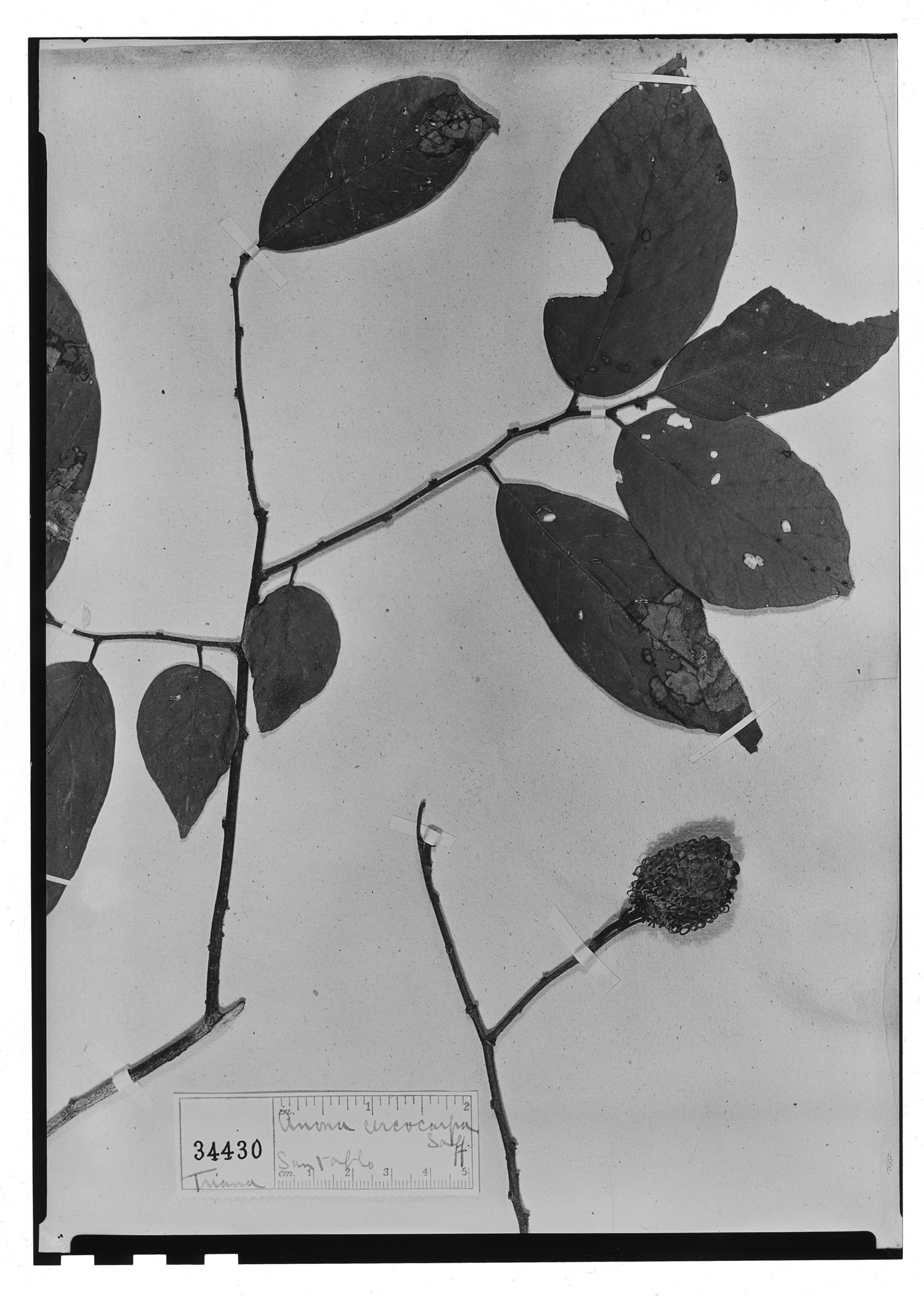
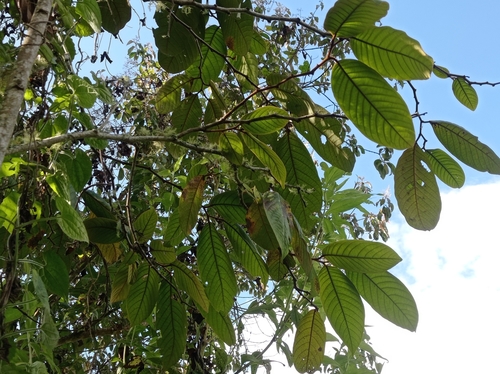
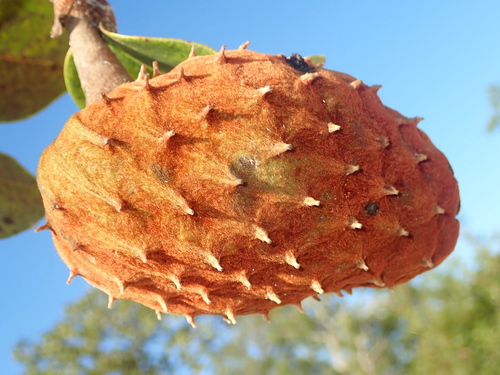
A tall evergreen tree. It grows to 30 m tall. It has many branches and is aromatic. The bark is grey-brown. It peels easily. The leaves are oblong and 8-16.5 cm long by 2.8-6.5 cm wide. They are leathery and bluish-green. They have fine hairs underneath. The base tapers and runs into the leaf stalk. The flowers are single and in twisted branched spikes. These are 5.5 cm long by 0,4 cm wide. They are creamy-green in colour. The fruit has 7-24 carpels each one like a pod. They are 6 cm long and form dense clusters. They are green to red in colour and red inside. They are succulent and split when ripe. The seeds are black and 10 mm long. They have a yellow papery seed layer.
Edible Uses
The fruit and seeds are used as an aromatic peppery spice to flavour coffee, wine, and other dishes. They are cooked in soups for flavouring and seasoning.
Traditional Uses
The fruit and seeds are used for an aromatic peppery spice. It is used to flavour coffee, wine and other food dishes. They are cooked in soup for flavouring and as a spice.
Medicinal Uses
Xylopia aethiopica is used extensively in construction, African cuisine and traditional medicine. The plant's bark is used to make doors and partitions. The wood is known to be resistant to termite attack and is used in hut construction: posts, scantlings, roof-ridges and joists. The wood is also used for boat construction: masts, oars, paddles and spars. In Togo and Gabon, wood was traditionally used to make bows and crossbows for hunters and warriors. An infusion of the plant's bark or fruit has been useful in the treatment of bronchitis and dysenteric conditions, or as a mouthwash to treat toothaches. It has also been used as a medicine for biliousness and febrile pains. The bark, when steeped in palm wine, is used to treat asthma, stomach-aches and rheumatism. The plant's seeds are also used in the Nigerian traditional mixture Aju Mbaise. In Senegal, the fruit is used to flavor café Touba, a coffee drink that is the country's spiritual beverage and the traditional drink of the Mouride brotherhood. In the Middle Ages the fruit was exported to Europe as a 'pepper.' In the eastern part of Nigeria, the plant's fruit is an essential ingredient in preparation of local soups to aid new mothers in breastfeeding. It remains an important item of local trade throughout Africa as a spice, and flavouring for food and for medicine. The fruit is sometimes put into jars of water for purification purposes.
Distribution
A tropical plant. It occurs in evergreen forest at low altitude. It grows in both lowland rainforest and on the edges of forests in the savannah zones. It can grow on the edges of mangroves and in palm groves. It can grow in seasonally flooded forests. It suits humid locations.
Where It Grows
Africa, Angola, Benin, Burkina Faso, Cameroon, Central Africa, Central African Republic, CAR, Chad, Congo DR, Congo R, Côte d'Ivoire, Cuba, East Africa, Equatorial Guinea, Ethiopia, Gabon, Gambia, Ghana, Guinea-Bissau, Guinea, Guinée, Ivory Coast, Kenya, Liberia, Malawi, Mali, Mozambique, Nigeria, Sao Tome and Principe, Senegal, Sierra Leone, Southern Africa, Sudan, Tanzania, Togo, Uganda, West Africa, West Indies, Zambia, Zimbabwe,
Cultivation
Ethiopian pepper is a plant of the moist, lowland tropics, where it can be found at elevations from 200 - 500 metres. It is found in areas where the mean annual temperature is within the range 20 - 31°c, and the mean annual rainfall 1,500 - 2,500mm. Found in the wild in well-drained loamy and sandy loam soils. Young trees grow rapidly for their first three years. Typical fruit yields are about two to three metric tons per annum per hectare.
Other Uses
The plant contains 2 - 4.5% essential oils. The oil from the bark consists mainly of pinene, trans-pinocarveol, verbenone and myrtenol; whereas the leaf oil is mainly spathulenol, cryptone, beta-caryophyllene and limonene. The slash of the bole is white, sappy and very fragrant. The fresh scented bark is kept as an incense in hut rooms. The fruit, ground up with Capsicum peppers, is mixed with kola nuts and used as a repellent for the Kola weevil. The pulverized fruits are added to snuff to increase its pungency. The fruits are sometimes put into jars of water to purify the water. The seeds, separated from the fruit, are a substitute for pepper, and have cosmetic uses. Mixed with other spices they are rubbed on the body as a cosmetic and scent, and are commonly used as a perfume for clothing. The thick, fibrous bark peels readily and yields a cordage. The bark is used to make doors and partitions, and to wrap around torches. The root wood can be used as a cork. The wood is white or pale yellowish brown in the heart, and fairly hard. It is said to be light and brittle in Sierra Leone, and to be of no commercial application, but elsewhere to be heavy, strong and elastic, and is used for purposes requiring resilience such as boat-construction, masts, oars, paddles and spars. Traditionally, it is used for making bows and crossbows for hunters and warriors. The wood is resistant to termite attack and is used in hut-construction for posts, scantlings, roof-ridges and joists. The wood makes a good fuel. It burns with a hot flame and has found use as a steamboat fuel. Within its native range, the tree is a pioneer species, found forming small woods on the savannah.
Production
Plants flower in January, April and September and fruit in April, June and July.
Other Information
It is exported to Europe. It is commonly used in West Africa. It is sold in local markets. Plants are occasionally cultivated.
Notes
There are 170 Xylopia species. They are a widespread tropical genus.
Synonyms
Also Known As
African pepper, Akwi, Atta, Bekala, Bokaha, Bribleque, Bu lew ba finoe, Calantu, Calatu, Canafio, Djo-gofe, Djodjo, Dodo, Eda, Equeche, Erauci, Erinje, Essi, Esso, Ethiopian pepper, Ferebah, Foutsan, Guile-balei, Guile-bete, Guile, Hewei, Hwentea, Idoie-iginal, Ika, Iobogofo, Iru, Janafim-O, Kandi, Kani, Kieng, Kimba, Kyimba, Luvinda, Malagueta-da-guine, Malagueta-preta, Ma-pos, Ma-tel, Mchofu, Mgana, Msaou, Muengeve, Mugana, Mughana, Mvamba kuakua, Mwawia, Mweya, N'cana, N'gani, Nka, Nkana, Nkuankua, Nkuwa nkuwa, N'sanu, Nsagalane, Nsombo, Nuebiho, Ocanhebo, Ogaa, Ogala, Ogana, Okala, Oukalla, Oyang, Pedjericou, Pimienta de Guinea, Poivre noir, Sange, Sela, Sem-unte-pulhe, Senegal pepper, Sengi, Sente, Seve, Siawo, Siminji, Siminyi, Sin-de, Spice tree, Uda, Ugha, Uka, Unien, Whentia
References (48)
- Ambe, G., 2001, Les fruits sauvages comestibles des savanes guinéennes de Côte-d’Ivoire : état de la connaissance par une population locale, les Malinké. Biotechnol. Agron. Soc. Environ. 5(1), 43-48
- Assogbadjo, A. E. et al, 2013, Specific Richness and Cultural Importance of Wild Edible Trees in Benin. Acta Hort. 979, ISHS 2013
- Atato, A., et al, 2010, Diversity of Edible Wild Fruit Tree Species of Togo. Global Science Books.
- Bouba, A. A., et al, 2012, Proximate Composition, Mineral and Vitamin Content of Some Wild Plants Used as Spices in Cameroon. Food and Nutrition Sciences 3:423-432
- Burkill, H. M., 1985, The useful plants of west tropical Africa, Vol. 1. Kew.
Show all 48 references Hide references
- Catarino, L., et al, 2016, Ecological data in support of an analysis of Guinea-Bissau's medicinal flora. Data in Brief 7 (2016):1078-1097
- Davis, S.D., Heywood, V.H., & Hamilton, A.C. (eds), 1994, Centres of plant Diversity. WWF.Vol 1. p 165
- Dibong, S. D., et al, 2011, Inventory and Biodiversity of species edible wild fruits sold in the markets of Douala, Cameroon. International Journal of Applied Biology and Pharmaceutical Technology. 2(3).
- Diop, A. l., et al, 2021, Cultural importance of wild edible plants in three sympatric communities: Agni, Akyé and Gwa in the Department of Alépé (Southeast of Côte d’Ivoire). Ethnobotany Research and Applications 22:35. p 6
- Djihounouck, Y., et al, 2018, Diversité Et Importance Socio-Economique Des Espèces Fruitières Sauvages Comestibles En Zone Kasa (Sud-Ouest Du Sénégal). European Scientific Journal December 2018 edition Vol.14, No.36 ISSN: 1857 – 7881
- Djihounouck, Y., et al, 2021, Ethnobotanical Uses of Non-cultivated Edible Fruit Species in the Department of Oussouye (South Senegal). Journal of Food Research; Vol. 10, No. 4 p 20
- Ezekwesili, C. N., Nwodo, O. F. C., Eneh, F. U. and Ogbunugafor, H. A., 2010, Investigation of the chemical composition and biological activity of Xylopia aethiopica Dunal (Annonaceae) African Journal of Biotechnology: 9 (43): pp. 7352-7354.
- Facciola, S., 1998, Cornucopia 2: a Source Book of Edible Plants. Kampong Publications, p 14
- Fongnzossie Fedoung, E., et al, 2020, Wild edible plants and mushrooms of the Bamenda Highlands in Cameroon: ethnobotanical assessment and potentials for enhancing food security. Journal of Ethnobiology and Ethnomedicine 16:12
- Fowler, D. G., 2007, Zambian Plants: Their Vernacular Names and Uses. Kew. p 8
- Glew, R. H., et al, 1997, Amino Acid, Fatty Avid and Mineral Composition of 24 Indigenous Plants of Burkina Faso. Journal of Food Composition and Analysis 10, 205-217
- Grivetti, L. E., 1980, Agricultural development: present and potential role of edible wild plants. Part 2: Sub-Saharan Africa, Report to the Department of State Agency for International Development. p 30
- Hahn, K., et al, 2018, The Use of Wild Plants for Food: a National Scale Analysis for Burkina Faso (West Africa) Flora et Vegetatio Sudano-Sambesica 21, 25-33
- Harris, D. J., 2002, The vascular plants of the Dzanga-Sangha Reserve, Central African Republic. National Botanic Garden of Belgium, 2002. – 274 pages p 47
- Hedrick, U.P., 1919, (Ed.), Sturtevant's edible plants of the world. p 689
- Hoare A. L., 2007, The Use of Non-timber Forest Products in the Congo Basin. Constraints and Opportunities. Rainforest Foundation. p 14
- INFOODSUpdatedFGU-list.xls
- Ingram, V. & Schure, J. 2010, Review of Non Timber Forest Products (NTFPs) in Central Africa, Cameroon. Center for International Forestry Research (CIFR). p 34
- Kafoutchoni, K. M., et al, 2018, Species richness, cultural importance, and prioritization of wild spices for conservation in the Sudano-Guinean zone of Benin (West Africa). Journal of Ethnobiology and Ethnomedicine. 14:67
- Keay, R.W.J., 1989, Trees of Nigeria. Clarendon Press, Oxford. p 21
- Latham, P., 2004, Useful Plants of Bas-Congo province. Salvation Army & DFID p 295
- Lautenschläger, T., et al, 2018, First large-scale ethnobotanical survey in the province of Uíge, northern Angola. Journal of Ethnobiology and Ethnomedicine (2018) 14:51
- Malaisse, F., 1997, Se nourrir en floret claire africaine. Approche ecologique et nutritionnelle. CTA., p 92
- Manvell, A., 2011, Use of Non-Timber Forest Products around Sapo National Park, Liberia (Report B) p 52
- Mawunu, M., et al, 2020, First Survey of the Edible Non-Wood Forest Products Sold in Uige Province, Northern Angola. European Journal of Agriculture and Food Sciences. Vol. 2, No. 6
- Mawunu, M., et al, 2022, Ethnobotanical uses of wild edible plants of Mucuba municipality, Angola. Natural Resources for Human Health. 2022, 0:1-10
- Menninger, E.A., 1977, Edible Nuts of the World. Horticultural Books. Florida p 85
- Meregini, O. A., 2005, Some endangered plants producing edible fruits and seeds in Southeastern Nigeria. Fruits, Vol. 60 pp 211-220
- Miguel, E., et al, 1989, A checklist of the cultivated plants of Cuba. Kulturpflanze 37. 1989, 211-357
- Molla, A., Ethiopian Plant Names. http://www.ethiopic.com/aplants.htm
- N'Diaye, M., et al.,2003, Principle fruits of gathering consumed and marketed in Guinea. Fruits, Vol. 58: 99-116 (As Uvaria aethiopia)
- Palgrave, K.C., 1996, Trees of Southern Africa. Struik Publishers. p 169
- Raponda-Walker, A & Sillans, R., 1961, Les Plantes Utiles du Gabon. Editions Paul Lechevalier, Paris. p 72
- Reis, S. V. and Lipp, F. L., 1982, New Plant Sources for Drugs and Foods from the New York Botanical Garden herbarium. Harvard. p 730
- R. Sagra, Hist. phys. Cuba, Bot. Pl. vasc. 53. 1845
- Savill, P. S. & Fox, J. E. D., Trees of Sierra Leone. p 43
- Ubom, R. M., 2010, Ethnobotany and Diversity Conservatioon in the Niger Delta, Nigeria. International Journal of Botany. 6(3): 310-322
- Vivien, J., & Faure, J.J., 1996, Fruitiers Sauvages d'Afrique. Especes du Cameroun. CTA p 48
- White, F., Dowsett-Lemaire, F. and Chapman, J. D., 2001, Evergreen Forest Flora of Malawi. Kew. p 132
- Wiersema, J. H. & Leon, B., 2013, World Economic Plants. A Standard Reference CRC Press. 2nd Ed. p 731
- World Checklist of Useful Plant Species 2020. Royal Botanic Gardens, Kew
- www.worldagroforestrycentre.org/treedb/
- Zeven, A. C. & de West, J. M. J., 1982, Dictionary of cultivated plants and their regions of diversity. Wageningen. p 122