Xanthosoma sagittifolium
(L.) Schott
Chinese taro, Tannia, West Indian kale
iNaturalist· cc-by-nc
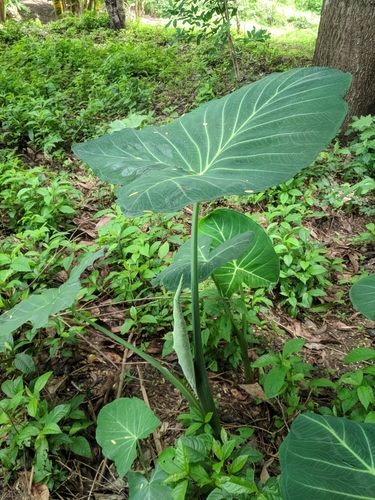
(c) Roberto R. Calderón, some rights reserved (CC BY-NC), uploaded by Roberto R. Calderón
iNaturalist· cc-by-nc
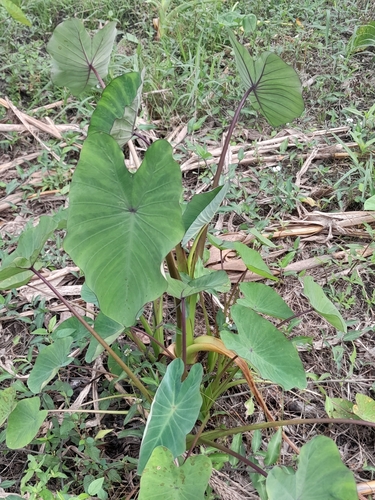
(c) chauming, some rights reserved (CC BY-NC), uploaded by chauming
iNaturalist· cc-by-sa
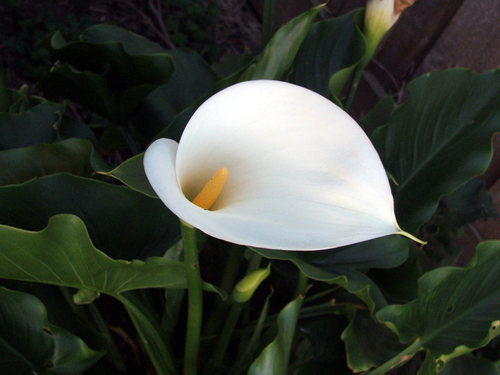
(c) Jeevan Jose, Kerala, India, some rights reserved (CC BY-SA)
Summary
Source: WikipediaXanthosoma sagittifolium, or tannia, is a tropical flowering plant from the family Araceae. It produces an edible, starchy corm. X. sagittifolium is native to tropical America where it has been first cultivated. Around the 19th century, the plant spread to Southeast Asia and Africa and has been cultivated there ever since. X. sagittifolium is often confused with the related plant Colocasia esculenta (taro), which is similar both in appearance and its uses. Both plants are often collectively named 'cocoyam'. Tannia is among the world’s most important tuber crops and feeds 400 million people worldwide. There are multiple varieties, the two most common being the red flesh and the white flesh variety. They were selectively bred to improve pest and disease resistance, to shorten the time it takes to reach maturity and to improve the cooking quality.
Description
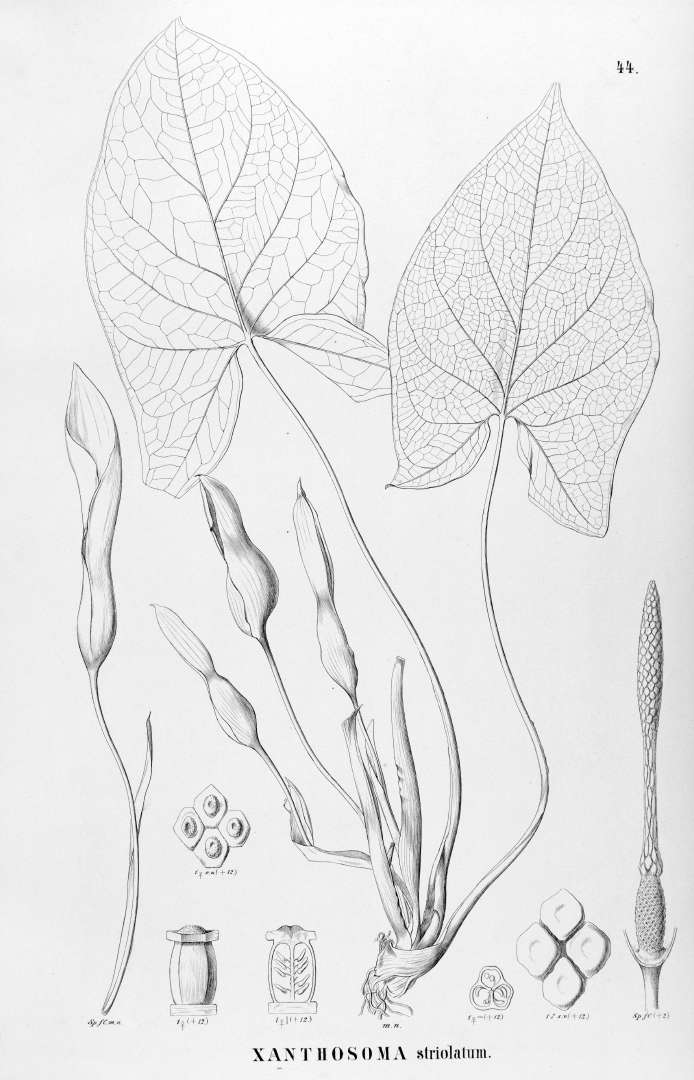
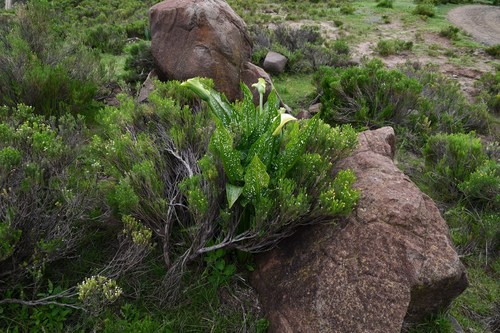
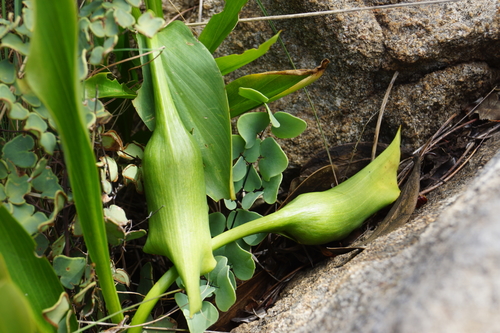
A herb up to 2 m tall. It has a short stem. At the top of the stem it produces large leaves. A corm is produced at the base of the plant. It produces about 10 cormels on the underground corm. These are about 15-25 cm long and flask shaped. The get wider towards the tip. Leaves are large and the stalk joins to the edge of the leaf. The leaves stand erect on stout petioles. There is a vein around the edge of the leaf. The leaf stalks can be 1 m long. The leaf blade is oval and 50-75 cm long. The leaf has triangular lobes at the bottom. The flower is produced below the leaves. The large bract around the flower is pale green and about 20 cm long. The bases of this overlap. The closely arranged spike of flowers is about 15 cm long. The smaller female section is at the bottom and the male section is larger and towards the top. There is a variety with blue on the stalks and leaves that was called Xanthosoma violaceum. X. mafaffa. The leaves are broad and spearhead shape. They are 60-130 cm long. There is a gap in the leaf blade on either side where the stalk joins which helps distinguish it from Xanthosoma sagittifolium. The edges of the leaves are wavy and they can have bluish or white veins. The flowers are of one sex. The spadix is taller than the spathe. The spathe is white and a vase shape. It is constricted below. It is 25 cm tall.
Edible Uses
Tannia is a versatile crop with both its corm and leaves suitable for human consumption. The corms can be categorized into smaller secondary corms and main corms. Secondary corms are primarily used in various culinary applications, in similar ways as potatoes. They can be boiled, fried, roasted, steamed, baked, or ground into flour. The leaves of the tannia plant find common culinary use as a leafy green, similar to spinach. In contrast, primary corms are typically designated for animal feed rather than human consumption because of the higher amount of oxalates. In Bolivia, it is called walusa, in Colombia bore, in Costa Rica tiquizque or macal, in Cuba malanga, in Mexico mafafa, in Nicaragua quequisque, in Panama otoe, in Dominican cuisine is called yautía, yautía morada, and yautía coco and ocumo in Venezuela. In Brazil, the leaves are sold as taioba. The tuber (called nampi or malanga) is also used in the cuisine of these countries. The plant is often interplanted within reforestation areas to control weeds and provide shade during the early stages of growth. In Puerto Rican cuisine and Dominican cuisine, the plant and its corm are called yautía. In Dominican Republic as well as in Puerto Rican pasteles en hoja, yautía is ground with squash, potato, green bananas and plantains into a dough-like fluid paste containing pork and ham, and boiled in a banana leaf or paper wrapper. The yautía corm is used in stews, soups, or simply served boiled much like a potato. It is used in local dishes such as guanime, alcapurrias, sancocho, and mondongo. In alcapurrias, it is also ground with green bananas and made into fried croquettes containing picadillo or seafood. Yautía majada is also prepared and consumed when mashed in some instances. Yautía puree is usually served with fish or shellfish cooked in coconut milk. In Suriname and the Netherlands, the plant is called tayer. The shredded root is baked with chicken, fruit juices, salted meat, and spices in the popular Surinamese dish, pom. Eaten over rice or on bread, pom is commonly eaten in Suriname at family gatherings and on special occasions, and is also popular throughout the Netherlands. In Surinamese cuisine the leaves are also often baked with a Maggi-cube (chicken boullion cube) and eaten alongside rice and chicken or salted beef.
Traditional Uses
Cormels are eaten roasted or boiled. Main corms are often fed to pigs. Young leaves can be eaten after cooking. The leaf stalks are cooked as a vegetable and also used in chutney.
Known Hazards
All parts of the plant contain calcium oxalate crystals. This substance is toxic fresh and, if eaten, makes the mouth, tongue and throat feel as if hundreds of small needles are digging in to them. However, calcium oxalate is easily broken down either by thoroughly cooking the plant or by fully drying it and, in either of these states, it is safe to eat the plant. People with a tendency to rheumatism, arthritis, gout, kidney stones and hyperacidity should take especial caution if including this plant in their diet.
Distribution
A tropical plant. It suits tropical rainforest regions. It grows well in hot, humid tropical areas. It can stand high rainfall. It can tolerate light shade. It does well in regions with an annual average temperature of 26°C. It grows from sea level up to about 2000 m. Soils need to be well drained but should be moist. It needs a well distributed rainfall of 1,400-2,100 mm during the growing season. It does not do well in atoll soils. The best pH if 5.5-6.8.
Where It Grows
Africa, Amazon, American Samoa, Antilles, Asia, Australia, Bangladesh, Benin, Bolivia, Bougainville, Brazil, Burkina Faso, Cambodia, Cameroon, Cape Verde, Caribbean, Central Africa, Central America*, China, Chuuk, Colombia, Congo DR, Cook Islands, Costa Rica, Côte d'Ivoire, Cuba, Dominica, Dominican Republic, East Africa, East Timor, Easter Island, Ecuador, Ethiopia, Fiji, FSM, Gabon, Ghana, Grenada, Grenadines, Guam, Guatemala, Guiana, Guianas, Guinea, Guinée, Guyana, Haiti, Hawaii, Honduras, India, Indochina, Indonesia, Ivory Coast, Jamaica, Kiribati, Kosrae, Madagascar, Malaysia, Marquesas, Marshall Islands, Mexico, Micronesia, Nauru, New Caledonia, Nicaragua, Nigeria, Norfolk Island, North America, Northeastern India, Pacific, Panama, Papua New Guinea, PNG, Peru, Philippines, Pohnpei, Puerto Rico, Rotuma, Samoa, Sao Tome and Principe, SE Asia, Senegal, Sierra Leone, Sikkim, Singapore, Solomon Islands, South America, South Sudan, Sri Lanka, St Lucia, St. Vincent and Grenadines, Suriname, Tanzania, Thailand, Timor-Leste, Togo, Tokelau, Tonga, Tuvalu, Uganda, USA, Vanuatu, Venezuela, Vietnam, Virgin Islands, Wallis & Futuna, West Africa, West Indies, Yap, Zambia, Zimbabwe,
Cultivation
Xanthosoma taro is normally planted by using the top piece of the main central corm or stem. Pieces weighing 1.5 kg are often used. It can also be grown by using the small side corms which may weigh 0.3 kg; or pieces of the corm can be used as long as they have some buds on them. These are often presprouted before planting. To multiply large amounts of planting material and still achieve acceptable yields, the latter method of using sections of the main corm works well. In crop growth, an axillary bud is produced in the axil of each leaf but only some of these develop into cormels. Often 10 or more cormels develop per plant into cormels 15-25 cm long. The crop duration is about 9 months although crops are often left for 12 months before harvesting. Plants are often planted to make the maximum benefit of natural rainfall. It has been recorded that plants increase in total dry matter production for 6 months then the percentage of dry matter in corm and cormels continues to increase while overall dry matter reduces. This effect may be due to lower rainfall near maturity. They can be planted at any time of the year but in dry areas the middle of the dry season should be avoided. Plants are spaced at varying distances but there is often about 0.9m x 1.5m between plants. A closer spacing of 0.5 m x 0.6 m producing a plant density of 36,800 plants per hectare has given high yields, but variations with rainfall regime and other growth conditions undoubetdly alter this. Closer spacing increases planting requirements but reduces weeding requirements. Soil compaction reduces yields drastically. It reduces plant size as well as the shape and number of cormels. Therefore either naturally lose soils from forest fallow or well cultivated soils are needed. The free water table must be at least 45cm below the soil surface for satisfactory yields. Xanthosoma taro grows better in good soils especially ones with plenty of nitrogen. But is can be grown in relatively poor soils and still give a satisfactory amount of food. It is best suited to alluvial soils with a well distributed rainfall. It is tolerant of shade and is therefore used in intercropping under cacao and coconuts. In such conditions yields are reduced but still satisfactory. Plants deficient in nitrogen give stunted growth, small pale green leaves with short leaf stalks. Potassium produces dead edges around the margin of the leaf. Magnesium gives a bright orange colour between the veins. Sometimes a crop of corms can be harvested after 7 or 8 months but often plants take up to one year to grow a good crop. Where plants are on hillsides the corms are often harvested without actually digging out the whole plant. The soil is carefully dug away from the plant and the small corms are broken off the parent plant. The main stem is then covered to produce a new crop. Weed control is important and it is possible to use herbicides in this regard. The corms will store reasonably well under dry cool well ventilated conditions. The corms will also remain in good condition if they are left growing in the ground and just harvested when needed.
Propagation
Seed - rarely produced in cultivation. Division of the smaller corms that are produced on the side of the main corm.
Other Uses
The plant is used as a nurse-crop for cacao.
Production
Harvesting occurs after about 9 months. Cormels can be removed without moving the mother plant. Corms can be stored for a few weeks. They can be stored for 8 weeks at 7°C with a relative humidity of 80%.
Other Information
It is a commercially cultivated vegetable. Of considerable importance in many coastal and mid altitude areas of Papua New Guinea especially in wetter areas. A major root crop in the humid tropics.
Notes
There are 57 Xanthosoma species.
Nutrition
| Part | Moisture | kJ | kcal | Protein | Vit A | Vit C | Iron | Zinc |
|---|---|---|---|---|---|---|---|---|
| Root | 67.1 | 559 | 134 | 1.6 | 5 | 13.6 | 0.4 | 0.5 |
| Leaves | 90.6 | 143 | 34 | 2.5 | 3300 | 37 | 2 | — |
| Shoots | 89 | 139 | 33 | 3.1 | — | 82 | 0.3 | — |
Synonyms
Also Known As
Abalong, Aloklok, Anaji, 'Apea man pofo, Babua, Badoo, Banai, Batang talas hitam, Bentool, Blue taro, Boli ma, Bore, Buah kapas, Chou, Cocoyam leaves, Cocoyam, Dalo, Dalo ni tana, Dark-leaf malanga, Djakatawa, Dokonitania, Dolsialnek, Dolsielngeh, Dudh kachu, Dudh kochu, Fe, Gabing cebu, Gwaza, Huaylusa, Keladi hitam, Kewami, Kimpool, Kimpul hitam, Lamba, Langa, Lindjik, Ma, Macabo, Macal, Maduma, Mafafa, Mafaffa, Malanga, Mangareto, Mankani, Mbolin-ma, Me, Moa sangaru, Moulovikochu, Mukhikachu, New cocoyam, Ocumo, Palchembu, Quequeque, Quiscamote, Rascadera, Ruumabe, Sawahn awi, Sewah seipan, Sujikachu, Ta, Tabul, Taioba, Tajer, Talas belitung, Tales lindjik, Talo papalagi, Tannia, Tanyove, Tayo tyo, Tayobe, Tayonne, Tiquisque, Toa kachu, Tunya, Uncucha, Wahu, White malanga, Wono, Xeca, Yafane, Yautia, Yautia amarilla, Yellow malanga, Yopho, Yugwa
References (121)
- Abbiw, D.K., 1990, Useful Plants of Ghana. West African uses of wild and cultivated plants. Intermediate Technology Publications and the Royal Botanic Gardens, Kew. p 27 (As Xanthosoma mafaffa)
- Achigan-Dako, E, et al (Eds), 2009, Catalogue of Traditional Vegetables in Benin. International Foundation for Science. (As Xanthosoma mafaffa)
- Ambasta, S.P. (Ed.), 2000, The Useful Plants of India. CSIR India. p 693 (Also as Xanthosoma nigrum)
- Anderson, E. F., 1993, Plants and people of the Golden Triangle. Dioscorides Press. p 224 (As Xanthosoma violaceum)
- Ara, R. I. T., 2015, Leafy Vegetables in Bangladesh. Photon eBooks. p 30 (As Xanthosoma atrovirens)
Show all 121 references Hide references
- Asprilla-Perea, J., & Diaz-Puente, J.M., 2018, Traditional use of wild edible food in rural territories within tropical forest zones: A case study from the northwestern Colombia. New Trends and Issues Proceedings on Humanities and Social Sciences [Online]. 5(1), 162–181.
- Baa-Poku, F. & Asante, I. K., 2020, Use of Neglected and Underutilized Crop Species (NUCS) in some farming communities in the Upper Afram and Upper Dayi River Basins in Ghana. International Journal of Technology and Management Research 5 (2): 48-63
- Barrau, J., 1976, Subsistence Agriculture in Polynesia and Micronesia. Bernice P. Bishop Museu, Bulletin 223 Honolulu Hawaii. Kraus reprint. p 39 (As Xanthosoma violaceum) and (Also as Xanthosoma violaceum) and p 42 (As Xanthosoma atrovirens)
- Bernal, R., et al, (Eds), 2016, Catalogo de Plantas y Liquenes de Colombia, Volumen 2, Magnoliaceae a Zygophyllaceae. Universidad Nacional de Colombia. p 2495 (As Xanthosoma mafaffa)
- Bennett, B. C., 1990, Useful Plants of Amazonian Ecuador. US Agency for International Development. Fifth Progress Report. New York Botanical Gardens. p 40 (As Xanthosoma violaceum)
- Borrell, O.W., 1989, An Annotated Checklist of the Flora of Kairiru Island, New Guinea. Marcellin College, Victoria Australia. p 17
- Bourret, D., 1981, Bonnes-Plantes de Nouvelle-Caledonie et des Loyaute. ORSTOM. p 61
- Brickell, C. (Ed.), 1999, The Royal Horticultural Society A-Z Encyclopedia of Garden Plants. Convent Garden Books. p 1065 (Also as Xanthosoma violaceum)
- Brown, D., 2000, Aroids. Plants of the Arum family. Timber Press. (Second edition) p 258 (As Xanthosoma nigrum)and p 261 (As Xanthosoma atrovirens)
- Burkill, H. M., 1985, The useful plants of west tropical Africa, Vol. 1. Kew.
- Burkill, I.H., 1966, A Dictionary of the Economic Products of the Malay Peninsula. Ministry of Agriculture and Cooperatives, Kuala Lumpur, Malaysia. Vol 2 (I-Z) p 2312 (Also as Xanthosoma violaceum)
- Call, C. A., et al, 2004, Participatory Rural Appraisal in the Upland Ecosystem of Mt Malindang, Misamis Occidental, Philippines. Biodiversity Research Programme for Development in Mindanao.
- Chizmar Fernandez, C., et al, 2009, Plantas comestibles de Centroamerica. Instituto de Biodiversidad, Costa Rica. p 63
- Chowdery, T., et al, 2014, Wild edible plants of Uttar Dinajpur District, West Bengal. Life Science Leaflets. 47:pp 20-36 http://lifesciencesleaflets.ning.com
- Chowdhury, M. & Mukherjee, R., 2012, Wild Edible Plants Consumed by Local Communities of Maldah of West Bengal, India. Indian J.Sci.Res.3(2) : 163-170
- Cobley, L.S. (rev. Steele, W.M.) 2nd Ed., 1976, An Introduction to the Botany of Tropical Crops. Longmans. p 126
- Coe, F. G. and Anderson, G. J., 1999, Ethnobotany of the Sumu (Ulwa) of Southeastern Nicaragua and Comparisons with Miskitu Plant Lore. Economic Botany Vol. 53. No. 4. pp. 363-386
- D'Ambrosio, U., & Puri, R. K., 2016, Foodways in transition: food plants, diet and local perceptions of change in a Costa Rican Ngäbe community. Journal of Ethnobiology and Ethnomedicine (2016) 12:3 p 22
- de Polle, E., Plantas Silvestres Comestible de Guatemala. 1(1) Universidad de San Carlos de Guatemala. (As Xanthosoma violaceum)
- Duarte, M. C., et al, 2022, Diversity of Useful Plants in Cabo Verde Islands: A Biogeographic and Conservation Perspective. Plants 2022, 11, 1313 p 8
- Englberger, L., et al, 2006, Documentation of the traditional food system of Pohnpei. Indigenous People's food systems. Chp 6 p 119
- Facciola, S., 1998, Cornucopia 2: a Source Book of Edible Plants. Kampong Publications, p 25 (As Xanthosoma mafaffa) and p 25 (As Xanthosoma violaceum) and (As Xanthosoma atrovirens)
- FAO, 1993, Valor Nutritivo Y Usis en Alimantacion humana de Algunis Cultivos Autoctonos Subexplotados de Mesoamerica. FAO, Santiago, Chile. p 78
- Flora of Australia Volume 49, Oceanic Islands 1, Australian Government Publishing Service, Canberra. (1994) p 417
- Foo, J.T.S.(ed), 1996, A Guide to Common Vegetables. Singapore Science Foundation. p 16
- Franklin, J., Keppel, G., & Whistler, W., 2008, The vegetation and flora of Lakeba, Nayau and Aiwa Islands, Central Lau Group, Fiji. Micronesica 40(1/2): 169–225, 2008
- French, B.R., 1986, Food Plants of Papua New Guinea, A Compendium. Asia Pacific Science Foundation p 4
- French, B.R., 2010, Food Plants of Solomon Islands. A Compendium. Food Plants International Inc. p 10
- Gangte, H. E., et al, 2013, Wild Edible Plants used by the Zou Tribe in Manipur, India. International Journal of Scientific and Research Publications, Volume 3, Issue 5
- Giraldi, M. & Hanazaki, N., 2014, Use of Cultivated and Harvested Edible Plants by Caiçaras—What Can Ethnobotany Add to Food Security Discussions? Human Ecology Review, Volume 20, Number 2, 2014
- Grubben, G. J. H. and Denton, O. A. (eds), 2004, Plant Resources of Tropical Africa 2. Vegetables. PROTA, Wageningen, Netherlands. p 566
- Guite, C., 2016, Study of wild edible plants associated with the Paite Tribe of Manipur, India. International Journal of Current Research. Vol. 8, Issue 11, pp. 40927-40932
- Harkonen, M. & Vainio-Mattila, K., 1998, Some examples of Natural Products in the Eastern Arc Mountains. Journal of East African Natural History 87:265-278
- Hedrick, U.P., 1919, (Ed.), Sturtevant's edible plants of the world. p 689
- Henty, E.E., 1980, Harmful Plants in Papua New Guinea. Botany Bulletin No 12. Division Botany, Lae, Papua New Guinea. p 23
- Hermandez Bermejo, J.E., and Leon, J. (Eds.), 1994, Neglected Crops. 1492 from a different perspective. FAO Plant Production and Protection Series No 26. FAO, Rome. p18, 253, p 215 (As Xanthosoma violaceum), p 254 (As Xanthosoma atrovirens)
- Hibbert, M., 2002, The Aussie Plant Finder 2002, Florilegium. p 310 (Also as Xanthosoma violaceum)
- Hossain, U. & Rahman, A., 2018, Study and quantitative analysis of wild vegetable floral diversity available in Barisal district, Bangladesh. Asian J. Med. Biol. Res. 2018, 4 (4), 362-371 (Also as Xanthosoma atrovirens)
- http://research.famsi.org/botanyworking_plant_list.php (As Xanthosoma nigrum)
- http://www.botanic-gardens-ljubljana.com/en/plants
- Hunter, D., et al, 2019, The potential of neglected and underutilized species for improving diets and nutrition. Planta (2019) 250:709-729
- Index sem. hort. berol. app. 3. 1854 (As Xanthosoma atrovirens)
- Jardin, C., 1970, List of Foods Used In Africa, FAO Nutrition Information Document Series No 2.p 21, 111 (As Xanthosoma mafaffa) and p 21 (As Xanthosoma violaceum) and (As Xanthosoma atrovirens)
- Katz, E., et al, 2012, No greens in the forest? Note on the limited consumption of greens in the Amazon. Acta Soc Bot Pol 81(4):283–293
- Kay, D.E., 1973, Root Crops, Digest 2, Tropical Products Institute, London, p 160 (Also as Xanthosoma violaceum) and (As Xanthosoma atrovirens)
- Kays, S. J., and Dias, J. C. S., 1995, Common Names of Commercially Cultivated Vegetables of the World in 15 languages. Economic Botany, Vol. 49, No. 2, pp. 115-152
- Kebebew, M. & Leta, G., 2016, Wild Edible Plant Bio-diversity and Utilization System in Nech Sar National Park, Ethiopia. International Journal of Bio-resource and Stress Management 2016, 7(4):885-896
- Kiple, K.F. & Ornelas, K.C., (eds), 2000, The Cambridge World History of Food. CUP p 1807 (Also as Xanthosoma atrovirens)
- Kumar, S. A., Manus, D. & Mallika, M., 2018, Impact of non-timber forest products on Forest and in Livelihood Economy of the People of Adjoining Areas of Jalpaiguri Forest Division, West Bengal, India. Int. J. of Life Sciences, 2018; 6 (2):365-385
- Latham, P., 2004, Useful Plants of Bas-Congo province. Salvation Army & DFID p 294
- Lembaga Biologi Nasional, 1977, Ubi-Ubian, Balai Pustaka, Jakarta. p 48 (As Xanthosoma violaceum)
- Lentz, D. L., 1993, Medicinal and Other Economic Plants of the Paya of Honduras. Economic Botany, Vol. 47, No. 4, pp. 358-370 (As Xanthosoma violaceum)
- Lim, T. K., 2015, Edible Medicinal and Non Medicinal Plants. Volume 9, Modified Stems, Roots, Bulbs. Springer p 86
- Llamas, K.A., 2003, Tropical Flowering Plants. Timber Press. p 87 (As Xanthosoma mafaffa)
- Macmillan, H.F. (Revised Barlow, H.S., et al) 1991, Tropical Planting and Gardening. Sixth edition. Malayan Nature Society. Kuala Lumpur. p 342
- Mapes, C. & Basurto, F., 2016, Biodiversity and Edible Plants of Mexico. Chapter 5 in R. Lira, et al. (eds.), Ethnobotany of Mexico, Ethnobiology, Springer. p 114 (As Xanthosoma violaceum)
- Martin, F.W. & Ruberte, R.M., 1979, Edible Leaves of the Tropics. Antillian College Press, Mayaguez, Puerto Rico. p 21 and p 176 (As Xanthosoma mafaffa), p 176 (As Xanthosoma violaceum)
- Massal, E and Barrau, J., 1973, Food Plants of the South Sea Islands. SPC Technical Paper No 94. Nounea, New Caledonia. p 6-10
- Medhi, P. & Borthakur, S. K., 2012, Phytoresources from North Cachur Hills of Assam -3: Edible plants sold at Hflong market. Indian Journal of Natural Products and Resources. 3(1) pp 84-109
- Miguel, E., et al, 1989, A checklist of the cultivated plants of Cuba. Kulturpflanze 37. 1989, 211-357
- Moerman, D. F., 2010, Native American Ethnobotany. Timber Press. p 602 (As Xanthosoma atrovirens)
- Nyadanu, D., et al, 2015, Agro-biodiversity and challenges of on-farm conservation: the case of plant genetic resources of neglected and underutilized crop species in Ghana. Genet. Resourc. Crop Evol. 62(7):
- Ochse, J.J. et al, 1931, Vegetables of the Dutch East Indies. Asher reprint. p 60 (As Xanthosoma violaceum)
- Oesterr. Bot. Wochenbl. 3:370. 1853 (As Xanthosoma violaceum)
- Onwueme, I.C., 1978, The Tropical Tuber Crops. Wiley, p 199
- Oomen, H.A.P.C., & Grubben, G.J.H., 1978, Tropical Leaf Vegetables in Human Nutrition, Communication 69, Department of Agricultural research, RTI Amsterdam, p 66, 81
- Paniagua Zambrana, N. Y., et al, 2017, Traditional knowledge hiding in plain sight - twenty-first century ethnobotany of the Chacobo in Beni, Bolivia. Journal of Ethnobiology and Ethnomedicine (2017) 13:57
- Parham, B. E. V., 1972, Plants of Samoa. New Zealand Department of Scientific and Industrial Research. Information Series. No. 85 p 113 (As Xanthosoma violaceum)
- Pawera, L., et al, 2020, Wild Food Plants and Trends in Their Use: From Knowledge and Perceptions to Drivers of Change in West Sumatra, Indonesia, Foods. 2020, 9, 1240
- Pena, F. B., et al, 1998, Los quelites de la Sierra Norte de Puebla, Mexico: Inventory Y Formas de Preparacion. Bol. Soc. Bot. Mexico 62:49-62 (As Xanthosoma violaceum)
- Plants of Haiti Smithsonian Institute http://botany.si.edu
- Plucknett, D.L., Edible Aroids, in Simmonds, N.W., (Ed.), 1979, Evolution of Crop Plants. Longman. p 10
- Purseglove, J.W., 1972, Tropical Crops. Monocotyledons. Longmans p 69, p 70 (As Xanthosoma mafaffa) and p 69 (As Xanthosoma violaceum) and (As Xanthosoma atrovirens)
- Raponda-Walker, A & Sillans, R., 1961, Les Plantes Utiles du Gabon. Editions Paul Lechevalier, Paris. p 97 (As Xanthosoma violaceum)
- Recher, P, 2001, Fruit Spirit Botanical Gardens Plant Index. www.nrg.com.au/~recher/ seedlist.html p 3
- Schneider, E., 2001, Vegetables from Amaranth to Zucchini: The essential reference. HarperCollins. p 722
- H. Schott & S. L. Endlicher, Melet. bot. 19. 1832 ("sagittaefolium")
- Segnon, A. C. & Achigan-Dako, E. G., 2014, Comparative analysis of diversity and utilization of edible plants in arid and semi-arid areas in Benin. Journal of Ethnobiology and Ethnomedicine 2014, 10:80
- Sharma, B.B., 2005, Growing fruits and vegetables. Publications Division. Ministry of Information and broadcasting. India. p 237
- Sillitoe, P. 1995, An Ethnobotanical Account of the Plant Resources of the Wola Region, Southern Highlands Province, Papua New Guinea. J. Ethnobiol. 15(2): 201-235
- Slocum, P.D. & Robinson, P., 1999, Water Gardening. Water Lilies and Lotuses. Timber Press. p 103 (As Xanthosoma violaceum)
- Small, E., 2009, Top 100 Food Plants. The world's most important culinary crops. NRC Research Press. p 335
- Staples, G.W. and Herbst, D.R., 2005, A tropical Garden Flora. Bishop Museum Press, Honolulu, Hawaii. p 613 (Drawing) (As Xanthosoma violaceum)
- Stephens, K.M., & Dowling, R.M., 2002, Wetland Plants of Queensland. A field guide. CSIRO p 9 (As Xanthosoma violaceum)
- Stone, B. C., 1970, The Flora of Guam. A Manual for the Identification of the Vascular Plants of the Island. Micronesica. Journal of the University of Guam. p 120
- Sukarya, D. G., (Ed.) 2013, 3,500 Plant Species of the Botanic Gardens of Indonesia. LIPI p 1141, 1142 (Also as Xanthosoma nigrum)
- Sukenti, K., et al, 2016, Ethnobotanical study on local cuisine of the Sasak tribe in Lombok Island, Indonesia. Journal of Ethnic Foods. 3 (2016) 189-200 p 198 (As Xanthosoma violaceum)
- Tanaka, (As Xanthosoma atrovirens)
- Termote, C., et al, 2011, Eating from the wild: Turumbu, Mbole and Bali traditional knowledge of non-cultivated edible plants, District Tshopo, DRCongo, Gen Resourc Crop Evol. 58:585-618
- Termote, C., 2012, Wild edible plant use in Tshopo District, Democratic Republic of Congo. Universiteit Gent. p 69
- Terra, G.J.A., 1973, Tropical Vegetables. Communication 54e Royal Tropical Institute, Amsterdam, p 82 (As Xanthosoma mafaffa), p 21, 22, 82 (As Xanthosoma violaceum)
- Thaman, R.R., 1976, The Tongan Agricultural System, University of the South Pacific, Suva, Fiji. p 430
- Thaman, R. R., 1987, Plants of Kiribati: A listing and analysis of vernacular names. Atoll Research Bulletin No. 296
- Thaman, R. R., et al, 1994, The Flora of Nauru. Atoll Research Bulletin No. 392. Smithsonian Institute p 42
- Thaman, R. R, 2016, The flora of Tuvalu. Atoll Research Bulletin No. 611. Smithsonian Institute p 41
- Tindall, H.D., 1983, Vegetables in the tropics. Macmillan p. 58
- Torre, de la L., et al, 2008, Enciclopedia de las Plantas Útiles del Ecuador. Herbario QCA. Pontificia Universidad Católica del Ecuador. p 191
- Trimanto, & Hapsari L., 2016, Botanical survey in thirteen montane forests of Bawean Island Nature Reserve, East Java Indonesia: Conservation status, bioprospecting and potential tourism. Biodiversitas 17: 832-846.
- USDA, ARS, National Genetic Resources Program. Germplasm Resources Information Network - (GRIN). [Online Database] National Germplasm Resources Laboratory, Beltsville, Maryland. Available: www.ars-grin.gov/cgi-bin/npgs/html/econ.pl (10 April 2000) (Also as Xanthosoma violaceum)
- Vainio-Mattila, K., 2000, Wild vegetables used by the Sambaa in the Usumbara Mountains, NE Tanzania. Ann. Bot. Fennici 37:57-67
- Vander Velde, N, 2003, The Vascular Plants of Majuro Atoll, Republic of the Marshall Islands. Atoll research Bulletin. No. 503. Smithsonian Institute. p 31
- van Wyk, B., 2005, Food Plants of the World. An illustrated guide. Timber press. p 386 (Also as Xanthosoma atrovirens)
- Villachica, H., (Ed.), 1996, Frutales Y hortalizas promisorios de la Amazonia. FAO, Lima. p 341
- Vickery, M.L. and Vickery, B., 1979, Plant Products of Tropical Africa, Macmillan. p 18
- Wallace, P. A., Marfo, E. K., and Plahar, W. A., 1998, Nutritional quality and antinutritional composition of four non-conventional leafy vegetables. Food Chemistry 61(3) 287-291 (As Xanthosoma mafaffa)
- Walter, A. & Lebot, V., 2007, Gardens of Oceania. ACIAR Monograph No. 122. p 107
- Whistler, W. A., 1988, Ethnobotany of Tokelau: The Plants, Their Tokelau Names, and Their Uses. Economic Botany 42(2): 155-176
- Wiersema, J. H. & Leon, B., 2013, World Economic Plants. A Standard Reference CRC Press. 2nd Ed. p 730 (Also as Xanthosoma violaceum)
- Williams, C.N., Chew, W.Y., and Rajaratnam, J.A., 1989, Tree and Field Crops of the Wetter Regions of the Tropics. Longman, p 210
- Woodward, P., 2000, Asian Herbs and Vegetables. Hyland House. p 134
- World Checklist of Useful Plant Species 2020. Royal Botanic Gardens, Kew
- www.hawaii.edu Plants & Environments of the Marshall Islands
- Zaldivar, M. E., et al, 2002, Species Diversity of Edible Plants Grown in Homegardens of Chibehan Amerindians from Costa Rica. Human Ecology, Vol. 30, No. 3, pp. 301-316
- Zambrana, P, et al, 2017, Traditional knowledge hiding in plain sight – twenty-first century ethnobotany of the Chácobo in Beni, Bolivia. Journal of Ethnobiology and Ethnomedicine (2017) 13:57
- Zon, A.P.M. van der, Grubben, G.J.H., 1976, Les legumes-feuilles spontanes et cultives du Sud-Dahomey, Communication 65, Royal Tropical Institute, Amsterdam, p 107, 108
- Zuchowski W., 2007, Tropical Plants of Costa Rica. A Zona Tropical Publication, Comstock Publishing. p 167