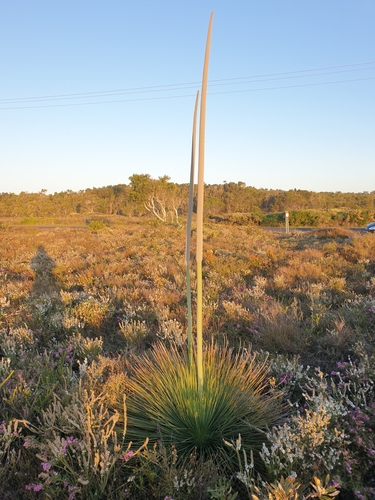
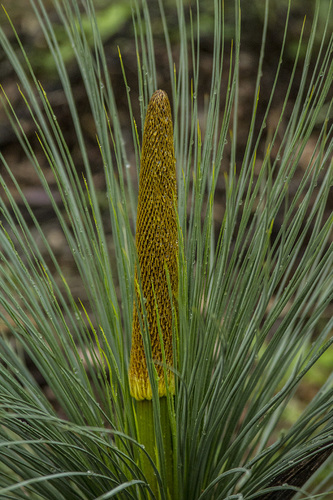
Xanthorrhoea australis
R. Br.
Grass tree, Blackboy, Kangaroo Tail
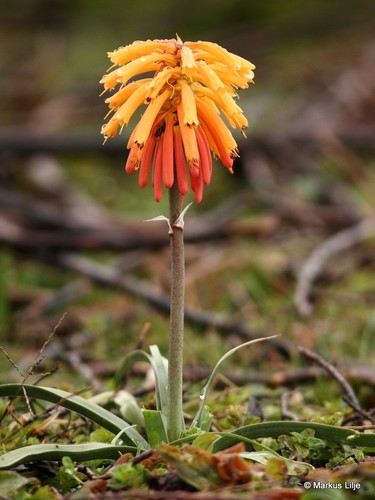
iNaturalist· cc-by-nc
(c) Susan Kruss, some rights reserved (CC BY-NC), uploaded by Susan Kruss
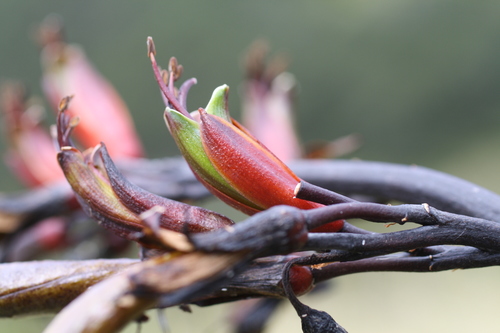
iNaturalist· cc-by-nc
(c) Wendy Feltham, some rights reserved (CC BY-NC), uploaded by Wendy Feltham
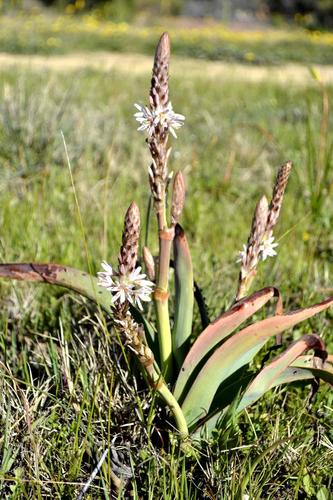
iNaturalist· cc-by-nc-sa
(c) dracophylla, some rights reserved (CC BY-NC-SA)
Summary
Source: WikipediaXanthorrhoea australis, the grass tree or austral grasstree, is an Australian plant. It is the most commonly seen species of the genus Xanthorrhoea. Its trunk can grow up to several metres tall and is often branched. In certain Aboriginal languages, it is called bukkup, baggup or kawee.
Description
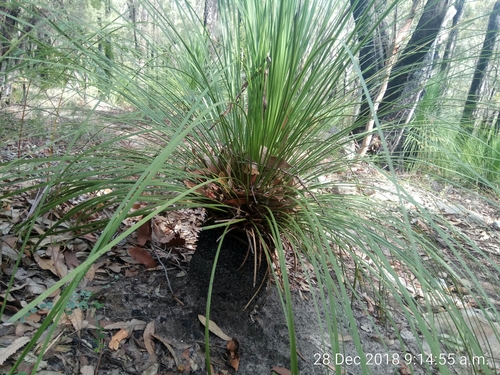
A small tree. It grows 0.3-2 m tall. It spreads 60 cm - 1 m wide. It has a large round crown of long thin leaves. They are grass like. The flowers occur closely packed along a long spike. The flowers are white. Dead flower spikes may stay on the tree for years.
Edible Uses
The pith of the stem can be eaten raw or roasted and has an agreeable, slightly balsamic nutty taste. It contains about 41% carbohydrate, 3.5% protein, and traces of vitamin C. Sugar can also be extracted from the stem. The leaf bases can be chewed — they are hard to detach from the plant and sometimes taste sweet and juicy, though more often they are tough and astringent. The flowers produce abundant nectar that can be collected by sucking the flowers directly or by cooking them to produce a syrup. The root may also be edible.
Medicinal Uses
The resin has medicinal uses, though no further details are given.
Distribution
It grows in temperate regions. It can grow in subtropical and semi-arid places. It grows at Rocky Cape National Park in Tasmania. It can stand heavy frosts. It can grow in full sun or light shade. It suits hardiness zones 9-11. Tasmanian Herbarium. Hobart Botanical Gardens. Arboretum Tasmania.
Where It Grows
Australia*, Tasmania*,
Cultivation
Requires a well-drained light or medium soil and a very sunny position. Succeeds in poor soils in the wild. This species is not very frost-hardy in this country and normally requires greenhouse protection. It tolerates temperatures down to at least -7°c in Australian gardens, though this cannot be translated directly to British gardens due to our cooler summers and longer colder and wetter winters. It would certainly be worthwhile trying it outdoors in the mildest areas of the country. Other members of this genus should also have the same edible and non-edible uses.
Propagation
Sow seed in spring in a warm greenhouse; seed usually germinates in about 5 weeks. Prick seedlings into individual pots when large enough to handle, grow on in the greenhouse through at least their first winter, then plant out in late spring or early summer under a frame or cloche until well established. Protect outdoor plants through at least their first winter. Offsets can be divided in late spring.
Other Uses
A resin collects around the bases of old leaves and can be harvested by beating the stems. It can be used as a varnish for wood or metal, an incense, a size, a sealing wax, a mahogany stain for wood, and a glue. The gum is soft and pliable when heated but cools to a rock-hard consistency. The flower stems make good firesticks.
Production
Plants grow very slowly.
Nutrition
| Part | Moisture | kJ | kcal | Protein | Vit A | Vit C | Iron | Zinc |
|---|---|---|---|---|---|---|---|---|
| Leaf | 66.1 | — | — | 1.7 | — | 1 | 2.6 | 0.5 |
Also Known As
Bowat, Baggup, Bukkup, Kawee
References (22)
- Bodkin, F., 1991, Encyclopedia Botanica. Cornstalk publishing, p 1029
- Cameron, M., (Ed.) 1981, A Guide to Flowers & Plants of Tasmania. Reed p 112
- Caton, J.M. & Hardwick, R. J., 2016, Field Guide to Useful Native Plants from Temperate Australia. Harbour Publishing House. p 338
- Cherikoff V. & Isaacs, J., The Bush Food Handbook. How to gather, grow, process and cook Australian Wild Foods. Ti Tree Press, Australia p 197
- Collier, P., 1993, Woodland Wild flowers of Tasmania. Plant Identikit. Society for growing Australian Plants Tasmania Region. Hobart.
Show all 22 references Hide references
- Cribb, A.B. & J.W., 1976, Wild Food in Australia, Fontana. p 184
- Cronin, L., 1989, The Concise Australian Flora. Reed. p 58
- Cundall, P., (ed.), 2004, Gardening Australia: flora: the gardener's bible. ABC Books. p 1489
- Curtis, W.M., & Morris, D.I., 1994, The Student's Flora of Tasmania. Part 4B St David's Park Publishing, Tasmania, p 419
- De Angelis, D., 2005, Aboriginal Plant Use of the Greater Melbourne Area. La Trobe University Environment Collective
- Greig, D., 1996, Flowering Natives for Home Gardens. Angus & Robertson. p 322
- Grieg, D., 2002, A photographic guide to Wildflowers of South-eastern Australia. New Holland. p 137
- Hastings Advance Community College, 2017, Uses for Native Plants of the Mornington Peninsula. 86pp. p 83
- Hibbert, M., 2002, The Aussie Plant Finder 2002, Florilegium. p 310
- Hiddins, L., 1999, Explore Wild Australia with the Bush Tucker Man. Penguin Books/ABC Books. p 143
- Isaacs, J., 1987, Bush Food, Aboriginal Food and Herbal Medicine. Weldons. p 124
- Lavelle, M., 2008, Wild Flowers of Australia and Oceania. Southwater. p 89
- Lord, E.E., & Willis, J.H., 1999, Shrubs and Trees for Australian gardens. Lothian. p 195
- Low, T., 1991, Wild Food Plants of Australia. Australian Nature FieldGuide, Angus & Robertson. p 140
- Morley, B. & Everard, B., 1970, Wild Flowers of the World. Ebury press. Plate 142
- Plants for a Future database, The Field, Penpol, Lostwithiel, Cornwall, PL22 0NG, UK. http://www.scs.leeds.ac.uk/pfaf/
- Tasmanian Herbarium Vascular Plants list p 92