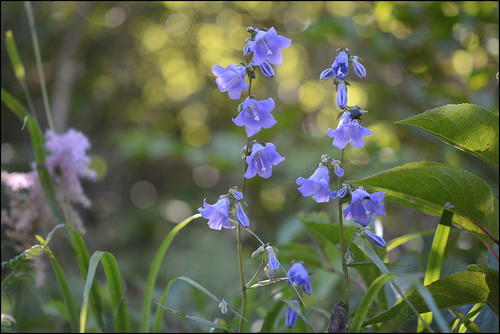
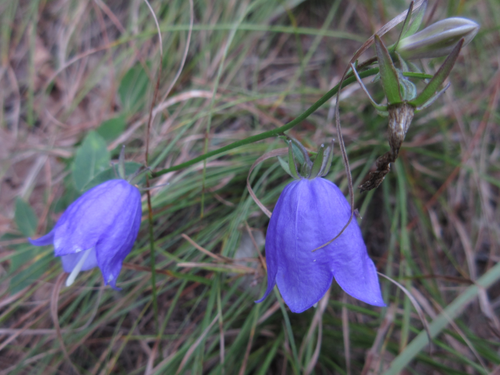
Wahlenbergia undulata
(L. f.) A. DC.
Pale bluebell
iNaturalist· cc-by
(c) Hilary Rose Dawson, some rights reserved (CC BY)
iNaturalist· cc-by
(c) Hilary Rose Dawson, some rights reserved (CC BY)
iNaturalist· cc-by
(c) Hilary Rose Dawson, some rights reserved (CC BY)
Description
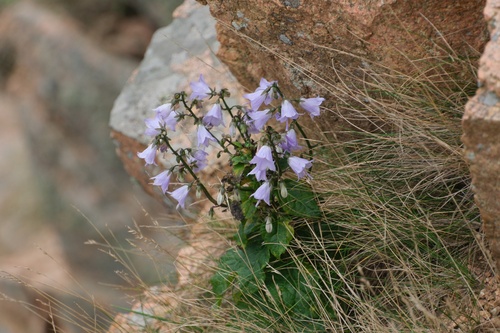
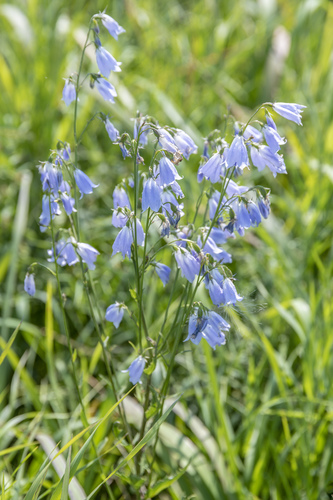
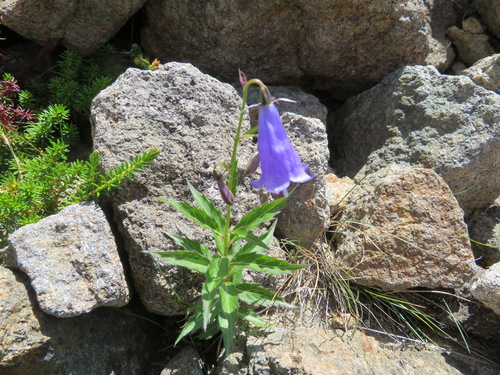
An annual herb. It is erect and grows up to 60 cm high. It has scattered white hairs. The leaves are on the lower half of the shoot. They do not have leaf stalks. The leaves taper from the base to the tip. They are 6 cm long and 5 mm wide. The edges are wavy. There are a few short teeth. The flowers are at the top. The flowers are 1.3 cm long and have pointed lobes. They are blue.
Edible Uses
The root tuber is eaten raw, and the leaves are cooked and eaten as a spinach.
Traditional Uses
The root tuber is eaten raw. The leaves are cooked and eaten as a spinach.
This uses section is brief — help expand it
Distribution
A tropical plant. It grows in dry soils. It can grow in arid places.
Where It Grows
Africa, Angola, Botswana, Central Africa, East Africa, Eswatini, Lesotho, Madagascar, Malawi, Mozambique, Namibia, South Africa, Southern Africa, Swaziland, Tanzania, Zambia, Zimbabwe,
Synonyms
Also Known As
Letoao, Morpetsane, Tenane, Ushwaqa
References (16)
- Fox, F. W. & Young, M. E. N., 1982, Food from the Veld. Delta Books. p 142
- Jardin, C., 1970, List of Foods Used In Africa, FAO Nutrition Information Document Series No 2.p 111
- Long, C., 2005, Swaziland's Flora - siSwati names and Uses http://www.sntc.org.sz/flora/
- Martin, F.W. & Ruberte, R.M., 1979, Edible Leaves of the Tropics. Antillian College Press, Mayaguez, Puerto Rico. p 180
- Matlhare, T., et al, Vegetables in Botswana. p 21 Bioversity website.
Show all 16 references Hide references
- Monogr. Campan. 148. 1830
- Oniang’o, R., Grum, M. and Obel-Lawson, E., editors. 2008. Developing African leafy vegetables for improved nutrition. Regional workshop, 6-9 December 2005. Rural Outreach Program, Nairobi, Kenya. p 3
- Peters, C. R., O'Brien, E. M., and Drummond, R.B., 1992, Edible Wild plants of Sub-saharan Africa. Kew. p 74
- Royal Botanic Gardens, Kew (1999). Survey of Economic Plants for Arid and Semi-Arid Lands (SEPASAL) database. Published on the Internet; http://www.rbgkew.org.uk/ceb/sepasal/internet [Accessed 5th April 2011]
- Ruiters-Welcome, A. K., 2019, Food plants of southern Africa. Ph.D. thesis. Univ. of Johannesburg p 41
- Smith, F. I. and Eyzaquirre, P., 2007, African leafy vegetables: Their role in the World Health Organization's global Fruit and Vegetables Initiative. AJFAND, Vol. 7 No. 3
- Swaziland's Flora Database http://www.sntc.org.sz/flora
- Tredgold, M.H., 1986, Food Plants of Zimbabwe. Mambo Press. p 61
- Vinnicombe, 1976,
- Welcome, A. K. & Van Wyk, B.-E., 2019, An inventory and analysis of the food plants of southern Africa. South African Journal of Botany 122 (2019) 136–179
- World Checklist of Useful Plant Species 2020. Royal Botanic Gardens, Kew