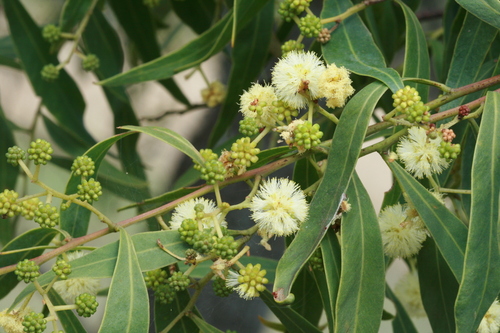
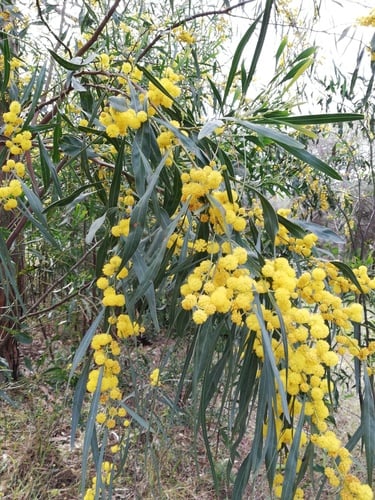
Vigna aconitifolia
(Jacq.) Marechal
Moth Bean, Turkish gram
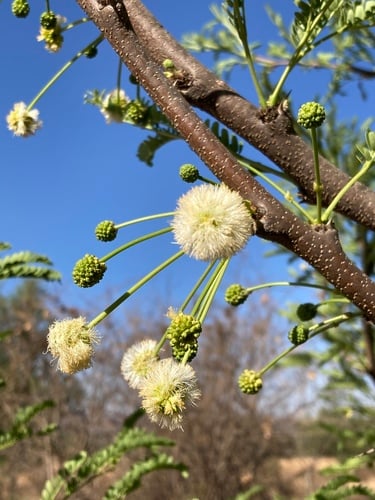
iNaturalist· cc-by-nc
(c) Siddarth Machado, some rights reserved (CC BY-NC)
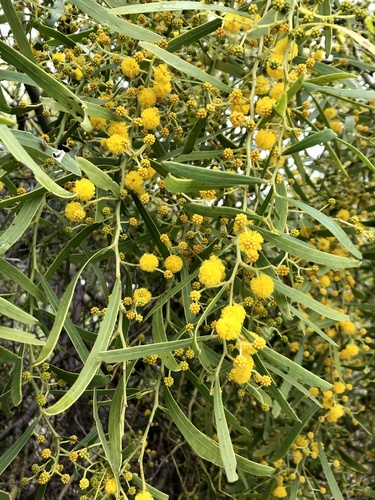
iNaturalist· cc-by
(c) Aravinth, some rights reserved (CC BY), uploaded by Aravinth
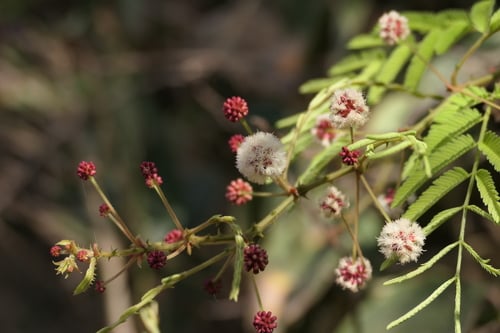
iNaturalist· cc-by
(c) Aravinth, some rights reserved (CC BY), uploaded by Aravinth
Summary
Source: WikipediaVigna aconitifolia is a drought-resistant legume, commonly grown in arid and semi-arid regions of India. It is commonly called mat bean, moth bean, matki or dew bean. Moth bean is a creeping annual herbaceous plant which grows to approximately 40 centimetres (16 in) high. Yellow flowers on its hairy and densely packed branches develop into yellow-brown pods, 2 to 3 inches in length. The beans of these pods contain approximately 22–24% protein. The pods, sprouts, and protein-rich seeds of this crop are commonly consumed in India. Moth bean can be grown on many soil types, and can also act as a pasture legume. Due to its drought-resistant qualities, its ability to combat soil erosion and its high protein content, moth bean has been identified as possibly a more significant food source in the future. It has been suggested that its suitability as a grain legume in semi-arid Africa should be further investigated.
Description
A slender annual herb. It can be erect or creeping. The vines form a mat like cover over the soil. It is slightly hairy. The leaves have stalks. They are deeply 3 lobed. The lobes are narrow. The flowers are yellow. The fruit is a pod shaped like a cylinder. There are usually 7-8 seeds. They are small and yellowish brown.
Edible Uses
Moth bean is consumed as forage by animals. Whole or split moth bean seeds can be cooked or fried. In India, particularly in the state of Maharashtra, moth beans are sprouted before cooking and used for making a spicy stew called matki usal. Matki usal forms the base of the Indian street food dish called misal pav. Fried dal of the bean is used to make a dry savory snack, known in India as dalmoth. The moth bean pods can be boiled and eaten. The flour of the bean is used for making another savoury snack called bhujia.
Traditional Uses
Seeds are used in lentil soup. They are boiled, parched, fried in oil or prepared with salt as a snack. They can be ground into flour and mixed with other grains to make unleavened bread. In India is it made into Dahl and bean paste. The young pods are cooked as a vegetable.
Medicinal Uses
The seeds are used medicinally in diets to treat fevers. The roots are said to be narcotic.
Distribution
It is a tropical plant. In Nepal it grows up to 1000 m altitude. It will grow on shallow dry soils. It is not tolerant of frost. It grows in areas with an annual rainfall between 380-1,730 mm. It grows in acid, neutral and alkaline soils. It grows below 1,300 m above sea level. It can grow in arid places. In Yunnan.
Where It Grows
Afghanistan, Africa, Americas, Asia, Australia, Bangladesh, Botswana, Central America, China, Costa Rica, East Africa, Ethiopia, Fiji, Himalayas, India, Indochina, Kenya, Mexico, Middle East, Myanmar, Nepal, North America, Pacific, Pakistan, Saudi Arabia, SE Asia, Somalia, South Africa, Southern Africa, Sudan, Sri Lanka, Thailand, USA, Vietnam, Yemen,
Cultivation
Plants are grown from seed.
Propagation
Seed - can be sown in situ. Presoaking overnight in warm water can shorten the time taken to germinate. It germinates best at a temperature of 25 - 27°c.
Other Uses
The plant provides good weed control and adds nitrogen to the soil when it is grown as a cover crop for soil improvement as a green manure. In India the plant is usually grown as a sole crop, or is intercropped with pearl millet, sorghum or other cereals, occasionally with pulses. It is grown as a green manure in rotation with cotton.
Other Information
It is a commercially cultivated vegetable. It is an important bean in India. The young pods re enjoyed.
Notes
There are about 150 Vigna species. They are mostly in the tropics. Also as Papilionaceae.
Nutrition
| Part | Moisture | kJ | kcal | Protein | Vit A | Vit C | Iron | Zinc |
|---|---|---|---|---|---|---|---|---|
| Seeds | 10.8 | — | — | 23.6 | — | — | — | — |
Synonyms
Also Known As
Bhioni, Bhringga, Birmoch, Birmung, Dau Odau, Dew bean, Gurans, Kheri, Kuncumape-salu, Madike, Makushthaka, Masjang, Mat bean, Math, Matki, Moch, Moot, Mugirambara, Mut, Muth bean, Papillon bean, Taw-pe-nauk, Tulukkapayir
References (35)
- Ambasta, S.P. (Ed.), 2000, The Useful Plants of India. CSIR India. p 676
- Bodkin, F., 1991, Encyclopedia Botanica. Cornstalk publishing, p 1017
- Brink, M. & Jansen, P.C.M., 2006. Vigna aconitifolia (Jacq.) Maréchal. [Internet] Record from Protabase. Brink, M. & Belay, G. (Editors). PROTA (Plant Resources of Tropical Africa), Wageningen, Netherlands. < http://database.prota.org/search.htm>. Accessed 23 October 2009
- Bull. Jard. Bot. Etat 39:160. 1969
- Burkill, I.H., 1966, A Dictionary of the Economic Products of the Malay Peninsula. Ministry of Agriculture and Cooperatives, Kuala Lumpur, Malaysia. Vol 2 (I-Z) p 1734 (As Phaseolus aconitifolius)
Show all 35 references Hide references
- Cobley, L.S. (rev. Steele, W.M.) 2nd Ed., 1976, An Introduction to the Botany of Tropical Crops. Longmans. p 91 (As Phaseolus aconitifolius)
- Facciola, S., 1998, Cornucopia 2: a Source Book of Edible Plants. Kampong Publications, p 112
- FAO, 1988, Traditional Food Plants, FAO Food and Nutrition Paper 42. FAO Rome p 402 (As Phaseolus aconitifolius)
- Flora of Pakistan. www.eFloras.org
- Hedrick, U.P., 1919, (Ed.), Sturtevant's edible plants of the world. p 476 (As Phaseolus aconitifolius)
- ILDIS Legumes of the World http:www:ildis.org/Legume/Web
- Jardin, C., 1970, List of Foods Used In Africa, FAO Nutrition Information Document Series No 2.p 27 (As Phaseolus aconitifolius)
- JSTOR Global Plants edible
- Kays, S. J., and Dias, J. C. S., 1995, Common Names of Commercially Cultivated Vegetables of the World in 15 languages. Economic Botany, Vol. 49, No. 2, pp. 115-152
- Kermath, B. M., et al, 2014, Food Plants in the Americas: A survey of the domesticated, cultivated and wild plants used for Human food in North, Central and South America and the Caribbean. On line draft. p 909
- Kiple, K.F. & Ornelas, K.C., (eds), 2000, The Cambridge World History of Food. CUP p 1816, 1868 (As Phaseolus aconitifolius)
- Lazarides, M. & Hince, B., 1993, Handbook of Economic Plants of Australia, CSIRO. p 246
- Macmillan, H.F. (Revised Barlow, H.S., et al) 1991, Tropical Planting and Gardening. Sixth edition. Malayan Nature Society. Kuala Lumpur. p 327 (As Phaseolus aconitifolius)
- Manandhar, N.P., 2002, Plants and People of Nepal. Timber Press. Portland, Oregon. p 356 (As Phaseolus aconitifolius)
- Pham-Hoang Ho, 1999, An Illustrated Flora of Vietnam. Nha Xuat Ban Tre. p 959
- Purseglove, J.W., 1968, Tropical Crops Dicotyledons, Longmans. p 286 (As Phaseolus aconitifolius)
- Royal Botanic Gardens, Kew (1999). Survey of Economic Plants for Arid and Semi-Arid Lands (SEPASAL) database. Published on the Internet; http://www.rbgkew.org.uk/ceb/sepasal/internet [Accessed 1st May 2011]
- Shah, G.L. et al, 1981, An account of the Ethnobotany of Saurashtra in Gujarat State (India). J. Econ. Tax. Bot. Vol 2 pp 173-182
- Shah, S. K., 2014, Dietary contribution of underutilized minor crops and indigenous plants collected from uncultivated lands and forests in Nepal. in Promotion of Underutilized Indigenous Food Resources for Food Security and Nutrition in Asia and Pacific. FAO. Bangkok p 64 (As Phaseolus aconitifolius)
- Singh, H.B., Arora R.K.,1978, Wild edible Plants of India. Indian Council of Agricultural Research, New Delhi. p 85
- Smith, A.C., 1985, Flora Vitiensis Nova, Lawaii, Kuai, Hawaii, Volume 3 p 240
- Solomon, C., 2001, Encyclopedia of Asian Food. New Holland. p 210
- Thulin, M., 1983, Leguminosae of Ethiopia. Opera Botanica 8:1-223
- USDA, ARS, National Genetic Resources Program. Germplasm Resources Information Network - (GRIN). [Online Database] National Germplasm Resources Laboratory, Beltsville, Maryland. Available: www.ars-grin.gov/cgi-bin/npgs/html/econ.pl (10 April 2000)
- USDA, ARS, National Genetic Resources Program. Germplasm Resources Information Network - (GRIN). [Online Database] National Germplasm Resources Laboratory, Beltsville, Maryland. Available: www.ars-grin.gov/cgi-bin/npgs/html/econ.pl (10 April 2000) (As Phaseolus aconitifolius)
- van Wyk, B., 2005, Food Plants of the World. An illustrated guide. Timber press. p 380
- Wiersema, J. H. & Leon, B., 2013, World Economic Plants. A Standard Reference CRC Press. 2nd Ed. p 719
- Wilson, J.M. & Witcombe, J.R., Crops for Arid lands, in Wickens, G.E., Goodin, J.R., and Field, D.V.,(Eds.) 1985, Plants for Arid Lands. Unwin Hyman, London, p 44
- World Checklist of Useful Plant Species 2020. Royal Botanic Gardens, Kew
- Zeven, A. C. & de West, J. M. J., 1982, Dictionary of cultivated plants and their regions of diversity. Wageningen. p 76