Acacia rostellifera
Benth.
Summer-scented wattle
iNaturalist· cc-by-nc
(c) Dean Beaver, some rights reserved (CC BY-NC), uploaded by Dean Beaver
iNaturalist· cc-by
(c) tessskye, some rights reserved (CC BY)
iNaturalist· cc-by
(c) Thomas Mesaglio, some rights reserved (CC BY), uploaded by Thomas Mesaglio
Summary
Source: WikipediaAcacia rostellifera, commonly known as summer-scented wattle or skunk tree, is a coastal tree or small tree in the family Fabaceae. Endemic to Western Australia, it occurs along the west coast as far north as Kalbarri in the Southwest Australia savanna ecoregion, and along the south coast as far east as Israelite Bay. The summer-scented wattle generally reproduces by suckers from underground stems. Because of this suckering, the species often forms thickets that exclude all other species. The tallest Acacia of its area, it can grow to 10 metres. Specimens above 3 metres are not often seen, however, as bushfires occur often in its area. Fire burns the plants right to the ground, but the underground stem resprouts vigorously.
Description
A shrub or small tree. It grows 5 m tall. There are prickles along the stem. The leaves are twice divided and there are 8-18 pairs of pinnae. There are up to 50 pairs of pinnules on each pinnae. The flowers are yellow. They are in large clusters at the ends of branches. The pods are flattened.
Edible Uses
The seeds and gum are eaten; the gum has a pleasant taste.
Traditional Uses
It has a gum which is eaten. It has a pleasant taste.
This uses section is brief — help expand it
Distribution
This tree occurs naturally in Western Australia. It prefers light to medium soils. It likes some lime. It prefers well drained soils. It requires an open sunny position but can stand light shade. It is drought resistant. It is damaged by heavy frosts. Coastal forms can tolerate salt spray near the coast.
Where It Grows
Australia*,
Cultivation
It is grown from seed. The seed need treatment to break the hard seed coat. Normally this is by putting the seeds in very hot water and letting the water cool down overnight then planting the seeds immediately. It can be grown from cuttings.
Production
The gum can be stored.
Notes
There are about 1,350 Acacia species. Over 1,000 occur in Australia. Also as Mimosaceae.
References (6)
- Bodkin, F., 1991, Encyclopedia Botanica. Cornstalk publishing, p 31
- Cherikoff V. & Isaacs, J., The Bush Food Handbook. How to gather, grow, process and cook Australian Wild Foods. Ti Tree Press, Australia p 47
- Elliot, W.R., & Jones, D.L., 1982, Encyclopedia of Australian Plants suitable for cultivation. Vol 2. Lothian. p 108
- London J. Bot. 1:356. 1842
- Lord, E.E., & Willis, J.H., 1999, Shrubs and Trees for Australian gardens. Lothian. p 41
Show all 6 references Hide references
- Paczkowska, G . & Chapman, A.R., 2000, The Western Australian Flora. A Descriptive Catalogue. Western Australian Herbarium. p 322
More from Fabaceae
Parkinsonia florida - (Benth. ex A.Gray) S.Watson
Blue Palo Verde
Parkinsonia praecox
Parochetus communis
Blue trefoil, Shamrock pea, Clover pea
Parosela lanata
Woolly parosella, Woolly Prairie-clover, Woolly Prairieclover
Parosella lanata - (Spreng.)Britton.
Woolly Parosella
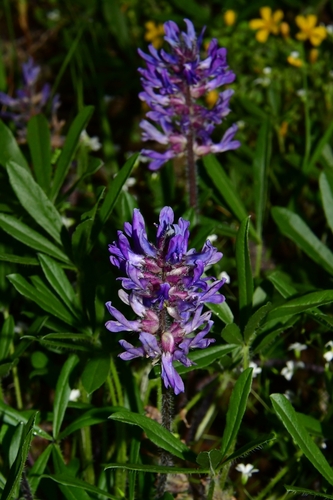
Pediomelum subacaule
White rim scurfpea, Nashville breadroot