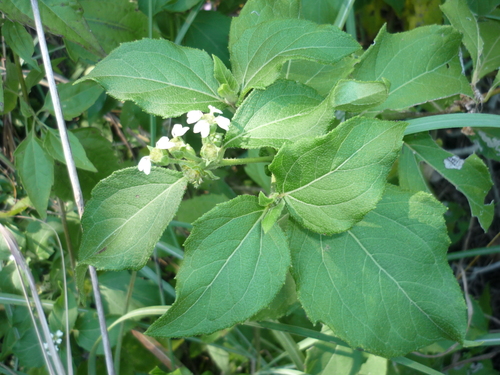
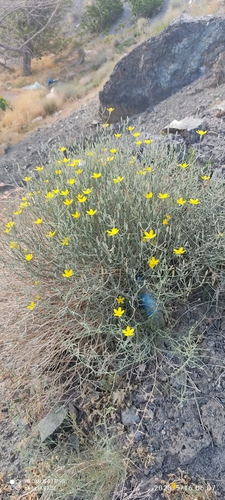
Cyanthillium cinereum
(L.) H. Rob.
Ash-coloured fleabane, Little iron weed
iNaturalist· cc0
no rights reserved, uploaded by 葉子
iNaturalist· cc-by-nc
(c) Shang-Kwei Wang, some rights reserved (CC BY-NC)
Summary
Source: WikipediaCyanthillium cinereum (also known as little ironweed and poovamkurunnal or poovamkurunnila in Malayalam, and monara kudumbiya in Sinhalese) is a species of perennial plants in the sunflower family. The species is native to tropical Africa and to tropical Asia (India, Sri Lanka, Indochina, Indonesia, etc.) and has become naturalized in Australia, Mesoamerica, tropical South America, the West Indies, and the US State of Florida. Cyanthillium cinereum is an annual herb up to 120 cm (4 feet) tall. It produces flat-topped arrays of numerous flower heads, each with pinkish or purplish disc florets but no ray florets. The species can be confused with Emilia sonchifolia, but the flower bracts of the latter are much longer and vase-shaped. Cyanthillium cinereum has been used for smoking cessation in Thailand and other countries, and as relief for the common cold. It used to be called Vernonia cinerea, but apparently there was a taxonomic update, sometime prior to early 2014. It's also called Sahadevi. This is a special medicinal plant used in Ayurveda. Its leaves are green and shiny, and the flowers are white or light purple in color. This plant naturally helps boost the body's immune system. It is mostly grown in warm and humid regions.
Description
An annual erect herb with stout spreading branches. It can continue to grow from year to year from its rootstock. It is about 50-100 cm high. The stems are firm and rounded but with ribs. It sprawls over other plants. The leaves have almost no leaf stalk and they are 2 to 12 cm long and shallowly toothed. The leaves are sparse on the upper stems. Leaves are paler underneath. About 40 to 70 flowers make up the flower head. This head is 2.5 mm across. The flower bract is green and the flowers pale purple.
Edible Uses
The young leaves are edible cooked and used as a pot-herb, often cooked with other leaves to improve flavor. The plant is powdered and added to millet or rice to make beer and other alcoholic drinks.
Traditional Uses
The young leaves are edible cooked. They are used as a pot-herb. It is cooked with other leaves to improve the flavour. Caution: Older plants contain cyanide and would need to be well cooked. The plant is powdered and added to millet or rice to make beer and other alcoholic drinks. Caution: Alcohol is a cause of cancer.
Medicinal Uses
The plant has been used in medicine.
Known Hazards
Older plants contain cyanide and require thorough cooking before consumption.
Distribution
A tropical plant. It is widely distributed in the tropics. It grows in the lowlands. It is a common weed in open waste spaces throughout the Philippines at low and medium altitudes. In Papua New Guinea it grows to 1200 m altitude. In Kenya it grows in hot coastal areas from sea level to 1,700 m altitude. In Nepal it grows between 80-2,300 m above sea level. It can grow in arid places.
Where It Grows
Africa, American Samoa, Angola, Asia, Australia, Benin, Brazil, Burkina Faso, Burundi, Cameroon, Central Africa, Central America, China, Congo DR, Costa Rica, Côte d'Ivoire, Dominican Republic, East Africa, East Timor, Ecuador, Eswatini, Fiji, Gabon, Ghana, Guatemala, Guiana, Guianas, Guinea, Guinée, Guinea-Bissau, Guyana, Hawaii, Himalayas, Honduras, India, Indochina, Indonesia, Ivory Coast, Japan, Kenya, Kiribati, Liberia, Madagascar, Malawi, Malaysia, Maldives, Mali, Marquesas, Micronesia, Mozambique, Myanmar, Nepal, Nicaragua, Nigeria, Pacific, Palau, Panama, Papua New Guinea, PNG, Philippines, Puerto Rico, Rwanda, SE Asia, Senegal, Sierra Leone, South Africa, South America, Southern Africa, Sri Lanka, Suriname, Swaziland, Taiwan, Tanzania, Timor-Leste, Togo, Tonga, Tuvalu, Uganda, USA, Venezuela, West Africa, West Indies, Zimbabwe,
Cultivation
It spreads naturally by seed.
Other Uses
The seeds yield a fatty oil which is used medicinally.
Notes
The plant has been used in medicine.
Synonyms
Also Known As
Agas-moro, Akar semboh, Babututuri, Barangam, Buyung-buyung, Chibuzi, Daudotpala, Devasahra, Fenkumburuvaano, Gadlak biro, Garitikamma, Ghaudavalli, Gyantaka, Jhurjhure, Jonge aroi, Kadu-pyan, Kalajira, Kambulic, Kukshim, Lalang-kapan, Marjuna, Maryuna, Mouku fai pula, Mukuttipundu, Namuipe, Osari, Piripudenaba, Puvank-odanthel, Puvankodanthel, Sadodi, Sadori, Sahadevi, Sasawi langit, Scrashangalamir, Sembung bikul, Sembung kebo, Tambak-tambak, Tombak-tombak
References (58)
- Achigan-Dako, E, et al (Eds), 2009, Catalogue of Traditional Vegetables in Benin. International Foundation for Science. (As Vernonia cinerea)
- Ambasta, S.P. (Ed.), 2000, The Useful Plants of India. CSIR India. p 672 (As Vernonia cinerea)
- Bircher, A. G. & Bircher, W. H., 2000, Encyclopedia of Fruit Trees and Edible Flowering Plants in Egypt and the Subtropics. AUC Press. p 60 (As Blumea chinensis)
- Borrell, O.W., 1989, An Annotated Checklist of the Flora of Kairiru Island, New Guinea. Marcellin College, Victoria Australia. p 64 (As Vernonia cinerea)
- Burkill, H. M., 1985, The useful plants of west tropical Africa, Vol. 1. Kew. (As Vernonia cinerea)
Show all 58 references Hide references
- Burkill, I.H., 1966, A Dictionary of the Economic Products of the Malay Peninsula. Ministry of Agriculture and Cooperatives, Kuala Lumpur, Malaysia. Vol 2 (I-Z) p 2267 (As Vernonia cinerea)
- Burkill, I.H., 1966, A Dictionary of the Economic Products of the Malay Peninsula. Ministry of Agriculture and Cooperatives, Kuala Lumpur, Malaysia. Vol 1 (A-H) p 342
- Caton, J.M. & Hardwick, R. J., 2016, Field Guide to Useful Native Plants from Temperate Australia. Harbour Publishing House. p 310 (As Vernonia cinerea)
- Codjia, J. T. C., et al, 2003, Diversity and local valorisation of vegetal edible products in Benin. Cahiers Agricultures 12:1-12 (As Vernonia cinerea)
- Cribb, A.B. & J.W., 1976, Wild Food in Australia, Fontana. p 136 (As Vernonia cinerea)
- Dangol, D. R., 2002, Economic uses of forest plant resources in western Chitwan, Nepal. Banko Janakari, 12(2): 56-64 (As Vernonia cinerea)
- Dangol, D. R. et al, 2017, Wild Edible Plants in Nepal. Proceedings of 2nd National Workshop on CUAOGR, 2017. (As Vernonia cinerea)
- Dansi, A., et al, 2008, Traditional leafy vegetables and their use in the Benin Republic. Genet Resour Crop Evol (2008) 55:1239–1256
- Dansi, A., et al, 2009, Traditional leafy vegetables in Benin: folk nomenclature, species under threat and domestication. Acta Bot. Gallica 156(2), 183-199 (As Vernonia cinerea)
- Facciola, S., 1998, Cornucopia 2: a Source Book of Edible Plants. Kampong Publications, p 45 (As Vernonia cinerea)
- Fox, F. W. & Young, M. E. N., 1982, Food from the Veld. Delta Books. p 128 (As Vernonia cinerea)
- Gautam, R. S., et al, 2022, Ethnobotanical Review of Wild Edible Plants of Nepal. Journal of Natural History Museum Volume 32, 2021-22 p 106
- GRIN
- Grivetti, L. E., 1980, Agricultural development: present and potential role of edible wild plants. Part 2: Sub-Saharan Africa, Report to the Department of State Agency for International Development. p 48 (As Vernonia cinerea)
- Grubben, G. J. H. and Denton, O. A. (eds), 2004, Plant Resources of Tropical Africa 2. Vegetables. PROTA, Wageningen, Netherlands. p 544 (As Vernonia cinerea)
- Henty, E.E., & Pritchard, G.S., 1973, Weeds of New Guinea and their control. Botany Bulletin No 7, Division of Botany, Lae, PNG. p 87 (As Vernonia cinerea)
- Hussey, B.M.J., Keighery, G.J., Cousens, R.D., Dodd, J., Lloyd, S.G., 1997, Western Weeds. A guide to the weeds of Western Australia. Plant Protection Society of Western Australia. p 108 (As Vernonia cinerea)
- Jadhav, R., et al, 2015, Forest Foods of Northern Western Ghats: Mode of Consumption, Nutrition and Availability. Asian Agri-History Vol. 19, No. 4: 293-317 (As Vernonia cinerea)
- Jardin, C., 1970, List of Foods Used In Africa, FAO Nutrition Information Document Series No 2.p 109 (As Vernonia cinerea)
- Kenneally, K.E., Edinger, D. C., and Willing T., 1996, Broome and Beyond, Plants and People of the Dampier Peninsula, Kimberley, Western Australia. Department of Conservation and Land Management. p 69 (As Vernonia cinerea)
- Lazarides, M. & Hince, B., 1993, Handbook of Economic Plants of Australia, CSIRO. p 245 (As Vernonia cinerea)
- Levitt, D., 1981, Plants and people. Aboriginal uses of plants on Groote Eylandt. Australian Institute of Aboriginal Studies, Canberra. p 89 (var. lanata) (As Vernonia cinerea)
- Linnaea 4:291. 1829 (As Vernonia cinerea)
- Malaisse, F., 1997, Se nourrir en floret claire africaine. Approche ecologique et nutritionnelle. CTA., p 91. (As Vernonia cinerea)
- Martin, F.W. & Ruberte, R.M., 1979, Edible Leaves of the Tropics. Antillian College Press, Mayaguez, Puerto Rico. p 79, 184, 186 (Also as Vernonia cinerea)
- Maundu, P. et al, 1999, Traditional Food Plants of Kenya. National Museum of Kenya. 288p (As Vernonia cinerea)
- Melzer, R. & Plumb, J., 2011, Plants of Capricornia. Belgamba, Rockhampton. p 511
- Monsalud, M.R., Tongacan, A.L., Lopez, F.R., & Lagrimas, M.Q., 1966, Edible Wild Plants in Philippine Forests. Philippine Journal of Science. p 454 (As Vernonia cinerea)
- Mutie, F. G., 2020, Conservation of Wild Food Plants and Their Potential for Combatting Food Insecurity in Kenya as Exemplified by the Drylands of Kitui County. Plants 2020, 9, 1017
- Mutie, F. M., et al, 2023, Important Medicinal and Food Taxa (Orders and Families) in Kenya, Based on Three Quantitative Approaches. Plants 2023, 12, 1145
- Nurfadilah, S., et al, 2017, Species richness, conservation status, and potential uses of plants in Segara Anakan Area of Sempu Island, East Java, Indonesia. BIODIVERSITAS. Volume 18, Number 4
- Ochse, J.J. et al, 1931, Vegetables of the Dutch East Indies. Asher reprint. p 151 (As Vernonia cinerea)
- Peekel, P.G., 1984, (Translation E.E.Henty), Flora of the Bismarck Archipelago for Naturalists, Division of Botany, Lae, PNG. p 555, 552 (As Vernonia cinerea)
- Peters, C. R., O'Brien, E. M., and Drummond, R.B., 1992, Edible Wild plants of Sub-saharan Africa. Kew. p 93 (As Vernonia cinerea)
- Prodr. 5:444. 1836
- PROSEA
- Robinson, H. 1999. Generic and subtribal classification of American Vernonieae. Smithsonian Contr. Bot. 89:65.
- Royal Botanic Gardens, Kew (1999). Survey of Economic Plants for Arid and Semi-Arid Lands (SEPASAL) database. Published on the Internet; http://www.rbgkew.org.uk/ceb/sepasal/internet [Accessed 14th April 2011] (As Vernonia cinerea)
- Ruiters-Welcome, A. K., 2019, Food plants of southern Africa. Ph.D. thesis. Univ. of Johannesburg p 34
- Singh, H.B., Arora R.K.,1978, Wild edible Plants of India. Indian Council of Agricultural Research, New Delhi. p 38 (As Vernonia cinerea)
- Smith, A.C., 1991, Flora Vitiensis Nova, Lawaii, Kuai, Hawaii, Volume 5 p 262 (As Vernonia cinerea)
- Sujanapal, P., & Sankaran, K. V., 2016, Common Plants of Maldives. FAO & Kerala FRI, p 101
- Sukarya, D. G., (Ed.) 2013, 3,500 Plant Species of the Botanic Gardens of Indonesia. LIPI p 1140 (As Vernonia cinerea)
- Terra, G.J.A., 1973, Tropical Vegetables. Communication 54e Royal Tropical Institute, Amsterdam, p 29 & p 80 (As Vernonia cinerea)
- Thaman, R. R., 1987, Plants of Kiribati: A listing and analysis of vernacular names. Atoll Research Bulletin No. 296 (As Vernonia cinerea)
- Thaman, R. R, 2016, The flora of Tuvalu. Atoll Research Bulletin No. 611. Smithsonian Institute p 67
- Ucheck Fomum, F., 2004. Vernonia amygdalina Delile. [Internet] Record from Protabase. Grubben, G.J.H. & Denton, O.A. (Editors). PROTA (Plant Resources of Tropical Africa), Wageningen, Netherlands. < http://database.prota.org/search.htm>. Accessed 23 October 2009 (As Vernonia cinerea)
- Westerway, J., et al, 2018, Preliminary checklist of the naturalised and pest plants of Timor-Leste. Blumea 63:157-163
- Welcome, A. K. & Van Wyk, B.-E., 2019, An inventory and analysis of the food plants of southern Africa. South African Journal of Botany 122 (2019) 136–179
- Wheeler, J.R.(ed.), 1992, Flora of the Kimberley Region. CALM, Western Australian Herbarium, p 958 (As Vernonia cinerea)
- Wild edible plants of Himachal Pradesh (As Vernonia cinerea)
- World Checklist of Useful Plant Species 2020. Royal Botanic Gardens, Kew
- Yuncker, T.G., 1959, Plants of Tonga, Bernice P. Bishop Museum, Hawaii, Bulletin 220. p 265 (As Vernonia cinerea)