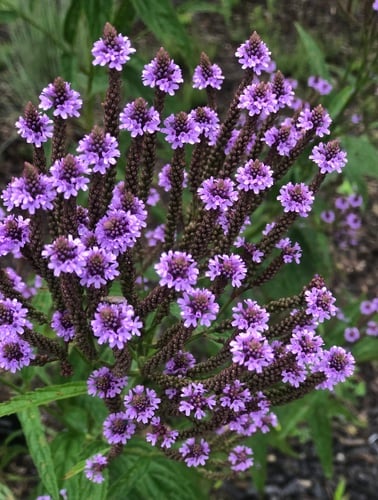
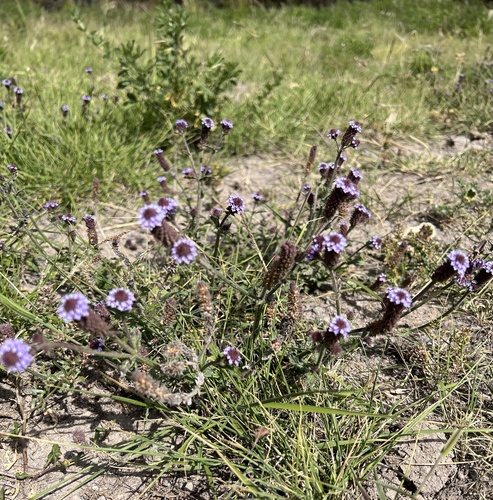
Verbena officinalis
L.
Common Verbena
iNaturalist· cc-by-nc
(c) 小铖/Smalltown, some rights reserved (CC BY-NC), uploaded by 小铖/Smalltown
iNaturalist· cc-by
(c) Denis Bastianelli, some rights reserved (CC BY)
Summary
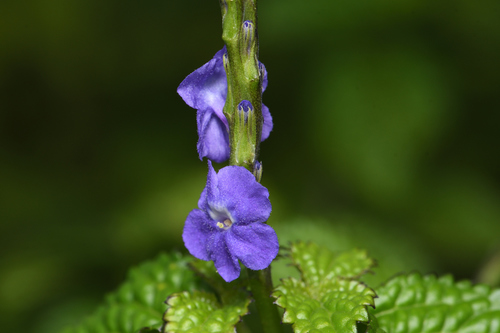
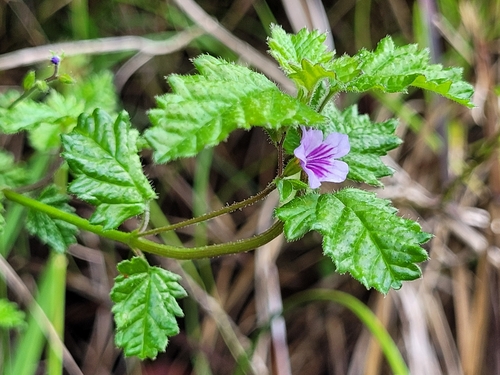
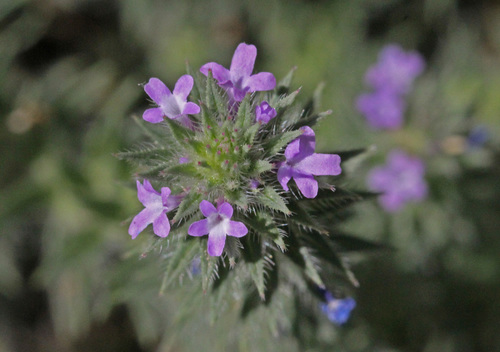
Source: WikipediaVerbena officinalis, the common vervain or common verbena, is a perennial herb native to Europe. It grows up to 70 cm (28 in) high, with an upright habitus. The lobed leaves are toothed, and the delicate spikes hold clusters of two-lipped mauve flowers. This plant prefers limey soils; it is occasionally grown as an ornamental plant but perhaps more often for the powerful properties some herbalists ascribe to it. Propagation is by root cuttings or seed. It is widely naturalised outside its native range, for example in North America.
Description
An evergreen shrub. It grows 30 cm to 1 m high. The roots are branched and are white or yellow. The stem has hairs. The leaves are about 2.5-8 cm long and 1-1.5 cm wide. The flowers are small and blue. The fruit are divided into 4 segments. It is bitter with a sweet smell.
Edible Uses
The leaves can be parboiled, seasoned, and eaten, or used as a tea substitute. The flowers are used as a garnish.
Traditional Uses
The young leaves are parboiled, seasoned and eaten. The leaves are used as a tea substitute. The flowers are fermented into wine and used as a garnish. It is used to flavour salt.
Medicinal Uses
Vervain has tonic and restorative properties and is used as a domestic herbal remedy. Taken internally it is useful for headaches, fevers, nervous exhaustion, depression, gall bladder problems, and insufficient lactation. It should not be given to pregnant women, though it can be used to assist contractions during labour. Externally, it treats minor injuries, eczema, sores, neuralgia, and gum disease. The leaves and flowering stems are analgesic, antibacterial, anticoagulant, antispasmodic, astringent, depurative, diaphoretic, mildly diuretic, emmenagogue, galactogogue, stimulant, tonic, and vulnerary. The plant is harvested as flowering begins in summer and dried for later use. Some remarkable results have been observed in the treatment of certain tumours, though further research is needed before definitive claims can be made. The root is astringent and used in the treatment of dysentery. This species ranked 12th in a Chinese survey of 250 potential antifertility plants. The plant is used in Bach flower remedies, with the prescribing keywords being 'Strain', 'Stress', 'Tension', and 'Over-enthusiasm'.
Known Hazards
High doses of verbenalin can cause nervous system paralysis resulting in stupor & convulsion. Allopathic medicine for high blood pressure can be effected by vervain. Uterus stimulation possible - avoid during pregnancy. Avoid if breast feeding. If allergies or fits use with caution.
Distribution
It is a temperate plant. It grows by roads and in open spaces. It will grow in most well-drained soils. It needs an open, sunny position. It is resistant to frost but sensitive to drought. It suits hardiness zones 4-8. Tasmania Herbarium. In Sichuan and Yunnan.
Where It Grows
Africa, Argentina, Asia, Australia, Balkans, Brazil, Britain, Cape Verde, Central America*, Central Asia, China, East Africa, Eurasia, Europe, France, Greece, Hungary, India, Indochina, Iraq, Italy, Japan, Jordan, Korea, Kurdistan, Laos, Lesotho, Luxembourg, Macedonia, Mediterranean, Mexico, Middle East, Morocco, Myanmar, Niue, North Africa, North America, Portugal, SE Asia, Sicily, Southern Africa, South America, Spain, Sudan, Taiwan, Tajikistan, Tasmania, Tibet, Turkey, Türkiye, Zambia, Zimbabwe,
Cultivation
A very easily grown plant, it succeeds in any moderately fertile well-drained but moisture retentive soil in a sunny position. Plants are very tolerant of neglect and will maintain themselves for a number of years even when growing in dense weed competition. Self-sows freely when growing in a suitable position. The growing plant attracts butterflies and moths.
Propagation
Seed — sow in early spring in a greenhouse, barely covering the seed. Germination should occur within 3 weeks. Prick seedlings into individual pots when large enough and plant out in early summer. Where seed is plentiful, it can also be sown in situ in late spring. Divide in spring; larger divisions go directly into permanent positions, while smaller ones are best potted and grown on in light shade in a greenhouse or cold frame before planting out in summer or the following spring. Basal cuttings taken in early summer — harvest shoots with plenty of underground stem when about 8–10cm above ground, pot individually, and keep in light shade in a cold frame or greenhouse until well rooted before planting out in summer.
Other Uses
None known.
Notes
There are about 250 Verbena species. It is used in medicine.
Nutrition
| Part | Moisture | kJ | kcal | Protein | Vit A | Vit C | Iron | Zinc |
|---|---|---|---|---|---|---|---|---|
| Leaves | 77 | — | — | — | — | — | 3.9 | 0.5 |
Also Known As
Bluebird vine, Holy Wort, Karaita, Kuma-tsuzura, Pamukh, Saung-daw-ku, Vasfu, Vervain
References (22)
- Ambasta, S.P. (Ed.), 2000, The Useful Plants of India. CSIR India. p 671
- Blamey, M and Grey-Wilson, C., 2005, Wild flowers of the Mediterranean. A & C Black London. p 387
- Bremness, L., 1994, Herbs. Collins Eyewitness Handbooks. Harper Collins. p 225
- Cundall, P., (ed.), 2004, Gardening Australia: flora: the gardener's bible. ABC Books. p 1460
- Curtis, W.M., 1993, The Student's Flora of Tasmania. Part 3 St David's Park Publishing, Tasmania, p 541
Show all 22 references Hide references
- Dashorst, G.R.M., and Jessop, J.P., 1998, Plants of the Adelaide Plains & Hills. Botanic Gardens of Adelaide and State Herbarium. p 122
- Denes, A., et al, 2012, Wild plants used for food by Hungarian ethnic groups living in the Carpathian Basin. Acta Societatis Botanicorum Poloniae 81 (4): 381-396
- Duarte, M. C., et al, 2022, Diversity of Useful Plants in Cabo Verde Islands: A Biogeographic and Conservation Perspective. Plants 2022, 11, 1313 p 16
- Facciola, S., 1998, Cornucopia 2: a Source Book of Edible Plants. Kampong Publications, p 244
- Fowler, D. G., 2007, Zambian Plants: Their Vernacular Names and Uses. Kew. p 85
- Geng, Y., et al, 2016, Traditional knowledge and its transmission of wild edibles used by the Naxi in Baidi Village, northwest Yunnan province. Journal of Ethnobiology and Ethnomedicine. 12:10
- Hani Medicine of Xishuangbanna, 1999, p 39
- Hibbert, M., 2002, The Aussie Plant Finder 2002, Florilegium. p 305
- Kunkel,
- Lamp, C & Collet F., 1989, Field Guide to Weeds in Australia. Inkata Press. p 321
- Nassif, F., & Tanji, A., 2013, Gathered food plants in Morocco: The long forgotten species in Ethnobotanical Research. Life Science Leaflets 3:17-54
- Oran, S. A. S., 2015, Selected Wild Aromatic Plants in Jordan. International Journal of Medicinal Plants. Photon 108 (2015) 686-699
- Plants for a Future database, The Field, Penpol, Lostwithiel, Cornwall, PL22 0NG, UK. http://www.scs.leeds.ac.uk/pfaf/
- Sp. pl. 1:20. 1753
- Tanaka,
- Tasmanian Herbarium Vascular Plants list p 58
- World Checklist of Useful Plant Species 2020. Royal Botanic Gardens, Kew