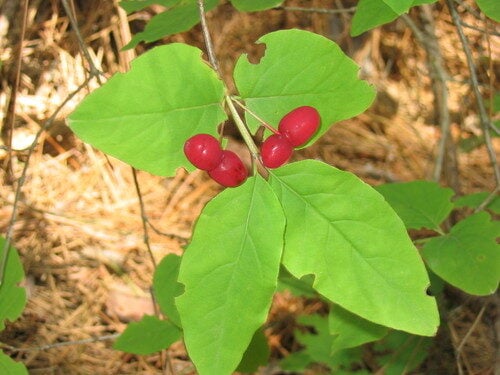
Valeriana eriocarpa
Desv.
Narrow-fruit Cornsalad, Italian corn salad
wikimedia· cc-by-sa
Wikimedia Commons - Andrea Moro
wikimedia· cc-by-sa
Wikimedia Commons - Krzysztof Ziarnek, Kenraiz
Summary
Source: WikipediaValeriana eriocarpa is a species of flowering plant in the family Caprifoliaceae. It is an annual native to western and southern Europe, northwestern Turkey, and north Africa.
Description
A soft annual herb. It grows 20 cm high. It has wide branches. There are rough hairs along the ridges on the stems. The leaves are sword shaped or spoon shaped. They are in a ring near the base. They also are on the stems but smaller and clasping the stem with an ear. The flowers occur as 10-20 very small flowers. They are 1 mm long and lilac in colour. They occur in clusters on the ends of the stems.
Edible Uses
The leaves are used as a lettuce substitute in salads, and larger leaves from plants grown in good soil are used as a potherb.
Traditional Uses
The leaves are used as a substitute for lettuce. They are eaten in salads. The larger leaves in good soil are used as a potherb.
This uses section is brief — help expand it
Distribution
It is a temperate plant. Tasmania Herbarium.
Where It Grows
Africa, Albania, Algeria, Australia, Balkans, Belgium, Britain, Bulgaria, Canary Islands, Caucasus, Chile, Crete, Europe, France, Germany, Greece, Italy, Libya, Mediterranean, Morocco, North Africa, North America, Romania, Sicily, Spain, Switzerland, Tasmania, Tunisia, Turkey, Türkiye, Turkmenistan, USA, Yugoslavia,
Other Information
It is a commercially cultivated vegetable.
Notes
There are about 50-60 Valerianella species. Also put in the family Valerianaceae.
Synonyms
Also Known As
Gaddinedda, Hairy-fruit cornsalad, Spezzaquartari
References (17)
- Bianchini, F., Corbetta, F., and Pistoia, M., 1975, Fruits of the Earth. Cassell. p 52 (As Valerianella eriocarpa)
- Facciola, S., 1998, Cornucopia 2: a Source Book of Edible Plants. Kampong Publications, p 243 (As Valerianella eriocarpa)
- Geraci, A., et al, 2018, The wild taxa utilized as vegetables in Sicily (Italy): a traditional component of the Mediterranean diet. Journal of Ethnobiology and Ethnomedicine (2018) 14:14 (As Valerianella eriocarpa)
- Hanelt, P. et al, (Eds.), 2001, Mansfield's encyclopedia of agricultural and horticultural crops. p 1704 (As Valerianella eriocarpa)
- Harris, S., Buchanan, A., Connolly, A., 2001, One Hundred Islands: The Flora of the Outer Furneaux. Tas Govt. p 244 (As Valerianella eriocarpa)
Show all 17 references Hide references
- Hedrick, U.P., 1919, (Ed.), Sturtevant's edible plants of the world. p 670 (As Valerianella eriocarpa)
- J. Bot. (Desvaux) 2:314, t. 11, fig. 2. 1809 (As Valerianella eriocarpa)
- Kays, S. J., and Dias, J. C. S., 1995, Common Names of Commercially Cultivated Vegetables of the World in 15 languages. Economic Botany, Vol. 49, No. 2, pp. 115-152 (As Valerianella eriocarpa)
- Lazarides, M. & Hince, B., 1993, Handbook of Economic Plants of Australia, CSIRO. p 244 (As Valerianella eriocarpa)
- Lentini, F. and Venza, F., 2007, Wild food plants of popular use in Sicily. J Ethnobiol Ethnomedicine. 3: 15 (As Valerianella eriocarpa)
- Pasta, S., et al, 2020, An Updated Checklist of the Sicilian Native Edible Plants: Preserving the Traditional Ecological Knowledge of Century-Old Agro-Pastoral Landscapes. Frontiers in Plant Science. Volume 11|Article 388 (As Valerianella eriocarpa)
- Plants for a Future database, The Field, Penpol, Lostwithiel, Cornwall, PL22 0NG, UK. http://www.scs.leeds.ac.uk/pfaf/ (As Valerianella eriocarpa)
- Tasmanian Herbarium Vascular Plants list p 58 (As Valerianella eriocarpa)
- USDA, ARS, National Genetic Resources Program. Germplasm Resources Information Network - (GRIN). [Online Database] National Germplasm Resources Laboratory, Beltsville, Maryland. Available: www.ars-grin.gov/cgi-bin/npgs/html/econ.pl (10 April 2000) (As Valerianella eriocarpa)
- Wiersema, J. H. & Leon, B., 2013, World Economic Plants. A Standard Reference CRC Press. 2nd Ed. p 711 (As Valerianella eriocarpa)
- World Checklist of Useful Plant Species 2020. Royal Botanic Gardens, Kew
- Zeven, A. C. & de West, J. M. J., 1982, Dictionary of cultivated plants and their regions of diversity. Wageningen. p 119