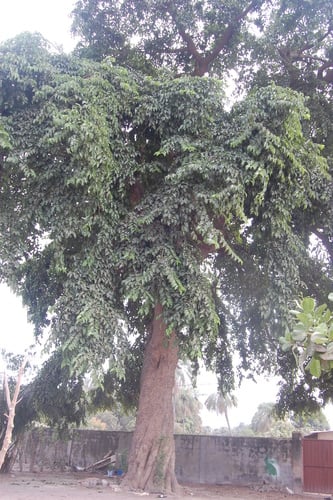
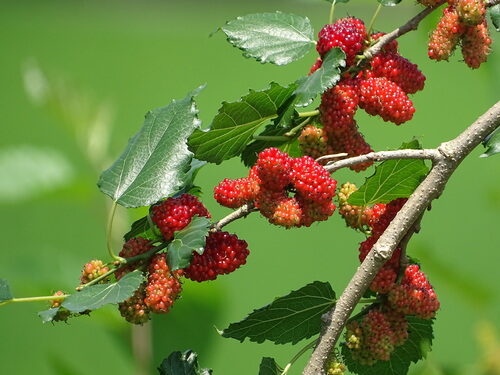
Ficus virgata
Reinw. ex Blume
Large-Leaved Weeping Fig
iNaturalist· cc-by-nc
(c) Graham Bell, some rights reserved (CC BY-NC), uploaded by Graham Bell
iNaturalist· cc-by-nc
(c) 李成華, some rights reserved (CC BY-NC), uploaded by 李成華
iNaturalist· cc0
no rights reserved, uploaded by 葉子
Summary
Source: WikipediaFicus virgata, commonly known as figwood, is a tree in the family Moraceae, native to areas of Southeast Asia and the western Pacific. It usually grows as a strangler on other trees, eventually smothering and killing its host, but may also grow on its own. In Australia it is found from Kutini-Payamu National Park in the northern part of Cape York Peninsula, south along the east coast to Paluma Range National Park, at altitudes from sea level up to about 400 m (1,300 ft). It was named by Dutch botanist Carl Ludwig Blume in 1825.
Description
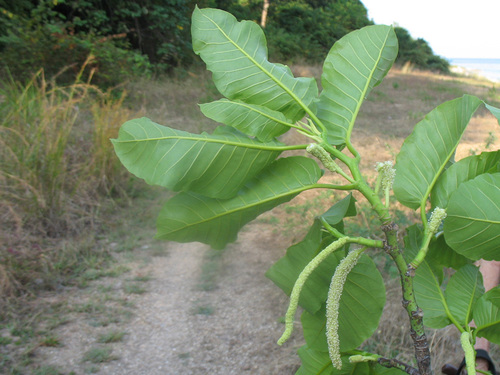
A fig. It is a medium size tree. It grows 10-20 m tall and spreads 10-25 m wide. It has a rounded or pointy crown. It has strangling roots but not aerial roots. The trunk can vary in length and has irregular flanges in it. The bark is grey and leathery. The young shoots are pale green. The leaves are simple and 10-20 cm long by 6-8 cm wide. They are oval. They are dark green and shiny on the upper surface and paler underneath. There is a flat gland where the midrib and first side vein join. The leaf stalks are 0.5-1 cm long. The fig fruit are 2-3 cm across. They are round and pink brown and produced in the axils of leaves. The surface of the fruit is rough. When they are ripe the fruit are orange to dark red.
Edible Uses
The ripe fruit are eaten fresh. The young shoots, particularly leaves under 3 days old, are eaten fresh or cooked in curries.
Traditional Uses
The fruit are eaten. The young shoots are eaten in curries. (Leaves under 3 days are eaten fresh.)
This uses section is brief — help expand it
Distribution
A tropical plant. It grows naturally in tropical rainforests. It is at low elevations.
Where It Grows
Asia, Australia, East Timor, India, Indonesia, Japan (Ryuku), Malaysia, New Caledonia, Pacific, Papua New Guinea, PNG, Philippines, SE Asia, Solomon Islands, Taiwan, Timor-Leste, Vanuatu,
Cultivation
Plants can be grown from seed or by aerial layering. It can also be grown by cuttings.
Propagation
Seed - Cuttings.
Production
In Australia, fruit are produced in all months of the year.
Notes
There are about 800-1000 Ficus species. They are mostly in the tropics. There are 120 Ficus species in tropical America.
Synonyms
Also Known As
Dao rong, Daun ulang-ulang, Diakit, Karahui, Kauis, Liuliu, Loa, Lumaput, Nunok
References (18)
- Beasley, J., 2011, Plants of Tropical North Queensland - the compact guide. Footloose publications. p 98
- Bijdr. 454. 1825
- Borrell, O.W., 1989, An Annotated Checklist of the Flora of Kairiru Island, New Guinea. Marcellin College, Victoria Australia. p 108, 202
- Cabalion, P. and Morat, P., 1983, Introduction le vegetation, la flore et aux noms vernaculaires de l'ile de Pentcoste (Vanuatu), In: Journal d'agriculture traditionnelle et de botanique appliquee JATBA Vol. 30, 3-4
- Cooper W & Cooper W T, 1994, Fruits of the Rain Forest. RD Press p 138
Show all 18 references Hide references
- Cooper, W. and Cooper, W., 2004, Fruits of the Australian Tropical Rainforest. Nokomis Editions, Victoria, Australia. p 328
- Cowie, I, 2006, A Survey of Flora and vegetation of the proposed Jaco-Tutuala-Lore National Park. Timor-Lests (East Timor) www.territorystories.nt/gov.au p 51
- Elliot, W.R., & Jones, D.L., 1992, Encyclopedia of Australian Plants suitable for cultivation. Vol 4. Lothian. p 293
- Flora of Australia, Volume 3, Hamamelidales to Casuarinales, Australian Government Publishing Service, Canberra (1989) p 60
- Flora of China @ efloras.org Volume 5
- GUPTA,
- Jackes, B.R., 2001, Plants of the Tropics. Rainforest to Heath. An Identification Guide. James Cook University. p 67
- Kuo, W. H. J., (Ed.) Taiwan's Ethnobotanical Database (1900-2000), http://tk.agron.ntu.edu.tw/ethnobot/DB1.htm
- Lebot, V. & Sam, C., Green desert or ‘all you can eat’? How diverse and edible was the flora of Vanuatu before human introductions?. Terra australis 52 p 408
- PROSEA handbook Volume 13 Spices. p 255
- Radke, P & A, Sankowsky, G & N., 1993, Growing Australian Tropical Plants. Frith & Frith, Australia. p 38
- Walter, A. & Sam C., 2002, Fruits of Oceania. ACIAR Monograph No. 85. Canberra. p 169
- World Checklist of Useful Plant Species 2020. Royal Botanic Gardens, Kew