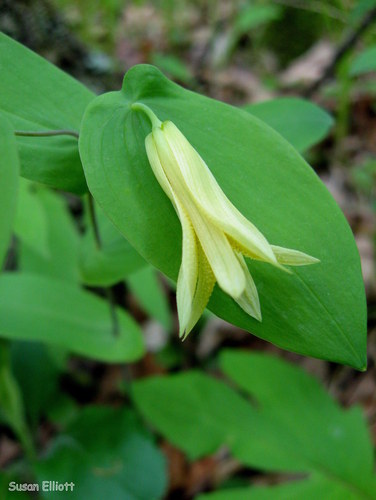
Uvularia sessilifolia
L.
Little Bellwort
iNaturalist· cc-by-nc-nd
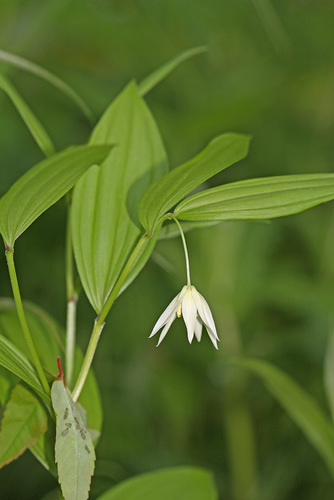
(c) Jason M Crockwell, some rights reserved (CC BY-NC-ND), uploaded by Jason M Crockwell
iNaturalist· cc-by
(c) Michael J. Papay, some rights reserved (CC BY), uploaded by Michael J. Papay
iNaturalist· cc-by-nc
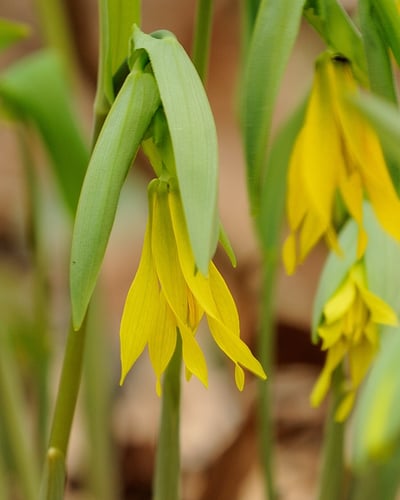
(c) Andrea Tirrell, some rights reserved (CC BY-NC), uploaded by Andrea Tirrell
Summary
Source: WikipediaUvularia sessilifolia, the sessile bellwort, sessileleaf bellwort, little merrybells or wild oats, is a species of bellwort native to eastern and central North America. It grows in woodlands with wet or dry soils. The strap-like leaves are sessile on the stem. The flowers are yellow, narrowly bell-shaped, and creamy yellow, blooming in spring. The leaves have no hairs on the margin and are somewhat narrow, distinguishing this plant from the similar Streptopus. They spread asexually by means of long under ground stolons with most plants in a clonal colony not flowering. Flowering plants often do not set seed, but when plants form seeds they are in three angled fruits. The native range extends from the Atlantic Ocean from Florida to Nova Scotia, west to Texas, The Dakotas and Manitoba . Uvularia sessilifolia 'Blizzard' is a cultivated form with misty variegated foliage.
Description
A herb. It has strap like leaves without a leaf stalk. The flowers are narrowly bell shaped and yellow.
This description is brief — help expand it
Edible Uses
Young shoots are cooked and used as an asparagus substitute; harvest them while still tender enough to snap off with a fingernail. The root is edible cooked or used in diet drinks.
Traditional Uses
The young tender shoots are cooked and served like asparagus. The rootstocks are cooked or used in diet drinks.
This uses section is brief — help expand it
Medicinal Uses
A tea made from the roots acts as a blood purifier and is used to treat diarrhoea. It is also taken internally to help heal broken bones. A poultice of the roots is applied externally to broken bones and boils.
Known Hazards
None listed
Distribution
It is a temperate plant. It suits hardiness zone 3-8.
Where It Grows
Australia, North America, USA,
Cultivation
Requires a cool moist shady position and a light sandy soil. Likes plenty of humus in the soil. Grows well in a deciduous woodland garden and in the rock garden. Plants grow much taller in rich soils and then succeed in the herbaceous border. They can spread quite quickly when in a suitable position. A very hardy plant, tolerating temperatures down to about -20°c. This species is closely related to U. caroliniana.
Propagation
Seed is best sown in a cold frame as soon as it is ripe in summer. Stored seed should be sown in late winter in a cold frame. Prick seedlings out into individual pots once large enough to handle and grow on in a greenhouse for at least their first winter. Plant out into permanent positions in late spring or early summer, after the last expected frosts. Division can be done after the plants die down in late summer, though early spring before flowering is preferred. Larger divisions can go directly into permanent positions; smaller ones are best potted up and grown on in light shade in a greenhouse or cold frame until established, then planted out the following spring.
Other Uses
None known.
Notes
There are 5 Uvularia species. Also put in the family Uvulariaceae.
Synonyms
Also Known As
Little merry bells
References (10)
- Beckstrom-Sternberg, Stephen M., and James A. Duke. "The Foodplant Database." http://probe.nalusda.gov:8300/cgi-bin/browse/foodplantdb.(ACEDB version 4.0 - data version July 1994)
- Duke, J.A., 1992, Handbook of Edible Weeds. CRC Press. p 206
- Facciola, S., 1998, Cornucopia 2: a Source Book of Edible Plants. Kampong Publications, p 145
- Hedrick, U.P., 1919, (Ed.), Sturtevant's edible plants of the world. p 666
- Jackes, D. A., 2007, Edible Forest Gardens
Show all 10 references Hide references
- Kermath, B. M., et al, 2014, Food Plants in the Americas: A survey of the domesticated, cultivated and wild plants used for Human food in North, Central and South America and the Caribbean. On line draft. p 889
- Lim, T. K., 2015, Edible Medicinal and Non Medicinal Plants. Volume 9, Modified Stems, Roots, Bulbs. Springer p 84
- Moerman, D. F., 2010, Native American Ethnobotany. Timber Press. p 582
- Plants for a Future database, The Field, Penpol, Lostwithiel, Cornwall, PL22 0NG, UK. http://www.scs.leeds.ac.uk/pfaf/
- Ryan, S., 2008, Dicksonia. Rare Plants Manual. Hyland House. p 117