Urospermum dalechampii
(L.) Scop.
Urospermum, False dandelion
iNaturalist· cc0
no rights reserved, uploaded by Nico
iNaturalist· cc-by-nc
(c) ortie75, some rights reserved (CC BY-NC)
iNaturalist· cc-by-nc
(c) Giuseppe Buscemi, some rights reserved (CC BY-NC)
Summary
Source: WikipediaUrospermum dalechampii, the smooth golden fleece or simply the golden-fleece, is a perennial herbaceous plant belonging to the genus Urospermum of the family Asteraceae.
Description
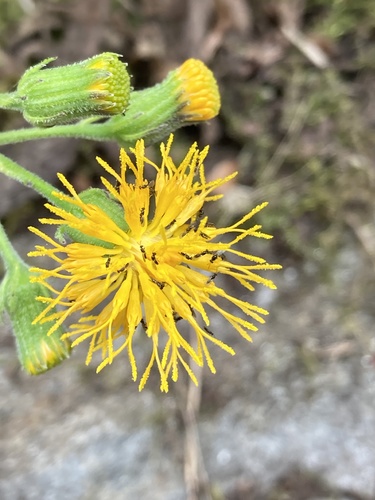
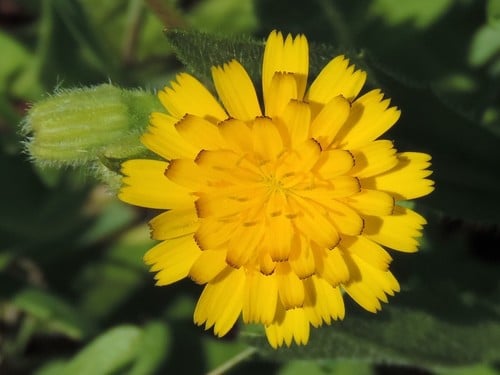
A low herb which keeps growing from year to year. The leaves at the base are divided into lobes along the stalk. The lobes point backwards. The leaves on the stem are oval or sword shaped. They clasp the stem and the upper leaves are opposite. The flower heads are yellow and often they have a black centre. They are 35-50 mm across and occur singly. The florets are all rayed. The outer florets have a reddish-brown underneath. The flower bracts are sword shaped and softly hairy. The achenes have long beaks. The fruit are 13-19 mm long.
Edible Uses
The leaves can be eaten raw and used in salads, though they are very bitter.
Traditional Uses
The leaves are boiled in mixtures.
This uses section is brief — help expand it
Medicinal Uses
None known
Distribution
It is a temperate plant. It grows on fallow land and waste ground. Tasmania Herbarium.
Where It Grows
Australia, Europe, France, Greece, Italy, Mediterranean, Sicily, Spain, Tasmania, Turkey, Türkiye, Yugoslavia,
Propagation
No specific information is available for this species, but sowing seed in situ is suggested — either as soon as it is ripe in late summer or in spring. Division is also an option.
Other Uses
None known
Synonyms
Also Known As
Cento coglioni, Cicoria sarvaggia, Cicuriune gentile, Cicuriune riccio, Cuosti i porci, Russeddha
References (11)
- Biscotti, N. & Pieroni, A., 2015, The hidden Mediterranean diet: wild vegetables traditionally gathered and consumed in the Gargano area, Apulia, SE Italy. Acta Societatis Botanicorum Poloniae 84 (3): 327-338
- Biscotti, N. et al, 2018, The traditional food use of wild vegetables in Apulia (Italy) in the light of Italian ethnobotanical literature. Italian Botanist 5:1-24
- Blamey, M and Grey-Wilson, C., 2005, Wild flowers of the Mediterranean. A & C Black London. p 461
- Geraci, A., et al, 2018, The wild taxa utilized as vegetables in Sicily (Italy): a traditional component of the Mediterranean diet. Journal of Ethnobiology and Ethnomedicine (2018) 14:14
- Lentini, F. and Venza, F., 2007, Wild food plants of popular use in Sicily. J Ethnobiol Ethnomedicine. 3: 15
Show all 11 references Hide references
- Nebel, S., Pieroni, A. & Heinrich, M., 2006, Ta cho`rta: Wild edible greens used in the Graecanic area in Calabria, Southern Italy. Appetite 47 (2006) 333–342
- Pasta, S., et al, 2020, An Updated Checklist of the Sicilian Native Edible Plants: Preserving the Traditional Ecological Knowledge of Century-Old Agro-Pastoral Landscapes. Frontiers in Plant Science. Volume 11|Article 388
- Pieroni, A., 1999, Gathered wild food plants in the Upper Valley of the Serchio River (Garfagnana), Central Italy. Economic Botany 53(3) pp 327-341
- Pieroni, A., et al, 2005, Food for two seasons: Culinary uses of non-cultivated local vegetables and mushrooms in a south Italian village. International Journal of Food Sciences and Nutrition, 56(4): 245-272
- Plants for a Future database, The Field, Penpol, Lostwithiel, Cornwall, PL22 0NG, UK. http://www.scs.leeds.ac.uk/pfaf/
- Tasmanian Herbarium Vascular Plants list p 15