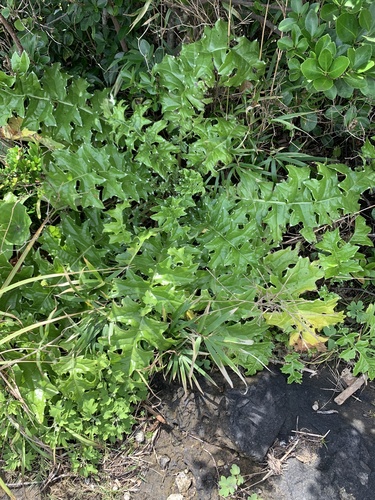
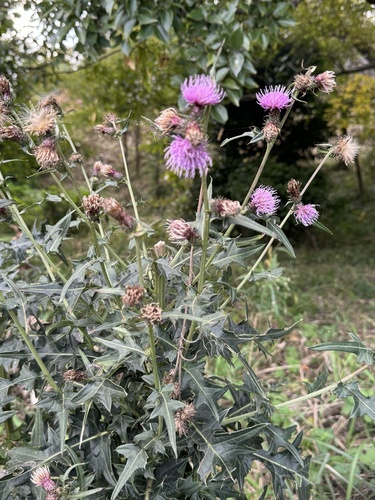
Tanacetum balsamita
L.
Painted Daisy, Pyrethrum, Alecost, Costmary
iNaturalist· cc-by-sa
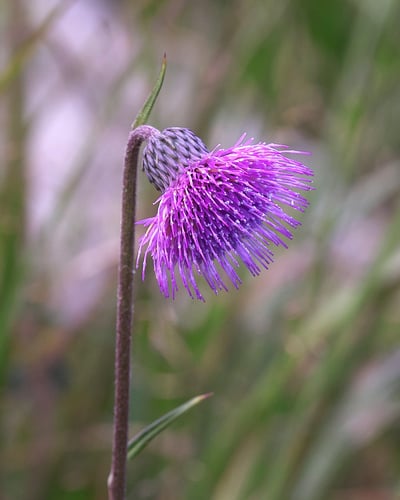
(c) Stanislav Doronenko, some rights reserved (CC BY-SA)
iNaturalist· cc-by-sa
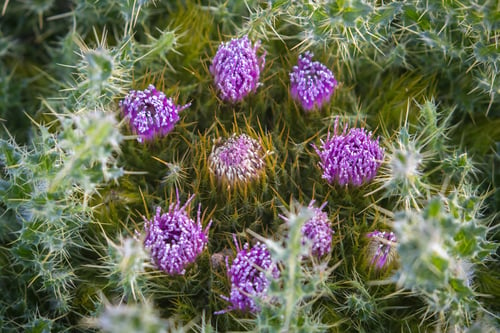
(c) Finitor, some rights reserved (CC BY-SA)
iNaturalist· cc-by
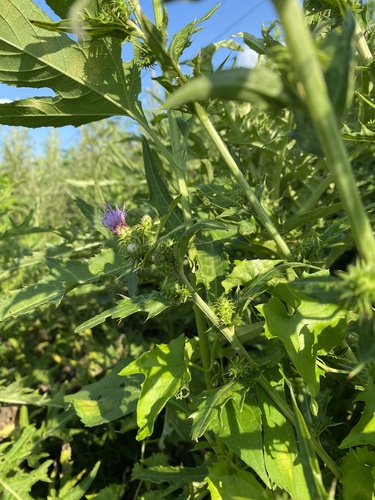
(c) InAweofGod'sCreation, some rights reserved (CC BY)
Summary
Source: WikipediaTanacetum balsamita is a perennial temperate herb known as costmary, alecost, balsam herb, bible leaf, or mint geranium. A fragrant plant native to southern Europe and western Asia, it has been used over centuries for culinary, aromatic, and traditional medicine purposes.
Description
A herb. It grows 90 cm high and spreads 45 cm high. It forms hard mats and keeps growing from year to year. It has rhizomes or underground stems. The leaves are silvery grey and scalloped along the edge. They are slightly hairy. They have an aroma. The leaves can be 30 cm long. The flowers are white and button like. The occur in large numbers and are small. They are yellow in the centre. The flowers open in full sunlight. The seeds are triangle shaped and ribbed.
Edible Uses
Leaves can be used raw or as a flavouring in soups, beer, and similar preparations. Chopped sparingly, they make a pleasant addition to salads, though their aroma can easily overpower a dish. The leaves were once widely used in brewing beer before hops (Humulus lupulus) became standard. Whole leaves laid in cake tins will gently flavour a cake as it bakes. The flower petals are suitable for making conserves. Dried leaves make a delicious tea.
Traditional Uses
The leaves are occasionally used in salads. They are used in small amounts. They are also used in meat and vegetable dishes. The leaves are used to flavour beers and also soups and sauces. The leaves are sweet and have a minty-lemony flavour and are used in salads, teas, and for flavouring meats and cakes. Whole leaves are laid under cakes while cooking to flavour cakes while baking. The dried leaves are used as an infusion for tea. The leaves are used in frittata in mixtures. Flower petals are used for conserves.
Medicinal Uses
Alecost is seldom used in herbal medicine, though it does benefit the digestive system. The leaves are antiseptic, astringent, digestive, and laxative. They have been taken internally as an aperient for dysentery and as a remedy for liver and gall bladder complaints. Externally, they have been made into a salve for burns and insect stings. The plant is now considered virtually obsolete in modern herbalism.
Distribution
It is a temperate plant. It will grow in most well-drained soils. It does best in an open sunny position. It is resistant to frost but sensitive to drought. It suits hardiness zones 6-10. In Hobart Botanical gardens.
Where It Grows
Argentina, Asia*, Australia, Britain, Caucasus, Europe, France, Germany, Italy, Mediterranean, Netherlands, North America, Portugal, South America, Spain, SW Asia, Switzerland, Tasmania, Turkey, Türkiye, USA,
Cultivation
An easily grown plant, it prefers a sunny warm position in a dry soil but thrives under most conditions. Tolerates a pH in the range 5.0 to 7.6. The leaves emit a soft balsamic odour. The sub-species T. balsamita tomentosum is called the camphor plant because of its camphor-scented foliage. Plants produces lot of leaves but no flowers when grown in the shade, though this is an advantage when the plant is being grown for its useful leaves. Alecost used to be commonly grown in the herb garden but it has fallen out of favour in recent times.
Propagation
Seed is seldom produced in Britain, but if obtained it is best sown in a cold frame in early spring. Prick seedlings into individual pots when large enough and grow on in a greenhouse through their first winter, then plant out in late spring or early summer after the last expected frosts. Division can be done in spring or autumn and is very easy — it succeeds at almost any time of year. Larger divisions can go directly into permanent positions; smaller ones are best potted up and grown on in light shade in a greenhouse or cold frame until established, then planted out in summer or the following spring. For basal cuttings in late spring, harvest shoots with plenty of underground stem when about 8–10cm above ground, pot into individual pots, and keep in light shade in a cold frame or greenhouse until rooting well before planting out in summer.
Other Uses
The plant has traditionally been used for its insecticidal properties. Dried leaves retain their fragrance well and are used in pot-pourri and as a strewing herb.
Other Information
IT is cultivated.
Notes
There are about 70 Tanacetum species.
Synonyms
Also Known As
Alecost, Bible leaf, Costamary, Erba di Santa Maria, Herba cuquera, Menta cuquera
References (22)
- Abbet, C., et al, 2014, Ethnobotanical survey on wild alpine food plants in Lower and Central Valais (Switzerland). Journal of Ethnopharmacology 151 (2014) 624–634
- Actes Soc. Hist. Nat. Paris 1:8. 1792 (As Balsamita major)
- Bonet, M. A. & Valles, J., 2002, Use of non-crop food vascular plants in Montseny biosphere reserve (Catalonia, Iberian Peninsula). International Journal of Food Sciences and Nutrition (2002) 53, 225–248
- Bremness, L., 1994, Herbs. Collins Eyewitness Handbooks. Harper Collins. p 220
- Brickell, C. (Ed.), 1999, The Royal Horticultural Society A-Z Encyclopedia of Garden Plants. Convent Garden Books. p 999
Show all 22 references Hide references
- Cundall, P., (ed.), 2004, Gardening Australia: flora: the gardener's bible. ABC Books. p 1399
- Esperanca, M. J., 1988. Surviving in the wild. A glance at the wild plants and their uses. Vol. 1. p 286 (As Chrysanthemum balsamita)
- Facciola, S., 1998, Cornucopia 2: a Source Book of Edible Plants. Kampong Publications, p 34 (As Balsamita major)
- Hedrick, U.P., 1919, (Ed.), Sturtevant's edible plants of the world. p 187 (As Chrysanthemum balsamita)
- Hibbert, M., 2002, The Aussie Plant Finder 2002, Florilegium. p 66, 297
- Kiple, K.F. & Ornelas, K.C., (eds), 2000, The Cambridge World History of Food. CUP p 432, 1763 (As Chrysanthemum balsamita)
- Kybal, J., 1980, Herbs and Spices, A Hamlyn Colour Guide, Hamlyn Sydney p 70 (As Chrysanthemum balsamita)
- Lim, T. K., Edible Medicinal and Non-Medicinal Plants Volume 7 Flowers (As Balsamita major)
- Pieroni, A., 1999, Gathered wild food plants in the Upper Valley of the Serchio River (Garfagnana), Central Italy. Economic Botany 53(3) pp 327-341 (As Balsamita major)
- Plants for a Future database, The Field, Penpol, Lostwithiel, Cornwall, PL22 0NG, UK. http://www.scs.leeds.ac.uk/pfaf/
- Pukalskas, A., et al, 2010, Isolation. identification and activity of natural antioxidants from costmary (Chrysanthemum balsamita) cultivated in Lithuania. Food Chemistry 122: 804-811 (As Chrysanthemum balsamita)
- Sansanelli, S., et al, 2014, Wild food plants traditionall consumed in the area of Bologna (Emilia Romagna region, Italy). Journal of Ethnobiology and Ethnomedicine 10:69
- Sp. pl. 2:845. 1753
- Sp. pl. ed. 2, 2:1252. 1763 (As Chrysanthemum balsamita)
- van Wyk, B., 2005, Food Plants of the World. An illustrated guide. Timber press. p 131 (As Chrysanthemum balsamita)
- Wiersema, J. H. & Leon, B., 2013, World Economic Plants. A Standard Reference CRC Press. 2nd Ed. p 675
- World Checklist of Useful Plant Species 2020. Royal Botanic Gardens, Kew