Ulva australis
Areschoug
Green algae, Sea cabbage, Lacy sea lettuce
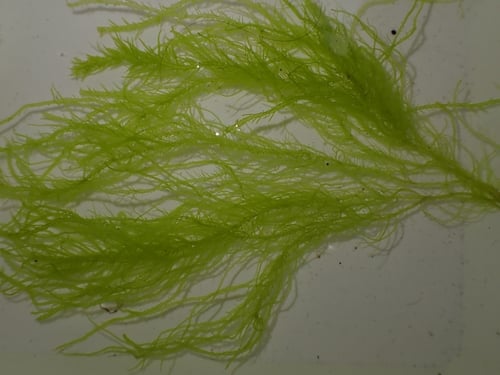
iNaturalist· cc-by-nc
(c) Wayne Martin, some rights reserved (CC BY-NC), uploaded by Wayne Martin
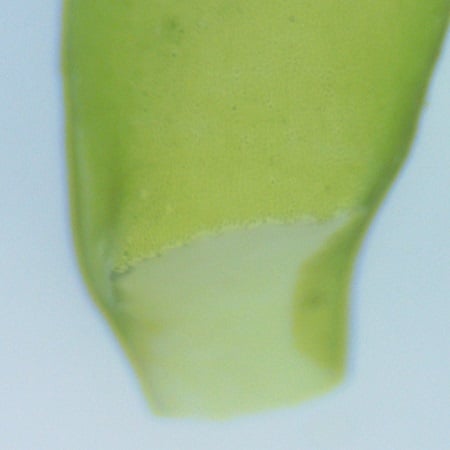
iNaturalist· cc-by-nc
(c) Wayne Martin, some rights reserved (CC BY-NC)
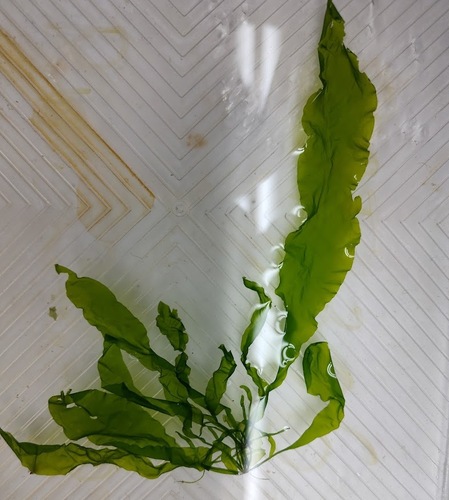
iNaturalist· cc-by-nc
(c) Wayne Martin, some rights reserved (CC BY-NC)
Summary
Source: WikipediaUlva australis, the southern sea lettuce, is a species of bright green coloured seaweed in the family Ulvaceae that can be found in waters around Australia and was first described by Swedish botanist Johan Erhard Areschoug. It is an edible green algae, although sometimes designated as a seaweed. General characteristics of Ulva australis include a smooth surface, distromatic blades, lobed fronds, and thallus color from dark green to light grass green. It can be either free floating or attached by a single holdfast. Its cells appear to be irregularly arranged, have rounded edges, and have shapes such as rectilinear, square, and pentagonal. It has been researched for a number of scientific properties in distinct fields such as environmental protection, medicine, and pharmacology. Ulva rigida has sometimes been confused with this species.
Description
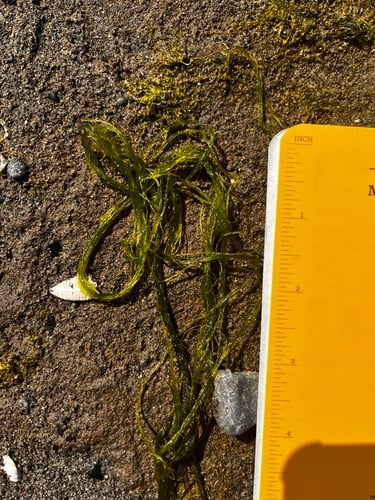
A bright green seaweed with irregular lobes found in tropical and temperate intertidal zones, growing on rocks, shells, and in shallow pools. It occurs in northern China and other coastal regions.
Edible Uses
The whole plant is lightly cooked and eaten.
Traditional Uses
The whole plant is slightly cooked then eaten.
This uses section is brief — help expand it
Distribution
It grows in tropical and temperate places. It grows in shallow water in the intertidal zone. It grows on shells and rocks. It can be in intertidal pools. It grows in northern China.
Where It Grows
Africa, Asia, Canada, China, East Africa, Europe, France, Indonesia, Japan, Kenya, Korea, Mauritius, Middle East, Netherlands, New Zealand, North America, Philippines, SE Asia, Singapore, Spain, Sri Lanka, Taiwan, Tanzania, USA, Yemen,
Synonyms
Also Known As
Ana-awosa, Awosa
References (9)
- Crowe, A., 1997, A Field Guide to the Native Edible Plants of New Zealand. Penguin. p 152 (As Ulva pertusa)
- Fujiwara-Arasaki, T. et al, 1984, The protein value in human nutrition of edible marine algae in Japan. Hydrobiologia 116/117, 513-516 (As Ulva pertusa)
- http://www.seavegetables.com (As Ulva pertusa)
- Hu, Shiu-ying, 2005, Food Plants of China. The Chinese University Press. p 258 (As Ulva pertusa)
- Nagai, T., and Yukimoto, T., 2003, Preparation and functional properties of beverages made from sea algae. Food Chemistry 81:327-332 (As Ulva pertusa)
Show all 9 references Hide references
- Pereira, L., 2011, A Review of the Nutrient Composition of Selected Edible Seaweeds. In Seaweed. Pomin V. H., (Ed.) Nova Science Publishers, Inc (As Ulva pertusa)
- Wang, Wei-Lung and Chiang, Young-Meng, 1994, Potential Economic Seaweeds of Hengchun Peninsula, Taiwan, Economic Botany, Vol. 48, No. 2, pp. 182-189 (As Ulva pertusa)
- Xia, B., and Abbott, I.A., 1987, Edible seaweeds of China and their place in the Chinese diet. Economic Botany 41:341-53 (As Ulva pertusa)
- Zemke-White, W. L. & Ohno, M., 1999, World seaweed utilisation: An end-of-century summary. Journal of Applied Phycology 11: 369-376 (As Ulva pertusa)