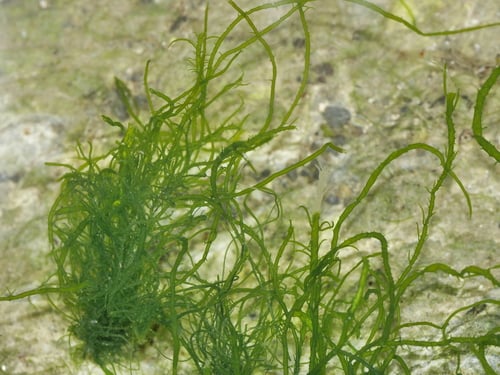
Enteromorpha compressa
(L.) Grev.
Green algae, Stone hair, Green nori
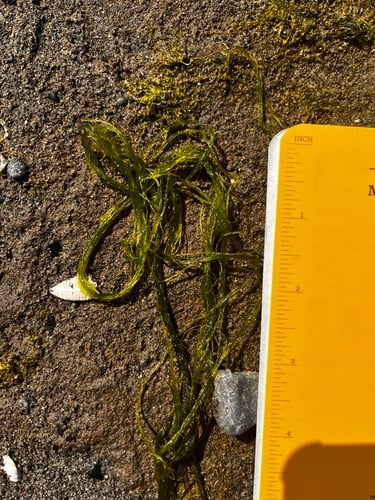
iNaturalist· cc-by
(c) Shaun, some rights reserved (CC BY)
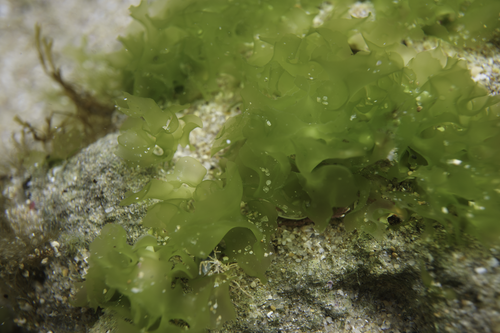
iNaturalist· cc-by
(c) Shaun, some rights reserved (CC BY)
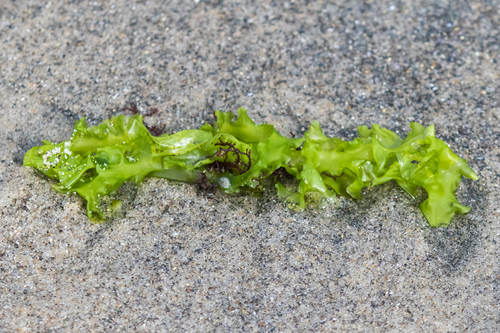
iNaturalist· cc-by-nc
(c) Joseph Knight, some rights reserved (CC BY-NC)
Description
A green seaweed in the Ulvaceae family that grows in shallow water in quiet seaside areas of tropical regions. It is rich in protein and minerals.
This description is brief — help expand it
Edible Uses
It can be eaten raw, dried or cooked. The dried algae is powdered and sprinkled on rice, savoury cakes and rice crackers.
Traditional Uses
It can be eaten raw, dried or cooked. The dried algae is powdered and sprinkled on rice, savoury cakes and rice crackers.
This uses section is brief — help expand it
Distribution
A tropical plant. It grows in shallow water in quiet seaside areas.
Where It Grows
Africa, Antarctica, Asia, Cape Verde, China, Ghana, Indonesia, Japan, Korea, Malaysia, Mediterranean, New Zealand, Pacific, Papua New Guinea, PNG, Philippines, SE Asia, Taiwan, West Africa,
Notes
It is rich in protein and minerals.
Also Known As
Hira-ao-nori, Lumot
References (15)
- Burkill, H. M., 1985, The useful plants of west tropical Africa, Vol. 5. Kew.
- Burkill, I.H., 1966, A Dictionary of the Economic Products of the Malay Peninsula. Ministry of Agriculture and Cooperatives, Kuala Lumpur, Malaysia. Vol 1 (A-H) p 943
- Crowe, A., 1997, A Field Guide to the Native Edible Plants of New Zealand. Penguin. p 146
- Facciola, S., 1998, Cornucopia 2: a Source Book of Edible Plants. Kampong Publications, p 261
- Hedrick, U.P., 1919, (Ed.), Sturtevant's edible plants of the world. p 290
Show all 15 references Hide references
- http://www.seavegetables.com
- Hu, Shiu-ying, 2005, Food Plants of China. The Chinese University Press. p 258
- Kiple, K.F. & Ornelas, K.C., (eds), 2000, The Cambridge World History of Food. CUP p 234
- Surey-Gent, S. & Morris G., 1987, Seaweed. A User's Guide. Whirret Books. London. p 24
- Tanaka,
- Velasquez, G.T., 1972, Studies and utilization of the Philippine marine algae. In Proceedings of the Seventh International Seaweed Symposium, ed. K Nisizawa, 62-5. New York.
- Wang, Wei-Lung and Chiang, Young-Meng, 1994, Potential Economic Seaweeds of Hengchun Peninsula, Taiwan, Economic Botany, Vol. 48, No. 2, pp. 182-189
- Zemke-White, W. L. & Ohno, M., 1999, World seaweed utilisation: An end-of-century summary. Journal of Applied Phycology 11: 369-376
- Xia, B., and Abbott, I.A., 1987, Edible seaweeds of China and their place in the Chinese diet. Economic Botany 41:341-53
- Zaneveld, J.S., 1955, Economic marine algae of tropical South and East Asia and their utilization. Indo-Pacific Special Publications, No 3 Bangkok.