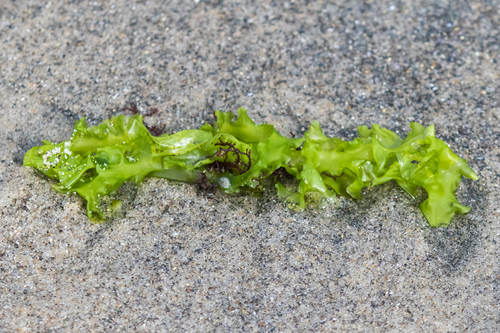
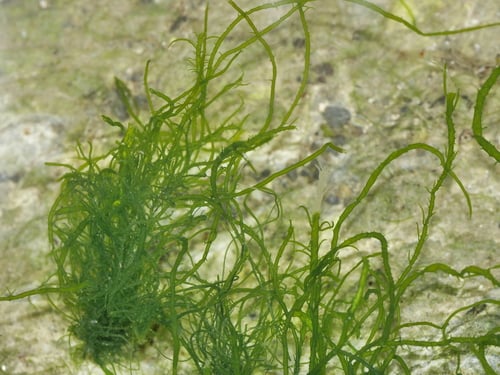
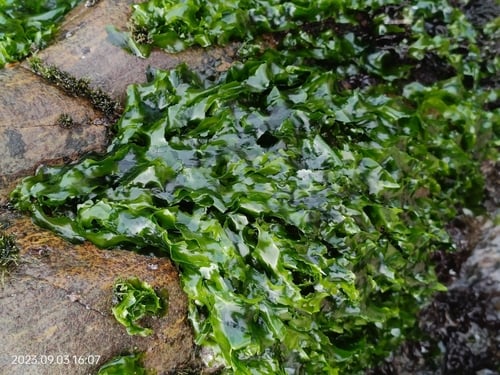
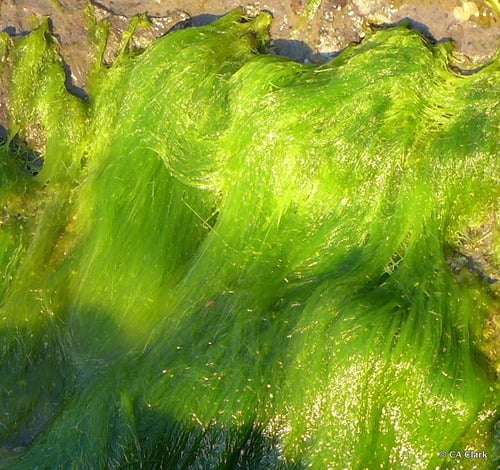
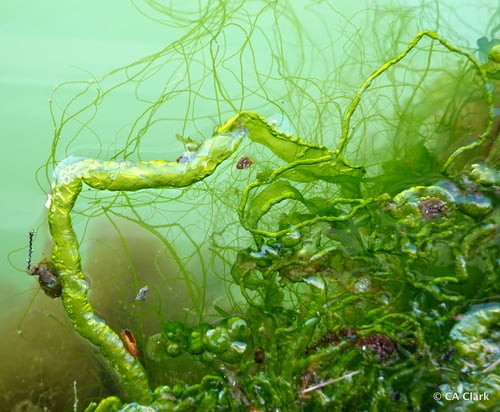
Enteromorpha linza
(L.) J. Agardh
Green algae
iNaturalist· cc-by-nc
(c) ryeung, some rights reserved (CC BY-NC)
iNaturalist· cc-by-nc
(c) ryeung, some rights reserved (CC BY-NC)
iNaturalist· cc-by-nc
(c) ryeung, some rights reserved (CC BY-NC)
Description
A seaweed in the Ulvaceae family that grows in temperate regions and is hollow where it tapers towards the base. It contains approximately 20% protein.
Edible Uses
The species is edible and therefore can be used as food and in cosmetic products. Ulva linza is used as a model organism for biofouling in marine environments. It has been found on a variety of man-made structures including ships’ hulls.
Traditional Uses
It is used in soups and cooked with meat or fish. It is dried and powdered for later use. It is used to add a salty topping to bread.
This uses section is brief — help expand it
Distribution
It is a temperate plant.
Where It Grows
Antarctica, Asia, Australia, China, Korea, Mediterranean, Taiwan,
Notes
It is about 20% protein.
Synonyms
Also Known As
Ipparae, Usuba-ao-nori
References (8)
- Facciola, S., 1998, Cornucopia 2: a Source Book of Edible Plants. Kampong Publications, p 261
- Fuhrer, B.A. et al, 1981, Seaweeds of Australia. Reed. p 90
- http://www.seavegetables.com
- Song, M., et al, 2013, Traditional knowledge of wild edible plants in Jeju Island, Korea. Indian Journal of Traditional Knowledge. 12(2) pp 177-194
- Surey-Gent, S. & Morris G., 1987, Seaweed. A User's Guide. Whirret Books. London. p 24
Show all 8 references Hide references
- Wang, Wei-Lung and Chiang, Young-Meng, 1994, Potential Economic Seaweeds of Hengchun Peninsula, Taiwan, Economic Botany, Vol. 48, No. 2, pp. 182-189
- Xia, B., and Abbott, I.A., 1987, Edible seaweeds of China and their place in the Chinese diet. Economic Botany 41:341-53
- Zemke-White, W. L. & Ohno, M., 1999, World seaweed utilisation: An end-of-century summary. Journal of Applied Phycology 11: 369-376