Typhonium trilobatum
(L.) Schott
Three-lobed Typhonium
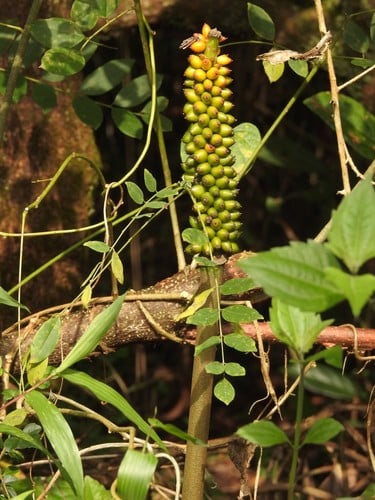
iNaturalist· cc-by-nc
(c) guanhong, some rights reserved (CC BY-NC), uploaded by guanhong
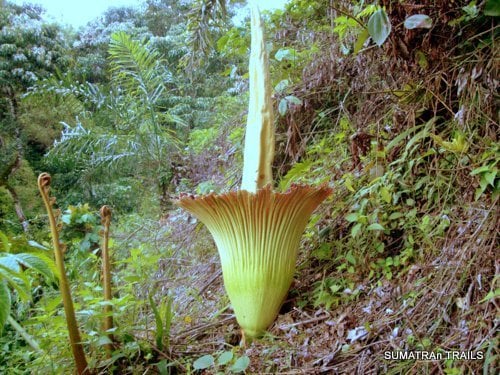
iNaturalist· cc-by-nc
(c) wenp, some rights reserved (CC BY-NC)
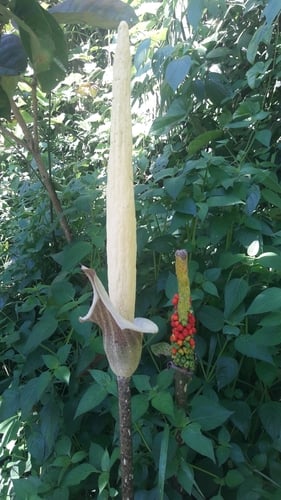
iNaturalist· cc-by-nc
(c) wenp, some rights reserved (CC BY-NC)
Description
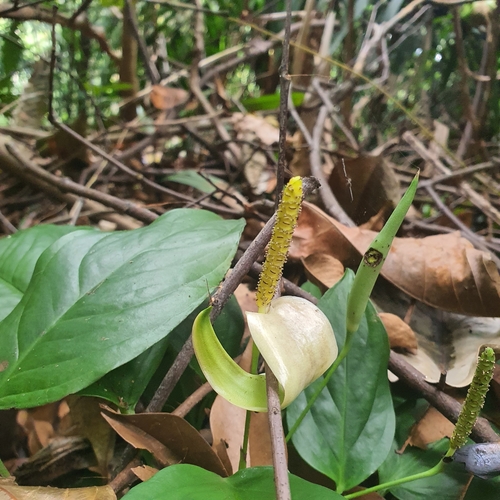
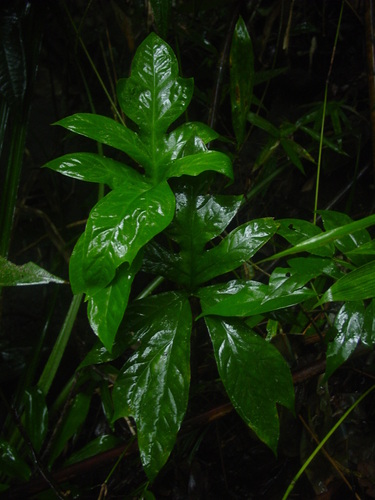
A fleshy annual herb. It grows 30-50 cm high. It grows from an underground tuber. This is several cm across. The leaf stalks are 40 cm long. The leaves are arrow shaped. They have 3 lobes. The leaves are 20 cm long by 10 cm wide. The flowers are reddish. They are in a spike. It has a large, brown spathe. The fruit is a green berry with purple spots. There are 1-2 seeds.
Edible Uses
The dried sliced tubers are eaten after cooking and drying to remove their acrid taste. The tender leaves are boiled and eaten or made into pickles. The leaf stalks and flower stalks are also cooked and eaten.
Traditional Uses
The dried sliced corms are eaten after cooking. They need drying to remove the acrid taste. The tender leaves are boiled and eaten. They are also used to make pickles. The leaf stalk and the spadix are cooked and eaten.
Medicinal Uses
It is used as a functional food.
Known Hazards
All parts of the plant contain calcium oxalate crystals. This substance is toxic fresh and, if eaten, makes the mouth, tongue and throat feel as if hundreds of small needles are digging in to them. However, calcium oxalate is easily broken down either by thoroughly cooking the plant or by fully drying it and, in either of these states, it is safe to eat the plant. People with a tendency to rheumatism, arthritis, gout, kidney stones and hyperacidity should take especial caution if including this plant in their diet.
Distribution
It is a tropical plant. It grows in shady, waste places. It grows in wetland. It grows in the lowland. It grows up to 700 m above sea level. In Yunnan.
Where It Grows
Africa, Asia, Bangladesh, Bhutan, Cambodia, Central America, China, Côte d'Ivoire, Himalayas, India, Indochina, Indonesia, Ivory Coast, Laos, Malaysia, Myanmar, Nepal, Northeastern India, Pacific, Philippines, SE Asia, Singapore, Sri Lanka, Thailand, Trinidad, Vietnam, West Africa,
Cultivation
Plants can be grown from seeds.
Propagation
Seed - Division of offsets in the dormant season
Other Information
It is sold in local markets.
Notes
There are about 50 Typhonium species. The rhizome is 69.9% water, protein 1.4%, fat 0.1%, carbohydrates 26%, minerals 1.6%. It is a functional food.
Synonyms
Also Known As
Bengal arum, Bo:n biew, C(ur) ch(os)c, Chakad, Chamghas, Durada-kandagadda, Gabi-gabihan, GHatkol, Gherkochoo, Ghet kachu, Ghiu kasu, Kandagadde, Karunai-kizhangu, Karunakizhanga, Keladi puyuh, Khakron, Khammam, Kharkol, Lheng, Mahora, Nirbis, Keladi puyuh, Samah, Sam ghas, Sam kochu, Samakosu, Syam kachu, Tel-hawng-nu, Thithe, Utaphit, Uttaphit
References (37)
- Ambasta, S.P. (Ed.), 2000, The Useful Plants of India. CSIR India. p 659
- Anderson, E. F., 1993, Plants and people of the Golden Triangle. Dioscorides Press. p 223
- Bandyopadhyay, S. et al, 2009, Wild edible plants of Koch Bihar district, West Bengal. Natural Products Radiance 8(1) 64-72
- Banerjee, A., et al, 2013, Ethnobotanical Documentation of Some Wild Edible Plants in Bankura District, West Bengal, India. The Journal of Ethnobiology and Traditional Medicine. Photon 120 (2013) 585-590
- BARC, 2016, State of Biodiversity for Food and Agriculture in Bangladesh. Bangladesh Agricultural Research Council.
Show all 37 references Hide references
- Baro, D., Baruah, S. and Borthukar, S. K. 2015, Documentation on wild vegetables of Baksa district, BTAD (Assam). Scholars Research Library. Archives of Applied Science Research, 2015, 7 (9):19-27
- Brown, D., 2000, Aroids. Plants of the Arum family. Timber Press. (Second edition) p 270
- Burkill, H. M., 1985, The useful plants of west tropical Africa, Vol. 1. Kew.
- Burkill, I.H., 1966, A Dictionary of the Economic Products of the Malay Peninsula. Ministry of Agriculture and Cooperatives, Kuala Lumpur, Malaysia. Vol 2 (I-Z) p 2235
- Chatterjee, R., et al, 2016, Diversity of Vegetable Crop in Home Gardens of Sub Himalayan Districts of West Bengal, India. Int. J. Horti. and Plant Sci.: Vol. 1, No. 1, p. 9-16, October 2016
- Chowdery, T., et al, 2014, Wild edible plants of Uttar Dinajpur District, West Bengal. Life Science Leaflets. 47:pp 20-36 http://lifesciencesleaflets.ning.com
- Chowdhury, A. & Das, A. P., 2014, Conservation through sustainable utilization of wetland leafy vegetables of Terai and Duars, West Bengal, India. International Journal of Advanced Life Sciences (IJALS), 7(4) p 657
- Chowdhury, M. & Mukherjee, R., 2012, Wild Edible Plants Consumed by Local Communities of Maldah of West Bengal, India. Indian J.Sci.Res.3(2) : 163-170
- Crevost & Lemarie, 1925, p 148
- Deka, N. & Devi, N., 2015, Wild edible aquatic and marshland angiosperms of Baka district, BTC area, Assam, India. Asian J. Plant Sci. Res. 5(1):32-48
- Dutta, U., 2012, Wild Vegetables collected by the local communities from the Churang reserve of BTD, Assam. International Journal of Science and Advanced Technology. Vol. 2(4) p 124
- Ghosh, C. & Das A. P., 2011, Some useful and poisonous tea garden weeds from the Darjiling District of West Bengal, India. Pleione 5(1): 91 - 114
- Grubben, G. J. H. and Denton, O. A. (eds), 2004, Plant Resources of Tropical Africa 2. Vegetables. PROTA, Wageningen, Netherlands. p 565
- Hossain, U. & Rahman, A., 2018, Study and quantitative analysis of wild vegetable floral diversity available in Barisal district, Bangladesh. Asian J. Med. Biol. Res. 2018, 4 (4), 362-371
- JSTOR Global Plants edible
- Kar, A., et al, 2013, Wild Edible Plant Resources used by the Mizos of Mizoram, India. Kathmandu University Journal of Science, Engineering and Technology. Vol. 9, No. 1, July, 2013, 106-126
- Kumar, S. A., Manus, D. & Mallika, M., 2018, Impact of non-timber forest products on Forest and in Livelihood Economy of the People of Adjoining Areas of Jalpaiguri Forest Division, West Bengal, India. Int. J. of Life Sciences, 2018; 6 (2):365-385
- Lim, T. K., 2015, Edible Medicinal and Non Medicinal Plants. Volume 9, Modified Stems, Roots, Bulbs. Springer p 84
- Lugod, G.C. and de Padua L.S., 1979, Wild Food Plants in the Philippines. Vol. 1. Univ. of Philippines Los Banos. p 16
- Macmillan, H.F. (Revised Barlow, H.S., et al), 1991, Tropical Planting and Gardening. Sixth edition. Malayan Nature Society. Kuala Lumpur. p 357
- McMakin, P.D., 2000, Flowering Plants of Thailand. A Field Guide. White Lotus. p 89
- Martin, F.W. & Ruberte, R.M., 1979, Edible Leaves of the Tropics. Antillian College Press, Mayaguez, Puerto Rico. p 176
- Partha, P., 2014, Ethnobotany of the Laleng (Patra) Community in Bangladesh. Journal of Pharmacognosy and Phytochemistry. 2(6):173-184
- Patiri, B. & Borah, A., 2007, Wild Edible Plants of Assam. Geethaki Publishers. p 159
- PROSEA handbook Volume 9 Plants yielding non-seed carbohydrates. p 181
- Rahmatullah, M., et al, 2009, A survey of medicinal plants in two areas of Dinajpur district, Bangladesh including plants which can be used as functional foods. American-Eurasian Journal of Sustainable Agriculture, 3(4): 862-876
- Sakar, A. & Das, A. P., 2018, The traditional knowledge on edible wild leafy vegetables of Rabha Tribe in Duars of North Bengal: a potential reinforcement to food security. Pleione 12(2): 275 - 281. 2018.
- Sukarya, D. G., (Ed.) 2013, 3,500 Plant Species of the Botanic Gardens of Indonesia. LIPI p 1140
- Terra, G.J.A., 1973, Tropical Vegetables. Communication 54e Royal Tropical Institute, Amsterdam, p 80
- Wiener Z. Kunst. 1829 (Drittes Quart. fasc. 88):732. 1829
- World Checklist of Useful Plant Species 2020. Royal Botanic Gardens, Kew
- Xu, Z., Tao, G. & Tan, J., 1988, Tropical Wild Flowers and Plants in Xishuangbanna, Agricultural Publishing House. photo 42