Amorphophallus paeoniifolius
(Decne.) Nicolson
Elephant foot yam
iNaturalist· cc-by-nc
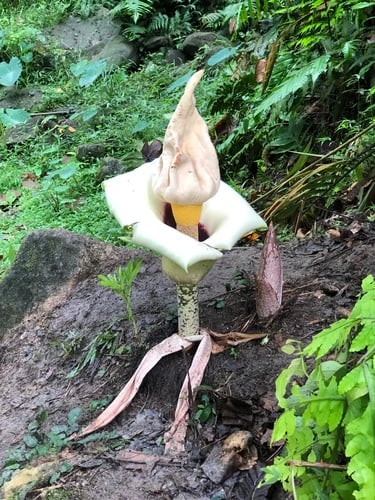
(c) 南门野客, some rights reserved (CC BY-NC), uploaded by 南门野客
iNaturalist· cc-by-nc
(c) Damon Tighe, some rights reserved (CC BY-NC), uploaded by Damon Tighe
iNaturalist· cc-by-nc
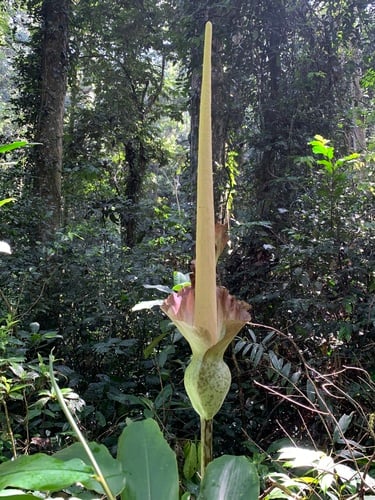
(c) onidiras-iNaturalist, some rights reserved (CC BY-NC), uploaded by onidiras-iNaturalist
Summary
Source: WikipediaAmorphophallus paeoniifolius, the elephant foot yam or whitespot giant arum, is a tropical plant native to Island Southeast Asia. It is cultivated for its edible tubers in Southeast Asia, South Asia, Madagascar, New Guinea, and the Pacific islands. Because of its production potential and popularity as a vegetable in various cuisines, it can be raised as a cash crop.
Description
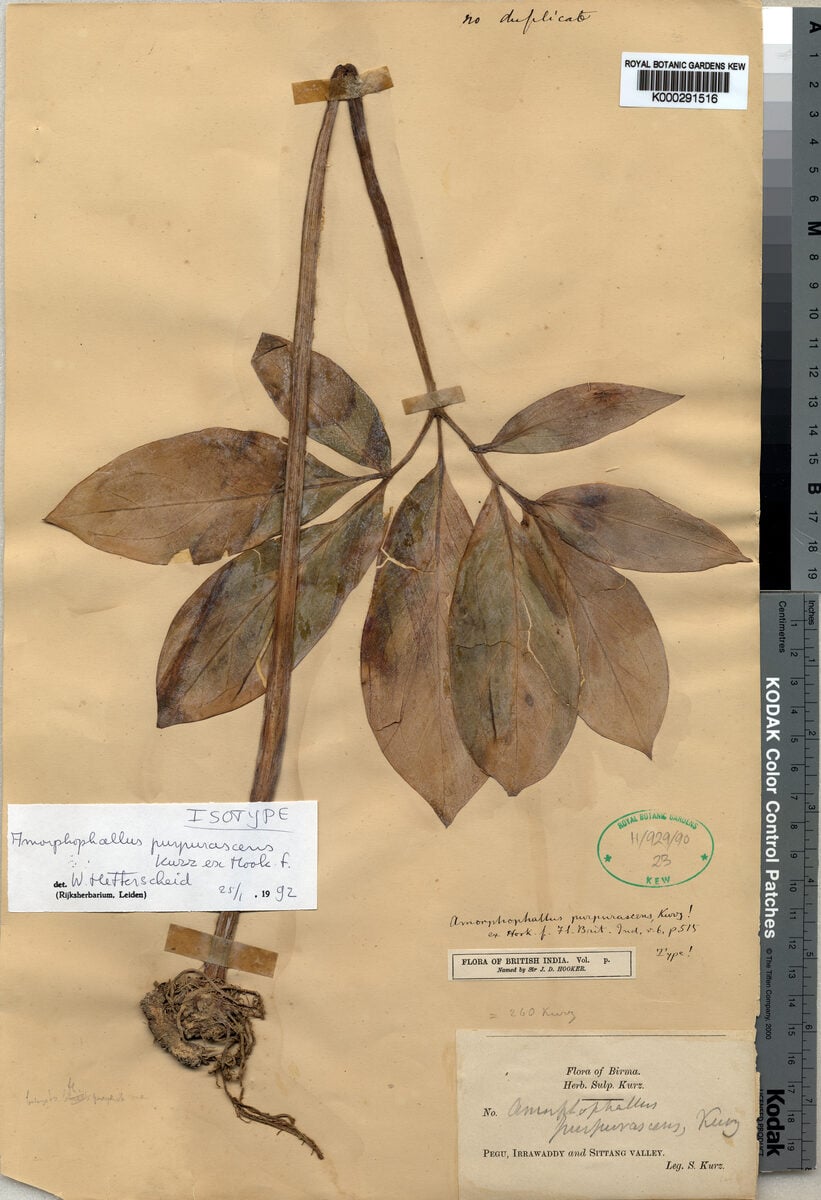
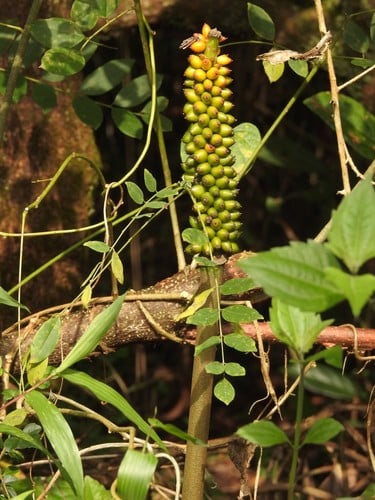
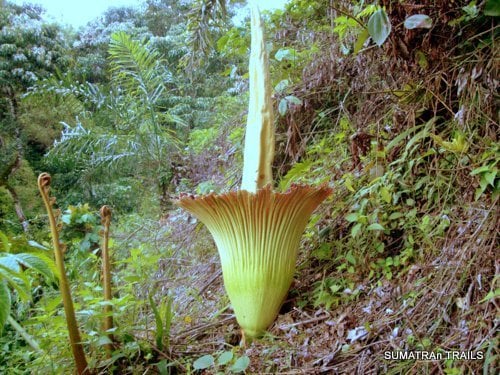
A taro family plant but with a very divided leaf. It grows to 0.75-1 m high. It is a herbaceous plant with rough and mottled leaf stalks. It has a straight stem and the leaf is divided into leaflets. The leaves can be 1 m in width. The leaves usually come singly from the ground. The leaf blades are divided into many lobes. The leaflets can be 3-35 cm long and 2-13 cm wide. The flower stalk can be 3-20 cm long. The bract around the flower is bell shaped and fluted. It can be 60 cm across. The edge is curved back and wavy. The flower is dull purple and up to 30 cm across. It can be 70 cm long. The flower gives of a bad smell like rotting meat and this attracts flies. The flower only develops after the leaves have died off. The leaves and corms especially in the wild varieties contain many stinging crystals. Edible kinds have a smooth petiole. It has a large round tuber up to 25 cm across. The large round underground corm produces small corms around the side. These can be 10 cm long. These are usually used for planting.
Edible Uses
The corm must be thoroughly boiled or baked before eating, as it is acrid when raw. Corms can grow very large — up to 50cm in diameter — and are usually harvested when three years old, at which point they can weigh up to 9kg. They can be stored for several months at 10°C. Fresh corms are turned into curd or chopped and dried. The curd is relatively tasteless but absorbs flavours well, making it a useful carbohydrate element in a wide range of other foods. Young leaves and petioles can also be eaten as a vegetable, but must be thoroughly cooked. Some caution is advised regarding toxicity for both the corms and leaves.
Traditional Uses
The corm is cooked and eaten. In some kinds it is burned and smashed with salt and eaten with rice. The young unopened leaves are edible cooked. The young petioles or leaf stalks are eaten cooked. They are often eaten with fish. They are also used in soup. The harvested stalks can only be stored for about one week.
Medicinal Uses
The root is carminative, restorative, stomachic, and tonic. It is dried and used in the treatment of piles and dysentery. The fresh root acts as an acrid stimulant and expectorant, and is widely used in India in the treatment of acute rheumatism. Some caution is advised regarding toxicity.
Known Hazards
Raw corms are acrid and toxic; must be thoroughly boiled or baked. Young leaves contain possible toxins and must be thoroughly cooked.
Distribution
A tropical plant. It occurs mainly in seasonally dry areas and grassland up to 800 m altitude in equatorial zones. It requires an average temperature of 25-35°C and rainfall of 1000-1500 mm during the growing season. Soils need to be well drained as it cannot stand waterlogging. It occurs widely around the Philippines in low altitude places especially where people have cleared the forest. It is common in Indonesia and Vietnam. In XTBG Yunnan.
Where It Grows
American Samoa, Asia, Australia, Bangladesh, Bhutan, Cambodia, China, Cook Islands, East Timor, Fiji, French Polynesia, Himalayas, India, Indochina, Indonesia, Laos, Madagascar, Malaysia, Marquesas, Myanmar, Nepal, Niue, Northeastern India, Pacific, Papua New Guinea, PNG, Philippines, Polynesia, Rotuma, Samoa, SE Asia, Seychelles, Solomon Islands, Sri Lanka, Tahiti, Thailand, Timor-Leste, Tonga, Vanuatu, Vietnam, Wallis & Futuna, West Timor,
Cultivation
The cormels are planted. Seeds will grow but flowers need hand pollination. Small corms from around the side are the normal part planted. If a very small corm is planted, the plant may need to grow for several seasons to produce a large yield. Setts or small cormels of 200 g are suitable for use planted at 30 cm x 30 cm spacing and produce seed corms of about 500 g. Larger corms take 3-4 years to produce. This is achieved by digging up corms and replanting next season. Each crop takes about 8 months to mature. Corms are planted 15 cm deep. Spacing is increased between plants in successive years of growth. After harvest, the corm needs to be kept for a few months before it is ready to produce a new shoot and re-grow.
Propagation
Seed — best sown in a pot in a warm greenhouse as soon as it is ripe, with the pot sealed in a plastic bag to retain moisture. Germination usually occurs within 1–8 months at 24°C. When large enough to handle, prick seedlings out into individual pots and grow on in the greenhouse for at least a couple of years. Plant out in late spring or early summer after the last expected frosts, providing protection such as a cloche until the plants are growing away strongly.
Other Uses
Plants are often grown as an understorey crop in woodlands or in plantations of betel (Areca spp.), coconuts (Cocos nucifera), bananas (Musa spp.), or coffee (Coffea spp.). The plant is noted as scented.
Production
The stalk dies back when the plant is mature. The corm will keep for several months. An individual corm can finally weigh 8 kg. When it is planted a single leaf stalk is produced and the irregular shaped leaf is produced at the top of the stalk. Eventually the corm under the ground increases in size then the leaf dies back. The corm could be harvested and stored, or eaten at this stage. If it is just left, a very large flower is produced. This type of growth pattern where vegetative growth is followed by a storage organ with dormancy, is the type of growth that suits areas with a distinct wet and dry season. It has the advantage that the corm will store well after harvest and can be eaten in the dry season when food is short.
Other Information
It is a commercially cultivated vegetable. In Papua New Guinea this plant is only grown and used by people in a few locations. It is more important in some other countries such as Indonesia, Vietnam and India. It is sold in local markets.
Notes
There are about 170-200 Amorphophallus species. It has benefits against colon cancer.
Nutrition
| Part | Moisture | kJ | kcal | Protein | Vit A | Vit C | Iron | Zinc |
|---|---|---|---|---|---|---|---|---|
| Corm | 76.1 | 352 | 83 | 1.3 | 0 | 3.5 | 0.6 | 0.2 |
| Tuber | 78 | 340 | 81 | 2 | 0 | 6 | 2.4 | 1.1 |
| Tuber | 79 | 268 | 64 | 1.5 | — | — | 2.3 | 0.9 |
| Leaf stalk | — | — | — | — | — | — | — | — |
| Leaves | — | — | — | — | — | — | — | — |
Synonyms
Also Known As
Achung, Adavi kanda, Arsaghna, Ba-tel-hawng, Badur, Baghraj, Balbag, Balukand, Bebebikeno, Buk, Chena, Daiga, Duk deu, Fi’i Andoi, Hakai, Hita, Iles-iles, Jimikanda, Jimmikand, Kaan, Kadu suvaragedde, Kalungu, Kamarn, Kanda, Karnai-kilangu, Karruna, Kembang bangah, Keobi, Khoai nua, Khoebi, Kidaran, Karunaikkalangu, Kolbot, Leba, Loka, Loki, Nua chuong, Olakunda, Ol kasu, Ol kochu, Ol, Ole, Olodot, Olua, Ool, Pende, Pungapung, Raja ala, Soa, Sooran, Sop, Soro, Stinking Snakeskin Lily, Suran, Suvarna gadde, Suweg, Talingo potato, Telinga potato, Teve, Tigi, Ubi kekek, Voodoo lily, Wa-u-bin, Wa-u-pin, Wal-kidaran, Walur, Whitespot giant arum, Wupwarna, Zamin-kand
References (142)
- Elephant foot yam references
- Ambasta S.P. (Ed.), 2000, The Useful Plants of India. CSIR India. p 36 (As Amorphophallus campanulatus)
- Anderson, E. F., 1993, Plants and people of the Golden Triangle. Dioscorides Press. p 202 (As Amorphophallus campanulatus)
- Anon., 1939, Note sur une plante a tubercles amylaces d'Ilis-Ilis de Java (Amorphophallus campanulatus Blume). Agron. colon. 28(255), 84-87.
- Anon., 1960/61. Effect of waxing on elephant yam Amorphophallus campanulatus. Ann. Rep. cent. Fd. technol. res. Inst. Mysore p 3
Show all 142 references Hide references
- Ansil, P. N., et al, 2014, Cytotoxic and apoptotic activities of Amorphophallus campanulatus (Roxb.) Bl. tuber extracts against colon carcinoma cell line HCT-15. Saudi Journal of Biological Sciences 21:524-531
- Arakeri, H.R., 1950, Seed production in suran (Amorphophallus campanulatus ) Dharwar Agric. Voll. Mag., 3:3-4.
- Arakeri, H.R., 1956, A note on storage and germination requirements of seeds of Suran. Indian J. Genet. 1:27-29.
- Backer, C.A. and Brink, B van den, 1968, Flora of Java. 3 vols. p111.
- Bandyopadhyay, S. et al, 2009, Wild edible plants of Koch Bihar district, West Bengal. Natural Products Radiance 8(1) 64-72
- Bandyopadhyay, S., et al, 2012, A Census of Wild Edible Plants from Howrah District, West Bengal, India. Proceedings of UGC sponsored National Seminar 2012 (As Amorphophallus campanulatus)
- Baro, D., Baruah, S. and Borthukar, S. K. 2015, Documentation on wild vegetables of Baksa district, BTAD (Assam). Scholars Research Library. Archives of Applied Science Research, 2015, 7 (9):19-27
- Barrau, J., 1976, Subsistence Agriculture in Polynesia and Micronesia. Bernice P. Bishop Museu, Bulletin 223 Honolulu Hawaii. Kraus reprint. p 39
- Bircher, A. G. & Bircher, W. H., 2000, Encyclopedia of Fruit Trees and Edible Flowering Plants in Egypt and the Subtropics. AUC Press. p 24 (As Amorphophallus campanulatus)
- Bois,D.,1927, Les Plantes Alimentaires Vol.1 p 527.
- Brown, D., 2000, Aroids. Plants of the Arum family. Timber Press. (Second edition) p 265
- Brock, J., 1993, Native Plants of Northern Australia, Reed. p 89
- Brown, W.H., 1920, Wild Food Plants of the Philippines. Bureau of Forestry Bulletin No. 21 Manila. p 31
- Brown, , 1951, Useful Plants of the Philippines. p344.
- Brown, D.,1988, Aroids. Timber Press, Portland, Oregon. p39-40 and 202-4.
- Burkill, I.H., 1966, A Dictionary of the Economic Products of the Malay Peninsula. Ministry of Agriculture and Cooperatives, Kuala Lumpur, Malaysia. Vol 1 (A-H) p 139 (As Amorphophallus campanulatus)
- Cabalion, P. and Morat, P., 1983, Introduction le vegetation, la flore et aux noms vernaculaires de l'ile de Pentcoste (Vanuatu), In: Journal d'agriculture traditionnelle et de botanique appliquee JATBA Vol. 30, 3-4
- Chandrakumar, P., et al, 2015, Ethnobotanical studies of wild edible plants of Gond, Halba and Kawar tribes of Salekasa Taluka, Gondia District, Maharashtra State, India. International Research Journal of Pharmacy 6(8)
- Chaugule, B.A. and Knot, B.D., 1957, Four years with suran. Indian Fmg., 7(9):27-31.
- Chaugule, B.A. and Knot, B.D., 1963, Effect of size of seed corm and spacing on growth and yield of four year suran, (Amorphophallus campanulatus Blume). Indian J. Agron. 7(4):310-318.
- Checklist of NT Vascular Plant Species. January 2003.
- Cherikoff V. & Isaacs, J., The Bush Food Handbook. How to gather, grow, process and cook Australian Wild Foods. Ti Tree Press, Australia p 198
- Chevalier, A., 1931, Les amorphophallus et leurs usages. Revue Bot. Appl. Agric. Trop. 11(122):809-816.
- Chowdery, T., et al, 2014, Wild edible plants of Uttar Dinajpur District, West Bengal. Life Science Leaflets. 47:pp 20-36 http://lifesciencesleaflets.ning.com
- Chowdhury, M. & Mukherjee, R., 2012, Wild Edible Plants Consumed by Local Communities of Maldah of West Bengal, India. Indian J.Sci.Res.3(2) : 163-170
- Christophersen, E., 1935, Flowering Plants of Samoa. Bishop Museum Bulletin. No 128 p40.
- Cooper, W. and Cooper, W., 2004, Fruits of the Australian Tropical Rainforest. Nokomis Editions, Victoria, Australia. p 59
- Coursey, D.G., 1968, The edible aroids. World Crops 20(4):25-30.
- Cowie, I, 2006, A Survey of Flora and vegetation of the proposed Jaco-Tutuala-Lore National Park. Timor-Lests (East Timor) www.territorystories.nt/gov.au p 43
- Deka, N. & Devi, N., 2015, Wild edible aquatic and marshland angiosperms of Baka district, BTC area, Assam, India. Asian J. Plant Sci. Res. 5(1):32-48
- Dutta, U., 2012, Wild Vegetables collected by the local communities from the Churang reserve of BTD, Assam. International Journal of Science and Advanced Technology. Vol. 2(4) p 119
- Dyani, S.K., & Sharma, R.V., 1987, Exploration of Socio-economic plant resources of Vyasi Valley in Tehri Garwhal. J. Econ. Tax. Bot. Vol. 9 No. 2 pp 299-310
- Drury, H., 1858, Useful Plants of India. p 32.
- Facciola, S., 1998, Cornucopia 2: a Source Book of Edible Plants. Kampong Publications, p 23 (As Amorphophallus campanulatus)
- Franklin, J., Keppel, G., & Whistler, W., 2008, The vegetation and flora of Lakeba, Nayau and Aiwa Islands, Central Lau Group, Fiji. Micronesica 40(1/2): 169–225, 2008
- French, B., 1986, Food Plants of Papua New Guinea, Asia Pacific Science Foundation p 55
- French, B.R., 2010, Food Plants of Solomon Islands. A Compendium. Food Plants International Inc. p 13
- Gangte, H. E., et al, 2013, Wild Edible Plants used by the Zou Tribe in Manipur, India. International Journal of Scientific and Research Publications, Volume 3, Issue 5
- Garde, M., et al, 2003, A Preliminary List of Kundedjnjenghmi Plant Names. Northern Land Council. (Arnhem Land, Australia)
- Gilliland, H.B., 1962, Common Malayan Plants. Univ.of Malaya. p 14.
- Guite, C., 2016, Study of wild edible plants associated with the Paite Tribe of Manipur, India. International Journal of Current Research. Vol. 8, Issue 11, pp. 40927-40932 (As campanulatus)
- Hedrick, U.P.(ed.), 1919, Sturtevant's Edible Plants of the World. Dover. p 51.
- Henderson, C.P. and I.R. Hancock, 1988, A Guide to the Useful Plants of the Solomon Islands. Res. Dept. Min of Ag. & Lands. Honiara, Solomon Islands. p 30
- Hooker, , Flora of British India. Vol.VI, 513
- Iyer Annasamy, N., 1935, A Note on the cultivation of elephant yam (Amorphophallus campanulatus ) in Chittoor Taluk. Madras Agric. J. 23(11):451-454
- Jacquat, C., 1990, Plants from the Markets of Thailand. D.K. Book House p 110
- Jos, J.S., Rajendran, P.G., and Hrishi, 1977a, Polymitosis in the microspores of elephant foot yam. Curr. Sci. 46:829-830
- Jos, J.S., and Vijaya Bai, K., 1986, Seed Set and Polyembryony in Amorphophallus campanulatus Blume. J. Indian Bot. Soc. 65:178-184
- Kachenchart, B., et al, 2008, Phenology of Edible Plants at Sakaerat Forest. In Proceedings of the FORTROP II: Tropical Forestry Change in a Changing World. Bangkok, Thailand.
- Kamala, S., et al, 2015, Whole transcriptome sequencing of diseased elephant food yam reveals complete genome sequence of Dasheen mosaic virus. Virology Reports 5:1-9
- Kar, A., 2004, Common wild vegetables of Aka tribe of Arunachal Pradesh. Indian Journal of Traditional Knowledge 3(3) pp 305-313
- Kar, A., et al, 2013, Wild Edible Plant Resources used by the Mizos of Mizoram, India. Kathmandu University Journal of Science, Engineering and Technology. Vol. 9, No. 1, July, 2013, 106-126
- Kay, D.E., 1973, Root Crops. Tropical Products Institute Crop and Product Digest. No 2. p 61
- Kays, S. J., and Dias, J. C. S., 1995, Common Names of Commercially Cultivated Vegetables of the World in 15 languages. Economic Botany, Vol. 49, No. 2, pp. 115-152
- Khumgratok, S., Edible Plants in Cultural Forests of Northeastern Thailand. Mahasarakham University Thailand.
- Khyade, M. S., et al, 2009, Wild Edible Plants Used By the Tribes of Akole Tahasil of Ahmednagar District (Ms), India. Ethnobotanical Leaflets 13: 1328-36, 2009
- Kiran, K. C., et al, 2019, Diversity and Seasonal Availability of Potential Wild Edible Plants from Vidarbha Region of Maharashtra State, India. Int.J.Curr.Microbiol.App.Sci (2019) 8(2): 1434-1446 (Also as Amorphophallus campanulatus)
- Koorders, S.H., 1913, Exkursions flora von Java. Blutenpflazen p 185.
- Koregrave, B.A., 1964, Effect of mixed cropping on the growth and yield of suran (Elephant yam Amorphophallus campanulatus Blume). Indian J. Agron. 9(4):255-260.
- Kumar, A., 2013, Ethnobotanical study of wild vegetables used by rural communities of Kannauj district, Uttar Pradesh, India. Emir. J. Food Agric. 2013. 25 (10): 760-766
- Kumar, G.M., & Shiddamallayya, N., 2014, Documentation of Wild Plant Tubers as Food Resources in Hassan District, Karnataka, International Journal of Applied Biology and Pharmaceutical Technology. 5(2) p 90 (As Amorphophallus campanulatus)
- Kumar, S. A., Manus, D. & Mallika, M., 2018, Impact of non-timber forest products on Forest and in Livelihood Economy of the People of Adjoining Areas of Jalpaiguri Forest Division, West Bengal, India. Int. J. of Life Sciences, 2018; 6 (2):365-385
- Kundu, B.C., 1967, Some edible rhizomatous and tuberous crops of India. Proc. 1st Sympos. Trop. Root Crops Pt 1:124-125.
- Lazarides, M. & Hince, B., 1993, Handbook of Economic Plants of Australia, CSIRO. p 18
- Lepofsky, D., 2003, The Ethnobotany of Cultivated Plants of the Maohi of the Society Islands. Economic Botany, Vol. 57, No. 1, pp. 73-92
- Liefting, A., et al, Samoan plant names. http://en.wikipedia.org
- Lim, T. K., 2015, Edible Medicinal and Non Medicinal Plants. Volume 9, Modified Stems, Roots, Bulbs. Springer p 8
- Llamas, K.A., 2003, Tropical Flowering Plants. Timber Press. p 79
- Loosli, J.K.,Villegas,V. and Ynalvez,L.A.,1954, The digestibility of tropical kudzu (Pueraria javanica )and ponapong (Amorphophallus campanulatus ) by swine. Philipp. Agric. 38(6- 7):491-493.
- Luczaj, L., et al, 2021, Wild food plants and fungi sold in the markets of Luang Prabang, Lao PDR. Journal of Ethnobiology and Ethnomedicine (2021) 17:6
- Lugod, G.C. and de Padua L.S., 1979, Wild Food Plants in the Philippines. Vol. 1. Univ. of Philippines Los Banos. p 14
- Macmillan, H.F. (Revised Barlow, H.S., et al) 1991, Tropical Planting and Gardening. Sixth edition. Malayan Nature Society. Kuala Lumpur. p 336
- Maghirang, R. G., et al, 2018. Ethnobotanical Studies of Some Plants Commonly Used as Vegetables in Selected Provinces of the Philippines. Journal of Nature Studies. 17(2), 30-43.
- Manandhar, N.P., 2002, Plants and People of Nepal. Timber Press. Portland, Oregon. p 87
- Massal, E., and Barrau, J., 1956, Food Plants of the South Sea Islands. SPC Techn. Paper. No 94 p 6-11.
- McClatchey, W., Thaman, R., & Vodonaivalu, S., 2000, A Preliminary Checklist of the Flora of Rotuma with Rotuman Names. Pacific Science (2000) Vol. 54, No. 4: 345-363
- Menisa, A. A., et al, 2012, Survey and characterization of Indigenous Food Plants in Ilocos Norte, Philippines. SEARCA Discussion Paper series No. 2011-2
- Mishra, N., et al, 2016, Indigenous knowledge in utilization of wetland plants in Bhadrak district, Odisha, India. Indian Journal of Natural Products and Resources. Vol. 7(1) pp. 82-89
- Misra, R. C., et al, 2013, Genetic resources of wild tuberous food plants traditionally used in Similipal Biosphere Reserve, Odisha, India. Genetic Resources and Crop Evolution. Vol. 60 No. 2. Springer
- Misra, S., 2018, Ethno Botany and Nutritional Status of Some Edible Plants of South Odisha, India. International Journal of Advances in Agricultural Science and Technology, Vol.5 Issue.2, February- 2018, pg. 21-32
- Monsalud, M.R., Tongacan, A.L., Lopez, F.R., & Lagrimas, M.Q., 1966, Edible Wild Plants in Philippine Forests. Philippine Journal of Science. p 444
- Morley, B.D., & Toelken, H.R., (Eds), 1983, Flowering Plants in Australia. Rigby. p 397
- Ochse, J.J. et al, 1931, Vegetables of the Dutch East Indies. Asher reprint. p 48
- Pancho, J.V., 1959, Notes on the cultivated aroids in the Philippines: the edible species. Baileya 7(1):63-70.
- Parham, Plants of the Fiji Islands. p361.
- Parham, B. E. V., 1972, Plants of Samoa. New Zealand Department of Scientific and Industrial Research. Information Series. No. 85 p 126
- Patiri, B. & Borah, A., 2007, Wild Edible Plants of Assam. Geethaki Publishers. p 157
- Peduruhewa, P. S., et al, 2021, Potential of Underutilized Wild Edible Plants as the Food for the Future – A Review. Journal of Food Security, Vol. 9, No. 4, 136-147
- Peekel, An Illustrated Flora of the bismarck Archipelago.
- Pena, R.S.,de la, 1970, The edible aroids in the Asian Pacific area. Proc. 2nd. Int. Sympos. Trop. Root & Tuber crops. 1Pt 5:136-140.
- Phon, P., 2000, Plants used in Cambodia. © Pauline Dy Phon, Phnom Penh, Cambodia. p32
- Plants for a Future database, The Field, Penpol, Lostwithiel, Cornwall, PL22 0NG, UK. http://www.scs.leeds.ac.uk/pfaf/.
- Plucknett, D.L.,1970, Colocasia, Xanthosoma, Alocasia, Cyrtosperma and Amorphophallus. Proc. 2nd Int.Sympos.Trop. Root and Tuber Crops. 1 Pt 1:127-135.
- Polinag, M. A., 2003, Food from the Wilderness. Department of Environment and Natural Resources. Laguna. (As Amorphophallus campanulatus)
- Prafulla, S., 2017, Wild Food Diversity of Nawegaon-Nagzira Tiger Reserve in Gondia-Bhandara district of Maharashtra, India. Int. J. of Life Sciences, 2017, Vol. 5 (4): 620-626
- Qudrat-I-Khuda, M. et al., 1960, Properties of certain starch varieties and their sources in East Pakistan. Pakistan J.Scient. Ind. Res. 3(3):159-162.
- Rajapaksha, U., 1998, Traditional Food Plants in Sri Lanka. HARTI, Sri Lanka. p 70 (As Amorphophallus campanulatus)
- Rajkalkshmi, P. et al, 2001, Total carotenoid and beta-carotene contents of forest green leafy vegetables consumed by tribals of south India. Plant Foods for Human Nutrition 56:225-238
- Rashid, H. E., 1977, Geography of Bangladesh. Westview. p 264 (As Amorphophallus campanulatus)
- Rajendran, P.G. and Hrishi, N., 1976, Breaking seed dormancy in Amorphophallus. J. Root Crops. 2:61-62.
- Rao, M. L. S., et al, 2014, Indigenous Plant Foods which are commonly consumed by the tribal communities in Dumbriguda Area of Visakhapatnam District, Andhra Pradesh, India. Biolife. Vol 2, Issue 3
- Ray, P.K., Mishra, S., & Mishra, S.S., 1985, Better Elephant-foot yams for Bihar. Indian farming (India) v 34(11) p 11,13, 36.
- Reantaso, C.G., 1935, Pungapung as a source of starch and alcohol. Philipp. Agric. 24:239-248.
- Recher, P, 2001, Fruit Spirit Botanical Gardens Plant Index. www.nrg.com.au/~recher/ seedlist.html p 1 (As Amorphophallus campanulatus)
- Reddy, B. M., 2012, Wild edible plants of Chandrapur district, Maharashtra, India. Indian Journal of Natural Products and Resources. 3(1) pp 110-117
- Reddy, K. N., et al, 2006, Traditional knowledge on wild food plants in Andhra Pradesh. Indian Journal of Traditional Knowledge 6(1) pp 223-229
- Ridley, Flora of the Malay Peninsula p 92.
- Sarma, H., et al, 2010, Updated Estimates of Wild Edible and Threatened Plants of Assam: A Meta-analysis. International Journal of Botany 6(4): 414-423
- Sen, H., Roychoudhury, N., Mukhopadhyay, S.K., 1987, Effect of sett size and spacing on the production of seed corm in Amorphophallus (Amorphophallus campanulatus Blume). Journal of Root Crops (India) v 13(2) p 121-123.
- Setiya, A. V., et al, 2016, Exploration and documentation of some wild edible plants used by the aboriginals from Gadchiroli District (M.S.) India. International Advanced Research Journal in Science, Engineering and Technology. 3(7)
- Sharma, B.B., 2005, Growing fruits and vegetables. Publications Division. Ministry of Information and broadcasting. India. p 232
- SHORTT
- Singh, A. G., et al, 2012, Wild Plants Used as Vegetable in Rupandehi District of Nepal and Their Ethnomedicinal Importance. J. Nat. Hist. Mus. Vol. 26, 2012, 111-125 (As Amorphophallus campanulatus)
- Singh, H.B., Arora R.K.,1978, Wild edible Plants of India. Indian Council of Agricultural Research, New Delhi. p 10
- Sukarya, D. G., (Ed.) 2013, 3,500 Plant Species of the Botanic Gardens of Indonesia. LIPI p 1062
- Suksri, S., et al, 2005, Ethnobotany in Bung Khong Long Non-Hunting Area, Northeast Thailand. Kasetsart J., (Nat. Sci) 39: 519-533
- Tanaka, T., 1976, Tanaka's Cyclopedia of Edible Plants of the World. p 40
- Tanaka, Y. & Van Ke, N., 2007, Edible Wild Plants of Vietnam: The bountiful garden. Orchid books. p 30
- Taxon 32:130. 1983
- Terra, G.J.A., 1966, Tropical Vegetables. Communication 54e Royal Tropical Institute, Amsterdam p 23
- Thitiprasert, W., et al, 2007, Country report on the State of Plant Genetic Resources for Food and Agriculture in Thailand (1997-2004). FAO
- Tiwi Plants and Animals. 2001, Aboriginal flora and fauna knowledge from Bathurst and Melville Islands, northern Australia. Northern Territory Botanical Bulletin; No. 24 p 24
- Trimanto, & Hapsari L., 2016, Botanical survey in thirteen montane forests of Bawean Island Nature Reserve, East Java Indonesia: Conservation status, bioprospecting and potential tourism. Biodiversitas 17: 832-846. (As campanulatus)
- Tsering, J., et al, 2017, Ethnobotanical appraisal on wild edible plants used by the Monpa community of Arunchal Pradesh. Indian Journal of Traditional Knowledge. Vol 16(4), October 2017, pp 626-637
- Ulian, T., et al, 2020, Unlocking plant resources to support food security and promote sustainable agriculture. Plants, People, Planet. 2020;2:421–445.
- Uprety, Y., et al, 2016, Traditional use and management of NTFPs in Kangchenjunga Landscape: implications for conservation and livelihoods. Journal of Ethnobiology and Ethnomedicine (2016) 12:19
- Walter, A. & Lebot, V., 2007, Gardens of Oceania. ACIAR Monograph No. 122 p. 62
- Wealth of India. p69.
- Wester, P.J., 1925, The Food Plants of the Philippines 3rd ed. Bureau of Agric. Bull. 39:218
- Wiersema, J. H. & Leon, B., 2013, World Economic Plants. A Standard Reference CRC Press. 2nd Ed. p 48
- Wight. R., 1963, Icones Plantarum Indiae Orientalis.
- Wightman, G. M. & Andrews, M.R., 1989, Plants of Northern Territory Monsoon Vine Forests (Vol 1). Conservation Commission of Northern Territory. p 156
- Williams, K.A.W., 1999, Native Plants of Queensland Volume 4. Keith A.W. Williams North Ipswich, Australia. p 52
- World Checklist of Useful Plant Species 2020. Royal Botanic Gardens, Kew
- Yuncker, T. G., 1943, The Flora of Niue Island. Bernice P. Bishop Museum Bulletin 178 p 28
- Yunupinu Banjgul, Laklak Yunupinu-Marika, et al. 1995, Rirratjinu Ethnobotany: Aboriginal Plant Use from Yirrkala, Arnhem Land, Australia. Northern Territory Botanical Bulletin No 21. Parks and Wildlife Commission of the Northern Territory. p 18.
- Zeven, A. C. & de West, J. M. J., 1982, Dictionary of cultivated plants and their regions of diversity. Wageningen. p 49 (As Amorphophallus campanulatus), p 71