Tsuga caroliniana
Englelmann
Carolina hemlock
iNaturalist· cc-by
(c) Tom Field, some rights reserved (CC BY), uploaded by Tom Field
iNaturalist· cc-by-nc
(c) Milo Pyne, some rights reserved (CC BY-NC), uploaded by Milo Pyne
iNaturalist· cc-by-sa
(c) Douglas Goldman, some rights reserved (CC BY-SA), uploaded by Douglas Goldman
Summary
Source: WikipediaTsuga caroliniana, the Carolina hemlock, is a species of hemlock endemic to the southern Appalachian Mountains of the United States. As of 2023, it is under review for listing under the Endangered Species Act of 1973.
Description
An evergreen pine tree. It grows 20 m high. The tree is broadly cone shaped. The bark is red-brown and furrowed. Ridges develop with age. The leaves are narrow and 2 cm long. They are dark green above and have 2 white bands underneath. The male and female flowers are in separate clusters. They are both brown and the male ones are below the shoot while female ones are at the tip. The fruit is a pale brown hanging cone. It is 2.5 cm long.
Edible Uses
The inner bark can be eaten raw or dried, ground into a powder, and used as a thickening in soups or mixed with cereals for bread. The leaves and twigs yield 'spruce oil', used commercially to flavour chewing gum, soft drinks, and ice cream. Young shoot tips are brewed into a herbal tea and are also an ingredient in 'spruce beer'.
Medicinal Uses
The bark is astringent, diaphoretic and diuretic. A tea made from the inner bark or twigs helps treat kidney or bladder problems and makes a useful enema for diarrhoea. It can be used as a gargle or mouthwash for mouth and throat problems, or applied externally to wash sores and ulcers. A bark poultice treats itchy armpits, and the powdered bark can be placed in shoes to help with tender or sweaty feet and foot odour. An infusion of stem tips treats kidney problems. A decoction of the roots has been used as a birthing aid to help expel the afterbirth, and the roots have been chewed to treat diarrhoea.
Distribution
It is a temperate plant. It grows naturally on mountain slopes in the S.E. United States. It grows between 760-1,200 m altitude. It cannot tolerate fire.
Where It Grows
Australia, North America, USA,
Cultivation
An easily grown plant, it thrives best when growing in a deep well-drained soil in the western parts of Britain where it appreciates the higher rainfall. However, it succeeds in most soils and positions, being especially good on acidic sandy soils but also tolerating some lime so long as there is plenty of humus in the soil. Plants are very shade tolerant when young, but need more sunlight as they grow older. Plants are thin and poor when grown in dry or exposed places. This species is more tolerant of atmospheric pollution than T. canadensis. A slow growing tree in Britain, it requires hot humid summers. It is probably less slow in the far west and in Ireland. Trees have not done well in this country even though they are very cold-tolerant. Plants in this genus are notably resistant to honey fungus.
Propagation
Seed germinates better with a short cold stratification and is best sown in a cold frame from autumn to late winter. It can also be sown in early spring, though it may not germinate until after the following winter. Where seed is plentiful, an outdoor spring sowing is possible. Pot-grown seedlings should be moved into individual pots once large enough to handle, grown on in a cold frame, and planted out in early summer the following year. Trees transplant well up to 80cm tall but are best placed in their final positions at 30–45cm or less in height, typically at 5–8 years old. Larger trees check badly and put on little growth for several years, which also badly affects root development and wind resistance.
Other Uses
The inner bark has been used in basket-making. A rosy-tan dye can be obtained from the bark, which is also a source of tannin. The following uses are based on those of T. canadensis, as this species is reported to have similar properties. A resin similar to that of Abies balsamea is gathered by incisions in the trunk or by boiling the wood. Hemlock pitch is obtained by distillation of the young branches, and 'Oil of Hemlock' is also reportedly distilled from the young branches. Boiled bark produces a wash for removing rust from iron and steel and preventing further rusting. The plant tolerates light trimming and can be grown as a hedge, though it does not make a good hedge in Britain. Some cultivars work as ground cover when planted about 1 metre apart; 'Pendula' is slow-growing but very effective. The wood is coarse-grained, light, soft, not strong, brittle, and not durable outdoors. It splits easily, weighs 26lb per cubic foot, and has numerous hard knots that can quickly dull an axe blade. It is occasionally used as coarse lumber for the exterior of buildings, and should be used with caution as outdoor fuel as it can project embers and burning wood several metres from the fire.
Notes
There are 10 or 11 Tsuga species.
References (7)
- Bodkin, F., 1991, Encyclopedia Botanica. Cornstalk publishing, p 995
- Bot. Gaz. 6:223. 1881
- Brickell, C. (Ed.), 1999, The Royal Horticultural Society A-Z Encyclopedia of Garden Plants. Convent Garden Books. p 1026
- Coombes, A.J., 2000, Trees. Dorling Kindersley Handbooks. p 77
- Elias, T.S. & Dykeman P.A., 1990, Edible Wild Plants. A North American Field guide. Sterling, New York p 122
Show all 7 references Hide references
- Little, E.L., 1980, National Audubon Society Field Guide to North American Trees. Alfred A. Knopf. p 300
- Marinelli, J. (Ed), 2004, Plant. DK. p 158
More from Pinaceae
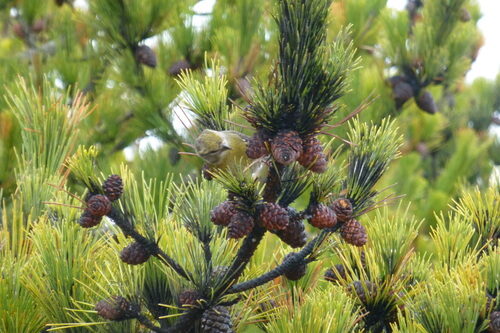
Pinus thunbergii
Japanese Black Pine
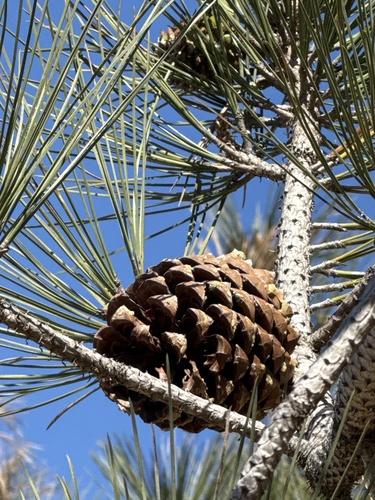
Pinus torreyana
Soledad Pine, Torrey Pine
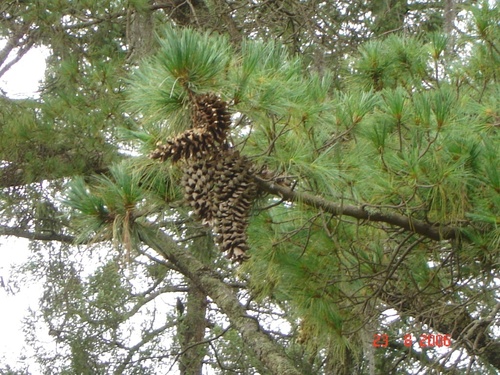
Pinus veitchii
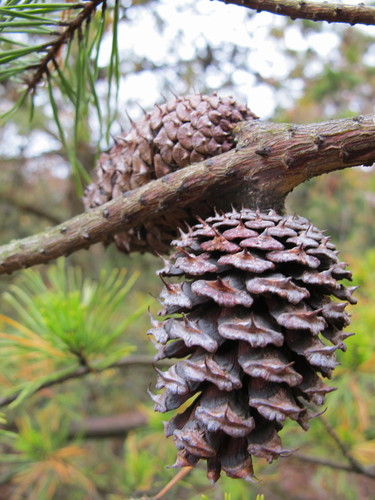
Pinus virginiana
Scrub pine, Ai song, Virginia pine
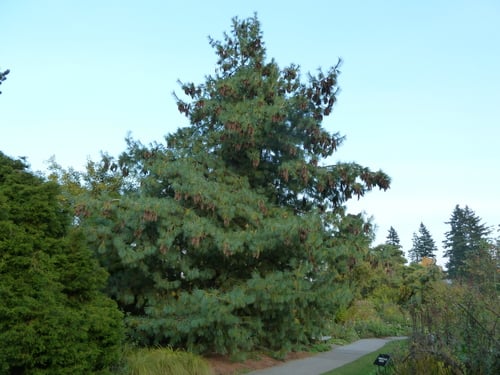
Pinus wallichiana
Himalayan blue pine, Bhutan pine, Blue Pine, Himalayan Pine, Qiao song, Kail, Yiro, Kaiar, Lim, Raisalla, Lamshing, Byans, Cheel, Dolchilla, Neet-kung, Tongschi, Lamshing
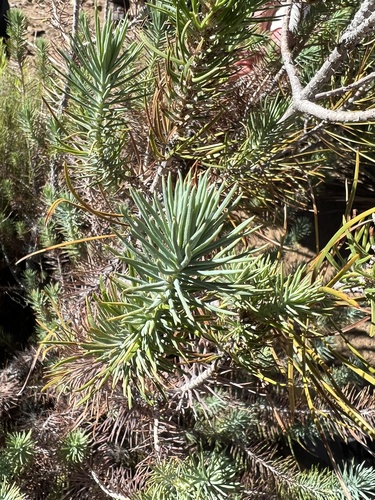
Pinus x quadrifolia
Parry pinyon