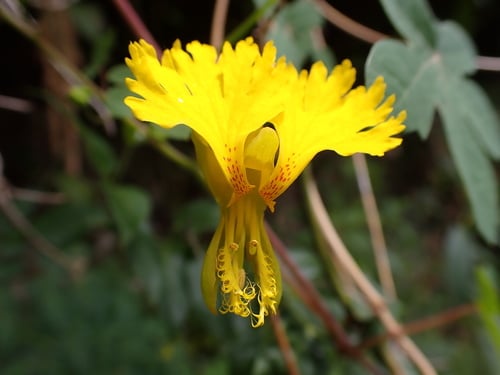
Tropaeolum tuberosum
Ruiz & Pav.
Anu, Mashua
iNaturalist· cc-by
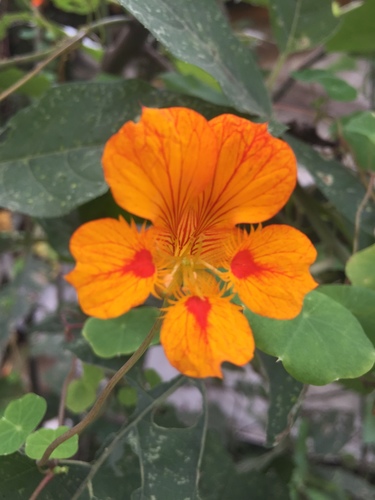
(c) David F. Belmonte, some rights reserved (CC BY), uploaded by David F. Belmonte
iNaturalist· cc-by-nc
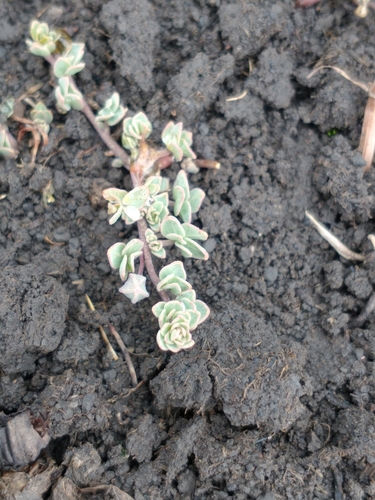
(c) Brandon Ortiz Arenas, some rights reserved (CC BY-NC), uploaded by Brandon Ortiz Arenas
iNaturalist· cc-by-nc-nd
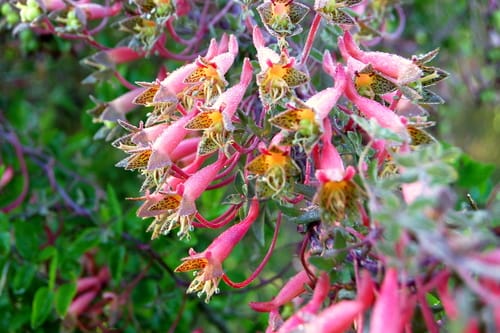
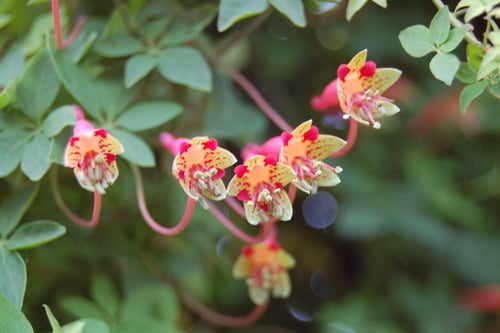
(c) FarOutFlora, some rights reserved (CC BY-NC-ND)
Summary
Source: WikipediaTropaeolum tuberosum (mashua, see below for other names) is a species of flowering plant in the family Tropaeolaceae, grown in the Andes, particularly in Peru and Bolivia, and to a lesser extent in Ecuador as well as in some areas of Colombia, for its edible tubers, which are eaten cooked or roasted as a vegetable. It is a minor food source, especially for native Amerindian populations. Mashua is a herbaceous perennial climber growing to 2–4 m (7–13 ft) in height. It is related to garden nasturtiums, and is occasionally cultivated as an ornamental for its brightly coloured tubular flowers. The leaves are peltate, roundly five-lobed with a petiole that twines weakly but is not truly a tendril. The root is tuberous.
Description
A climbing herb which climbs by twining around objects. It is grown each year from tubers. It can be 2-4 m high and spread 3 m wide. It does not have hairs. Stems are greenish red. Leaves have 5 lobes. Leaves vary between 5-20 cm long. Tubers are yellowish green with purple marks. They are often deeply furrowed. Flowers are red and yellow. They are 3-4 cm across and cup shaped with a long spur. The plant sets seed easily. Tuber colour and shape varies between varieties.
Edible Uses
The tubers are cooked and have a peppery flavour that many find unpleasant. Cooking them and then freezing them improves the flavour considerably, making them a delicacy to many. Harvesting after a light frost also helps, though a heavy frost can damage the tubers. Half-drying the tubers before use is another method reported to improve palatability. The tubers can grow up to 10cm long and 5cm thick, are high in vitamin C, and the dried tuber contains up to 16% protein. Leaves can be eaten raw or cooked as a vegetable. Flowers are eaten raw.
Traditional Uses
Tubers are eaten after boiling for 10 minutes. They are often sweetened. They can be added to stews. They are cured in the sun then freeze dried then boiled like potatoes. They can be cooked then frozen. The tender young leaves and flowers are also eaten.
Medicinal Uses
The tuber is considered an anaphrodisiac in the Andes, believed to reduce sexual desire — many men therefore refuse to eat it while recommending it for women. Clinical trials have indicated a reduction of up to 45% in some male hormones when the tuber forms a considerable part of the diet, though no loss in fertility has been observed.
Distribution
A tropical plant. It grows in high altitude, cool, moist, tropical regions. The plants are tolerant of frost. It requires 12 hour days for successful cultivation. It can grow on poor soils. In South America plants grow from 3,000 to 4,000 m altitude. It suits hardiness zones 8-10.
Where It Grows
Andes, Argentina, Australia, Bolivia*, Britain, Chile, Colombia, Ecuador, Europe, New Zealand, Pacific, Papua New Guinea, PNG, Peru, South America, Tasmania, Venezuela,
Cultivation
Requires well-drained lime-free soil in a warm sunny position. Grows best with its roots in the shade and top growth in the sun. Plants can become dormant in hot dry summers. Grows best in a pH range from 5.3 to 7.5. Prefers a turfy loam or a sandy peaty soil. This species is not very hardy when grown outdoors in Britain. The top growth will survive light frosts, whilst the tubers, if well mulched, will survive to at least -5°c. Anu is sensitive to the number of hours of daylight in a day and most forms will not flower or form new tubers until late in the season (from September), so a mild autumn is required for good yields. The variety 'Ken Aslet', however, is not affected by daylight hours, it flowers from June to October and produces larger tubers than the species from mid-summer onwards. T. tuberosum var. lineamaculatum 'Ken Aslet' has gained the Royal Horticultural Society's Award of Garden Merit. The tubers are formed very near the surface of the soil and so will require some protection, such as a mulch if they are to be left in the ground over the winter. The tubers can also be stored in a cool dry frost-free place over the winter and then planted out in April. Long cultivated in the Andes for its edible root, there are many named varieties. A potentially very high-yielding species, individual plants can produce up to 4 kilos of tubers - yields of 50 tonnes per hectare are possible. A climbing plant supports itself by twisting its leaf stalks around other plants etc. The caterpillars of the cabbage white butterfly can be a nuisance and often cause considerable damage to the leaves. Tubers are typically harvested in late autumn to early winter, usually around 6 to 8 months after planting. Mashua flowers in late spring to early summer, generally from May to July (Northern Hemisphere). Mashua is a fast-growing plant, reaching maturity within 6-8 months after planting. It can grow vigorously under suitable conditions. Tropaeolum tuberosum, also known as mashua, is self-fertile and can also cross-pollinate. It's a flowering plant that produces clusters of seeds that are easy to germinate.
Propagation
Sow seed in early spring in a greenhouse. Prick seedlings out into individual pots once large enough to handle and grow on in the greenhouse through their first winter. Plant out in late spring or early summer after the last expected frosts. Tubers can be divided in autumn or spring. In areas with cold winters, harvest tubers in autumn after top-growth has died down and store in a cool, frost-free place until planting out in spring. Basal stem cuttings can be taken in spring — pot into individual pots and place in light shade in a frame until established, then plant out in early summer.
Other Uses
Mashua can be used as a ground cover to prevent soil erosion and contribute to soil fertility, with its leaves providing shade for other crops. The growing plant is highly resistant to diseases and insects, containing nematocidal, bactericidal and insecticidal compounds. Its flowers are rich in nectar and pollen and are attractive to pollinators. The tubers and leaves provide food for both humans and wildlife, and the dense foliage offers some cover for animals, though it is not a primary nesting site. The plant's sprawling growth habit creates ground cover beneficial for various organisms, and leaf litter can serve as overwintering sites for invertebrates. The aromatic leaves may also help confuse pests, providing some degree of pest control.
Production
Plants mature in about 7 months. Tubers store satisfactorily. Tubers are often frozen or partially dried after harvest to improve the flavour. The average yield in Peru is about 4 to 12 tonnes per hectare. Yields of up to 70 tonnes per hectare are possible. The plant growing time is 220 to 240 days in Peru.
Other Information
It is a commercially cultivated vegetable. It has only recently been introduced into Papua New Guinea to try it out. It is an important crop in the high Andes.
Notes
It has benefits for other plants grown with it of controlling nematodes and insects. The tubers probably reduce the production of testosterone. There are 80 to 90 Tropaeolum species.
Synonyms
Also Known As
Capucine tubereuse, Cubio, Isana, Isano, Mascho, Mashwa, Maswallo, Mazuko, Navios, Navo, Occe-anu, Peruvian nasturtium, Tuberous nasturtium, Yana-anu, Ysano, Ysanu
References (33)
- Brickell, C. (Ed.), 1999, The Royal Horticultural Society A-Z Encyclopedia of Garden Plants. Convent Garden Books. p 1026
- Castillo, R. O., 1995, Plant Genetic Resources in the Andes: Impact, Conservation, and Management. Crop Science 35:355-360
- Crawford, M., 2012, How to grow Perennial Vegetables. Green Books. p 131
- Cundall, P., (ed.), 2004, Gardening Australia: flora: the gardener's bible. ABC Books. p 1434
- Facciola, S., 1998, Cornucopia 2: a Source Book of Edible Plants. Kampong Publications, p 242
Show all 33 references Hide references
- Fl. peruv. 3:77, t. 314. 1802
- Franquemont, C., et al, 1990, The Ethnobotany of Chinchero, an Andean Community in Southern Peru. Fieldiana Botany No. 24 p 102
- French, B.R., 1986, Food Plants of Papua New Guinea, A Compendium. Asia Pacific Science Foundation p 23
- Hedrick, U.P., 1919, (Ed.), Sturtevant's edible plants of the world. p 661
- Hermandez Bermejo, J.E., and Leon, J. (Eds.), 1994, Neglected Crops. 1492 from a different perspective. FAO Plant Production and Protection Series No 26. FAO, Rome. p 20, 152
- Heywood, V.H., Brummitt, R.K., Culham, A., and Seberg, O. 2007, Flowering Plant Families of the World. Royal Botanical Gardens, Kew. p 325
- Hibbert, M., 2002, The Aussie Plant Finder 2002, Florilegium. p 302
- Kay, D.E., 1973, Root Crops, Digest 2, Tropical Products Institute, London, p 4
- Kays, S. J., and Dias, J. C. S., 1995, Common Names of Commercially Cultivated Vegetables of the World in 15 languages. Economic Botany, Vol. 49, No. 2, pp. 115-152
- Kermath, B. M., et al, 2014, Food Plants in the Americas: A survey of the domesticated, cultivated and wild plants used for Human food in North, Central and South America and the Caribbean. On line draft. p 882
- Kiple, K.F. & Ornelas, K.C., (eds), 2000, The Cambridge World History of Food. CUP p 1811
- Lim, T. K., 2015, Edible Medicinal and Non Medicinal Plants. Volume 9, Modified Stems, Roots, Bulbs. Springer p 83
- Macbride. J. F., 1949, Flora of Peru. Geraniaceae. Field Museum Natural History. Chicago. p 619
- Macmillan, H.F. (Revised Barlow, H.S., et al), 1991, Tropical Planting and Gardening. Sixth edition. Malayan Nature Society. Kuala Lumpur. p 358
- Marinelli, J. (Ed), 2004, Plant. DK. p 219
- Morley, B. & Everard, B., 1970, Wild Flowers of the World. Ebury press. Plate 171
- Plants for a Future database, The Field, Penpol, Lostwithiel, Cornwall, PL22 0NG, UK. http://www.scs.leeds.ac.uk/pfaf/
- PROSEA handbook Volume 9 Plants yielding non-seed carbohydrates. p 181
- Purseglove, J.W., 1968, Tropical Crops Dicotyledons, Longmans. p 640
- Ryan, S., 2008, Dicksonia. Rare Plants Manual. Hyland House. p 79
- Smith, P.M., 1979, Isanu, in Simmonds, N.W., (ed), Crop Plant Evolution. Longmans. London. p 322
- Tapia, M. E., The role of under-utilised plant species with regard to increased food security and improved health of poor poeople, in mountain regions. IIAP-PNUD/Peru
- Terra, G.J.A., 1973, Tropical Vegetables. Communication 54e Royal Tropical Institute, Amsterdam, p 80
- Torre, de la, L., et al, 2008, Enciclopedia de las Plantas Útiles del Ecuador. Herbario QCA. Pontificia Universidad Católica del Ecuador. p 605
- USDA, ARS, National Genetic Resources Program. Germplasm Resources Information Network - (GRIN). [Online Database] National Germplasm Resources Laboratory, Beltsville, Maryland. Available: www.ars-grin.gov/cgi-bin/npgs/html/econ.pl (10 April 2000)
- van Wyk, B., 2005, Food Plants of the World. An illustrated guide. Timber press. p 370
- Wiersema, J. H. & Leon, B., 2013, World Economic Plants. A Standard Reference CRC Press. 2nd Ed. p 700
- World Checklist of Useful Plant Species 2020. Royal Botanic Gardens, Kew