Triumfetta cordifolia
Perr. & A. Rich.
Burweed
iNaturalist· cc-by-nc
(c) Bart Wursten, some rights reserved (CC BY-NC), uploaded by Bart Wursten
Description
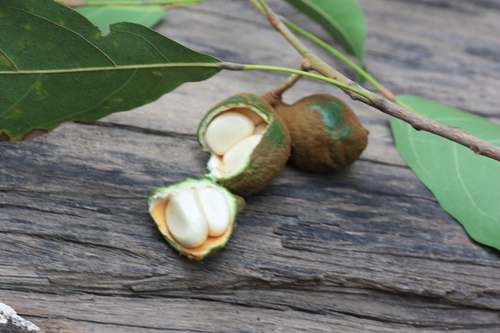
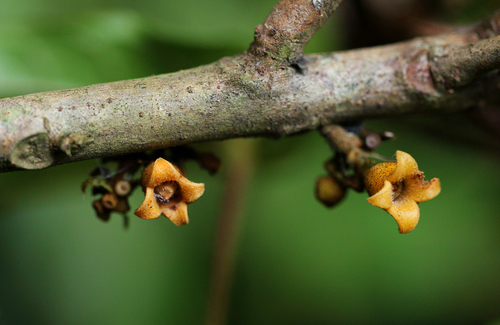
A shrub. It grows 3-4 m high. It varies in form. The stems are often 4 sided. The leaf blade is 5-14 cm long by 2-13 cm wide. They are oval and taper to the tip. They are heart shaped at the base. There are 3-5 lobes. There are teeth along the edge. There is a hairy covering on the leaves. The flowering shoot is large. The petals are yellow. The fruit are about 10 mm across.
Edible Uses
The leaves are eaten as a vegetable and used as a flavoring. The sticky sap produced when bark is removed from stems is added to soups.
Traditional Uses
The sticky sap produced as the bark is removed from the stems is added to soups.
This uses section is brief — help expand it
Medicinal Uses
All parts of the plant are widely used in African traditional medicine. Modern research has discovered a number of active compounds within the plant, some of which have proven medicinal efficacy. The stem is mucilaginous and recorded to be pungent. Two of the compounds it contains, maslinic acid and an oxidized derivative of betulin (betulinic acid), are known to have anti-HIV activity. An aqueous extract of the stem has been shown to induce weight loss and to have anti-hyperlipemic effects. The powdered root is mixed into food for the treatment of diarrhoea. Root preparations are applied as poultices on burns. The sap of the root or leaf, diluted with water, is taken to ease childbirth, to expel the placenta, and for the treatment of sterility in women. A maceration of the bark is used as a treatment for lumbago and muscle pain. Palm wine, in which the pounded bark has been steeped, is drunk in the treatment of lung problems. A decoction of the twigs with sugar is taken for the treatment of dyspnoea and intercostal neuralgia. In cases of insanity or possession, the sap of leafy twigs is drunk and the body is also sprinkled with it. The leaves are astringent, galactagogue, laxative, parturient. They are used in preparations to treat diarrhoea and dysentery; asthenia; marasmus; rhinitis; hepatitis; lumbago and muscle pain; and to help expel the placenta after childbirth. Young shoots are made into dressings for wounds to keep away insects. Softened leaves are rubbed on the affected areas as a treatment against lumbago, and warmed leaves are rubbed on the gums against caries. A decoction is applied as a wash against vaginal prolapse. An infusion of the flower is applied in enemas as a purgative, and ground flowers are steeped in water which is then drunk in the treatment of nausea.
Distribution
A tropical plant. It grows in waste land and forest clearings in West Africa. It grows in moist tropical regions. It grows in savannah woodland and in palm groves. It also grows in seasonally flooded land.
Where It Grows
Africa, Angola, Central Africa, Central African Republic, CAR, Congo DR, East Africa, Gambia, Ghana, Guinea, Guinée, Guinea-Bissau, Rwanda, Senegal, Sierra Leone, Tanzania, West Africa, Zambia,
Cultivation
It can be grown from cuttings.
Propagation
Seed - fairly easy, a germination rate of 80 - 90% can be expected. When cultivated for the mucilage in the stems, cuttings of 15 - 20cm long are taken from the top end of the harvested stems. Since the crop does not perform well under direct sunlight, the cuttings are usually planted in the shade of a tree. They are planted in a circle with a spacing of 10 - 15cm. If the cutting is not planted straight upward, adventitious roots may develop, causing a reduced capacity to produce slime. Therefore, some farmers tie the cuttings to a taller plant, e.g. plantain, to ensure that they grow upright.
Other Uses
A fibre is obtained from the bark of the stem and branches. Durable and water resistant, it is used for making strong rope, bowstring and fishing lines, brooms, bags, baskets, mats, hammocks, and traditional dancing costumes. It is sometimes made into belts used for climbing trees and palms, for instance to collect palm wine. Commercially, it has been used for making burlap cloth, sacks and packaging material. The fibre has the right balance between stiffness and elasticity to tie bundles into brooms. Fibre obtained from the branches is less flexible and more fragile than that from the stem. The fibre is comparable to jute (Corchorus spp.) in length and strength, but is less fine and flexible. Removing the bark from the stem requires some force. To obtain the fibre, the stem may be retted in water for several days. It takes more time in running water than in stagnant water, but the fibre obtained after soaking in running water has a lighter colour and better quality. It is difficult to extract the fibre from dry stems. Plant parts are locally used as toothbrushes.. The soft leaves have been used as toilet paper. Ash from the burnt leaves has been used for making soap and in the indigo industry. The wood is used for house construction. A rather strange entry, considering the plant is a shrub usually less than 2.5 metres tall with stems only 15mm in diameter. The stems are used as fuel wood and fire sticks. The plant is said to be resistant to fire and to have potential to be used in fire-breaks. This species is a host plant of the cotton stainer Dysdercus superstitiosus, a pest of cotton.
Production
In Central African Republic flowers have been recorded in November and fruit in December.
Notes
There are about 150 Triumfetta species. They are mostly in the tropics and subtropics. It has also been put in the family Sparmanniaceae. It may eventually be put in the family Malvaceae. These have also been in the family Tiliaceae.
Also Known As
Gingone, Kivungala, Luvunga, Mamanata, Mpungala, Mpunguela, Mutembe, Mvungila, Ngongi, Pilipi, Punquila, Umunaaba, Umusaareenda, Xipunga
References (16)
- Abbiw, D.K., 1990, Useful Plants of Ghana. West African uses of wild and cultivated plants. Intermediate Technology Publications and the Royal Botanic Gardens, Kew. p 42
- Busson, 1965,
- Dalziel, J. M., 1937, The Useful plants of west tropical Africa. Crown Agents for the Colonies London.
- Exell, A.W. et al, (Ed), 1963, Flora Zambesiaca Vol 2 Part 1 Crown Agents, London. p 76
- Flora Zambesiaca. http://apps.kew.org/efloras
Show all 16 references Hide references
- Fowler, D. G., 2007, Zambian Plants: Their Vernacular Names and Uses. Kew. p 46
- Grubben, G. J. H. and Denton, O. A. (eds), 2004, Plant Resources of Tropical Africa 2. Vegetables. PROTA, Wageningen, Netherlands. p 536
- A. Guillemin et al., Fl. Seneg. tent. 1:91, t. 18. 1831
- http://aflora.africa.kyoto-u.ac.jp
- Jardin, C., 1970, List of Foods Used In Africa, FAO Nutrition Information Document Series No 2.p 108
- Latham, P., 2004, Useful Plants of Bas-Congo province. Salvation Army & DFID p 286
- Lautenschläger, T., et al, 2018, First large-scale ethnobotanical survey in the province of Uíge, northern Angola. Journal of Ethnobiology and Ethnomedicine (2018) 14:51
- Martin, F.W. & Ruberte, R.M., 1979, Edible Leaves of the Tropics. Antillian College Press, Mayaguez, Puerto Rico. p 221
- Peters, C. R., O'Brien, E. M., and Drummond, R.B., 1992, Edible Wild plants of Sub-saharan Africa. Kew. p 194
- Terashima, H., et al, 1992, Ethnobotany of the Lega in the Tropical Rainforest of Eastern Zaire (Congo): Part Two, Zone de Walikale, African Study Monographs, Suppl. 19:1-60
- World Checklist of Useful Plant Species 2020. Royal Botanic Gardens, Kew