Thyrsostachys siamensis
(Kurz ex Munro) Gamble
Umbrella-handle bamboo, Monastery-bamboo
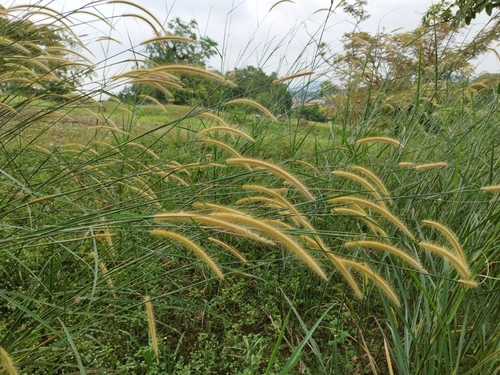
iNaturalist· cc-by-nc-sa
(c) Tony Rodd, some rights reserved (CC BY-NC-SA)
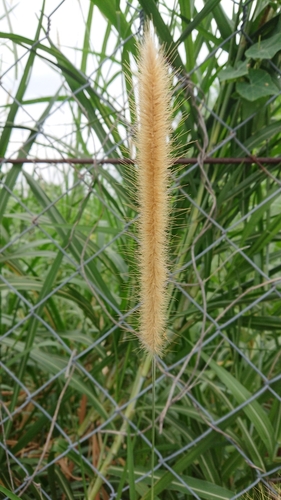
iNaturalist· cc-by-nc
(c) Phan Vũ Phúc Lân, some rights reserved (CC BY-NC)
Summary
Source: WikipediaThyrsostachys siamensis is one of two bamboo species belonging to the genus Thyrsostachys. It grows up to 7 to 13m tall. It is native to Yunnan, Myanmar, Laos, Thailand, Vietnam and naturalised in Sri Lanka, Bangladesh, Malaysia. The plant is also known as long-sheath bamboo, monastery bamboo, Thai bamboo, Thai umbrella bamboo, umbrella bamboo, and umbrella-handle bamboo.
Description
A bamboo. It forms tufts. The stems are erect or can bend over at the tip. They grow 8-14 m tall and are 2-8 cm across. They are smooth and greyish-green. It is 15-30 cm between the joints or nodes. The leaf blades are narrowly sword shaped and 7-14 cm long by 5-8 mm wide. The flowers are at the ends of the stems.
Edible Uses
Young shoots are cooked and eaten as a vegetable. They are considered to be among the finest of all bamboo shoots.
Traditional Uses
The shoots are cooked and eaten. They are also dried and stored.
This uses section is brief — help expand it
Medicinal Uses
None known
Distribution
A tropical plant. In southern China it grows in river valleys and hilly forested areas between 500-1,000 m above sea level. In the Cairns Botanical Gardens. In XTBG Yunnan.
Where It Grows
Asia, Australia, Cambodia, China, India, Indochina, Indonesia, Laos, Malaysia, Myanmar, SE Asia, Singapore, Thailand,
Cultivation
It grows best in areas where annual daytime annual temperatures are within the range 20 - 29°c, though it can tolerate 15 - 34°c. It prefers a mean annual rainfall of 1,000 - 2,000mm, but tolerates 600 - 4,500mm. It is found in areas both with and without a distinct dry season. Succeeds in full sun and in light shade. Prefers a heavy soil. Often found in poor soils in the wild, though it can tolerate a range of soils if they are well drained. Prefers a pH in the range 6 - 6.5, tolerating 5.5 - 7. Bamboos have an interesting method of growth. Each plant produces a number of new stems annually - these stems grow to their maximum height in their first year of growth, subsequent growth in the stem being limited to the production of new side branches and leaves. In the case of some mature tropical species the new stem could be as much as 30 metres tall, with daily increases in height of 30cm or more during their peak growth time. This makes them some of the fastest-growing species in the world. In natural populations the plant produces young shoots during the rainy season. Good years, when many new shoots are produced, alternate with poor years with many fewer new shoots. Generally, more shoots are produced if the rain is abundant. A clump is considered as good if it has 30 culms on average, but clumps may have up to 100 culms. In Thailand, a 3-year-old plantation, raised from seeds, produced on average 38 culms per clump with an average diameter of 14 - 23mm, of which 28 culms per clump were harvestable on average. Bamboos in general are usually monocarpic, living for many years before flowering, then flowering and seeding profusely for a period of 1 - 3 years before usually dying. Flowering is sporadic and gregarious. After flowering, the culms usually die. Gregarious flowering is rare and the flowering cycle is not known. Spacing: 30-40 ft. (9-12 m).
Propagation
Seed stored at room temperature gradually loses viability over 12–18 months; in cool storage at 2–4°C, good viability is retained for at least two years. Sow fresh seed for best results — it germinates within days, with 90–95% germination rates. Rhizome cuttings are taken from 1-year-old culms and comprise a length of rhizome with roots plus a culm up to 1 metre long. Plant in a nursery for 2–3 months, then transplant to the field during the rainy season. Generally, 10 rhizome cuttings can be taken from a 5–6-year-old clump, leaving 4–5 one-year-old culms in the clump.
Other Uses
The plant is cultivated as a windbreak. As a closely spaced, deep-rooting pioneer species, it is effective for permanent vegetation cover in soil conservation and erosion control. The culms are light, strong, and straight, used in house construction, general household applications, and cottage industries. They are made into baskets, chopsticks, umbrella and broom handles, handicrafts, and fishing rods, and serve as raw material for paper pulp and as fuel. The species is traditionally used to produce umbrella handles for people of high rank and for monks and priests. After harvesting, culms are submerged for 10–20 days in running water to reduce starch and sugar content, then cleaned, polished, and dried. For furniture making, culms are fire-cured, a process requiring considerable skill to avoid damage.
Production
A shoot weighs between 0.1-0.5 kg.
Other Information
It is cultivated.
Synonyms
Also Known As
Bambu jepang, Bambu siam, Htiyo-wa, Kyaung wa, Maihuo, Normai huak, Phai huak, Phai ruak, Tam vong rung, Thai bamboo, Thailand bamboo, Tiyowa
References (16)
- Ambasta, S.P. (Ed.), 2000, The Useful Plants of India. CSIR India. p 638
- Anderson, E. F., 1993, Plants and people of the Golden Triangle. Dioscorides Press. p 223
- Ann. Roy. Bot. Gard. (Calcutta) 7:59. 1896
- Dransfield, S. & Widjaja, EA., 1995, Plant Resources of South East Asia. PROSEA No. 7 Bamboos. Leiden. p 21
- Hibbert, M., 2002, The Aussie Plant Finder 2002, Florilegium. p 300
Show all 16 references Hide references
- http://www.plantnames.unimelb.edu.au/sorting/Bamboos_Edible.html
- Japanese International Research Centre for Agricultural Science www.jircas.affrc.go.jp/project/value_addition/Vegetables
- Somnasang, P., Moreno, G and Chusil K., 1998, Indigenous knowledge of wild hunting and gathering in north-east Thailand. Food and Nutrition Bulletin 19(4) p 359f
- Srichaiwong, P., et al, 2014, A Study of the Biodiversity of Natural Food Production to Support Community Upstream of Chi Basin, Thailand. Asian Social Science 10 (2):
- Sukarya, D. G., (Ed.) 2013, 3,500 Plant Species of the Botanic Gardens of Indonesia. LIPI p 851
- Tanaka, Y & Van Ke, N., 2007, Edible Wild Plants of Vietnam. Orchid Press. p 120
- USDA, ARS, National Genetic Resources Program. Germplasm Resources Information Network - (GRIN). [Online Database] National Germplasm Resources Laboratory, Beltsville, Maryland. Available: www.ars-grin.gov/cgi-bin/npgs/html/econ.pl (10 April 2000)
- Wiersema, J. H. & Leon, B., 2013, World Economic Plants. A Standard Reference CRC Press. 2nd Ed. p 686
- World Checklist of Useful Plant Species 2020. Royal Botanic Gardens, Kew
- Xu, You-Kai, et al, 2004, Wild Vegetable Resources and Market Survey in Xishuangbanna, Southwest China. Economic Botany. 58(4): 647-667.
- Yang, Y., et al, A review of bamboo resources in Yunnan, China www.bioversityinternational.org