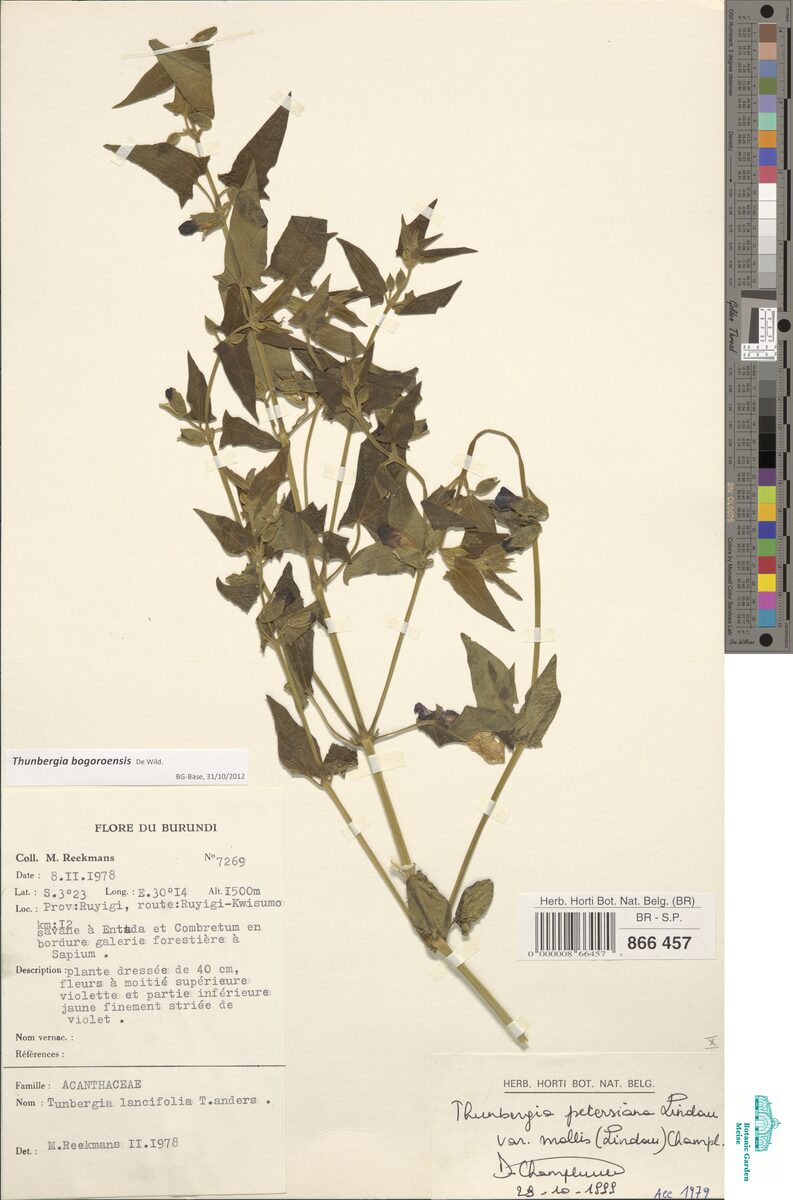
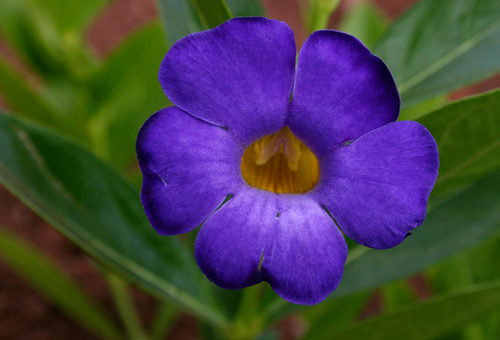
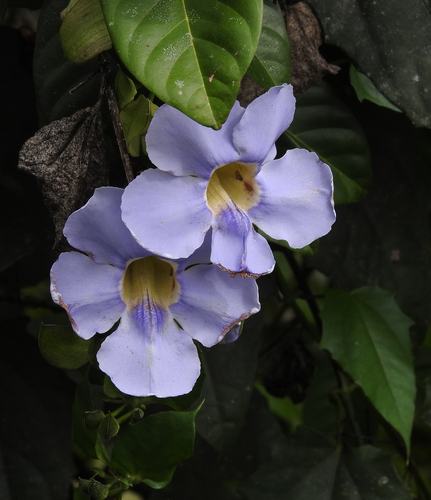
Thunbergia alata
Bojer ex Sims
Black-eyed-Susan vine
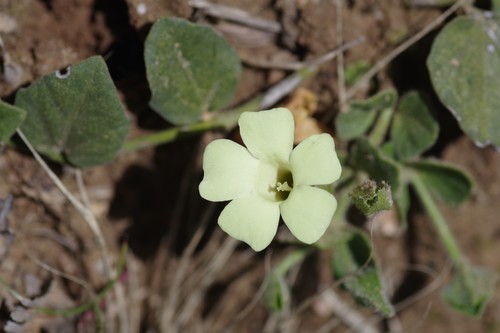
iNaturalist· cc-by-nc
(c) Isabella Quintero, some rights reserved (CC BY-NC)
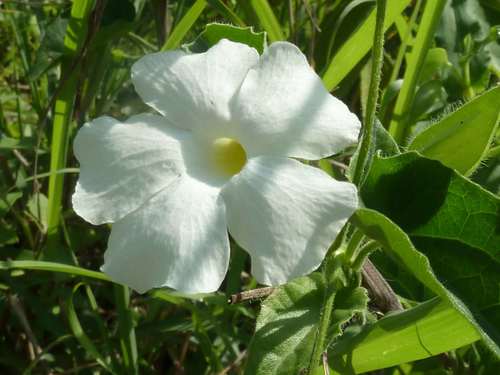
iNaturalist· cc-by-nc
(c) scheidtsantos, some rights reserved (CC BY-NC)
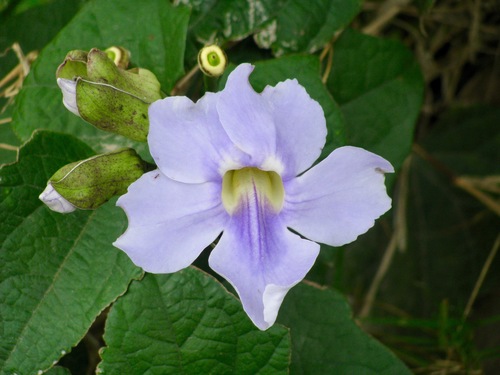
iNaturalist· cc-by-nc
(c) scheidtsantos, some rights reserved (CC BY-NC)
Summary
Source: WikipediaThunbergia alata, commonly called black-eyed Susan vine, is a herbaceous perennial climbing plant species in the family Acanthaceae. It is native to Eastern Africa, and has been naturalized in other parts of the world. It is grown as an ornamental plant in gardens and in hanging baskets. The name 'Black-eyed Susan' is thought to have come from a character that figures in many traditional ballads and songs. In the Ballad of Black-eyed Susan by John Gay, Susan goes aboard a ship in-dock to ask the sailors where her lover Sweet William has gone. Black-eyed Susan is also a name given to other species of flowers in the genus Rudbeckia.
Description
An evergreen twining climber. It keeps growing from year to year but is often grown as an annual plant. It grows 2.5 m high but is shorter if grown as an annual. The stems are slender, weak and twining. It winds to the right. The leaves are oval or triangular shaped with teeth along the edge. The are mid green colour. Leaves are 8 cm long with angular lobes at the base of the leaf. The leaf stalks have narrow wings. The flower has a long tube but spreads out at the top. The flowers are produced singly in the axils of the leaves. Many flowers are produced. Flowers are 3-4 cm across. They are usually bright orange-yellow. They can have a chocolate coloured centre. The petals can be white. Fruit are round 2-celled capsules. There can be 1-2 seeds in each cell. The seeds are irregularly ribbed on the back.
Edible Uses
The leaves are cooked and eaten as a vegetable. The seeds have been used as flavouring in relishes and chutneys.
Traditional Uses
The leaves are cooked and eaten as a vegetable. Caution: The leaves can contain poisonous compounds. The seeds have been used as flavouring in relishes and chutneys.
Medicinal Uses
The leaves are used as a drink for diarrhoea.
Known Hazards
The leaves can contain poisonous compounds.
Distribution
A tropical plant. It occurs naturally in tropical Africa. It needs a temperature above 7°C. It is damaged by drought and frost. It does best with a well-drained soil and a protected sunny position. In Papua New Guinea it grows from sea level to 1,000 m altitude. It can grow in arid places. In Argentina it rrows from sea level to 1,000 m above sea level. It suits hardiness zones 10-12. In Yunnan.
Where It Grows
Africa*, Argentina, Asia, Australia, Bahamas, Botswana, Brazil, Caribbean, Central Africa, Central America, China, Congo, Côte d'Ivoire, Cuba, Dominica, Dominican Republic, East Africa, Eswatini, Ethiopia, Fiji, Guianas, Guyana, Haiti, Hawaii, India, Ivory Coast, Jamaica, Kenya, Liberia, Malawi, Malaysia, Mauritius, Mozambique, Myanmar, Niger, Niue, Pacific, Paraguay, Papua New Guinea, PNG, Puerto Rico, Rwanda, Samoa, SE Asia, Sierra Leone, Southern Africa, South Africa, Sri Lanka, Suriname, Swaziland, Tonga, Uganda, West Africa, West Indies, Zambia, Zimbabwe,
Cultivation
It can be grown from seed or cuttings. The seed are sown 6 mm deep. The seedlings can be transplanted. Plants should be spaced 30 cm apart. It is grown as an annual plant in temperate climates.
Propagation
Seed - Cuttings.
Other Uses
The fruit resembles a diminuitive gourd and is used as such in play and as a spinning top by the children. The plant grows well as part of a hedge, responding well to trimming.
Production
It is fast growing.
Other Information
The leaves are only recorded as eaten in a few places. They are also used as a drink for diarrhoea.
Notes
There are about 200 Thunbergia species. It is sometimes used as a ground cover in plantations.
Synonyms
Also Known As
Akar ulan, Gisaayuura, Karkakubu, Krilata tunbergija, Matamavu
References (35)
- Acevedo-Rodriguez, P., 2005, Vine and Climbing Plants of Puerto Rico and the Virgin islands. Contributions to the United States National Herbarium. Volume 51:1-483 p 48
- Ambasta, S.P. (Ed.), 2000, The Useful Plants of India. CSIR India. p 637
- Bodkin, F., 1991, Encyclopedia Botanica. Cornstalk publishing, p 982
- Bot. Mag. 52: t. 2591. 1825
- Brickell, C. (Ed.), 1999, The Royal Horticultural Society A-Z Encyclopedia of Garden Plants. Convent Garden Books. p 1010
Show all 35 references Hide references
- Burkill, H. M., 1985, The useful plants of west tropical Africa, Vol. 1. Kew.
- Burkill, I.H., 1966, A Dictionary of the Economic Products of the Malay Peninsula. Ministry of Agriculture and Cooperatives, Kuala Lumpur, Malaysia. Vol 2 (I-Z) p 2197
- Burnie, G.(Ed.), 2003, Annuals and Bulbs. The Gardener's Handbooks. Fog City Press. p 230
- Cooper, W. and Cooper, W., 2004, Fruits of the Australian Tropical Rainforest. Nokomis Editions, Victoria, Australia. p 12
- Cundall, P., (ed.), 2004, Gardening Australia: flora: the gardener's bible. ABC Books. p 1414
- Grubben, G. J. H. and Denton, O. A. (eds), 2004, Plant Resources of Tropical Africa 2. Vegetables. PROTA, Wageningen, Netherlands. p 530
- Henty, E.E., & Pritchard, G.S., 1973, Weeds of New Guinea and their control. Botany Bulletin No 7, Division of Botany, Lae, PNG. p 51
- Herb., E. A., 1981,
- Hibbert, M., 2002, The Aussie Plant Finder 2002, Florilegium. p 299
- http://www.botanic-gardens-ljubljana.com/en/plants
- Jardin, C., 1970, List of Foods Used In Africa, FAO Nutrition Information Document Series No 2.p 106
- Joyce, D., 1998, The Garden Plant Selector. Ryland, Peters and Small. p 187
- Lamp, C & Collet F., 1989, Field Guide to Weeds in Australia. Inkata Press. p 299
- Lazarides, M. & Hince, B., 1993, Handbook of Economic Plants of Australia, CSIRO. p 236
- Llamas, K.A., 2003, Tropical Flowering Plants. Timber Press. p 39
- Lord, E.E., & Willis, J.H., 1999, Shrubs and Trees for Australian gardens. Lothian. p 338
- Martin, F.W. & Ruberte, R.M., 1979, Edible Leaves of the Tropics. Antillian College Press, Mayaguez, Puerto Rico. p 62, 79, 172
- Parham, B. E. V., 1972, Plants of Samoa. New Zealand Department of Scientific and Industrial Research. Information Series. No. 85 p 116
- Peekel, P.G., 1984, (Translation E.E.Henty), Flora of the Bismarck Archipelago for Naturalists, Division of Botany, Lae, PNG. p 512, 516
- Peters, C. R., O'Brien, E. M., and Drummond, R.B., 1992, Edible Wild plants of Sub-saharan Africa. Kew. p 45
- Pickering, H., & Roe, E., 2009, Wild Flowers of the Victoria Falls Area. Helen Pickering, London. p 19
- Plants of Haiti Smithsonian Institute http://botany.si.edu
- Royal Botanic Gardens, Kew (1999). Survey of Economic Plants for Arid and Semi-Arid Lands (SEPASAL) database. Published on the Internet; http://www.rbgkew.org.uk/ceb/sepasal/internet [Accessed 24th March 2011]
- Staples, G.W. and Herbst, D.R., 2005, A tropical Garden Flora. Bishop Museum Press, Honolulu, Hawaii. p 93
- Swaziland's Flora Database http://www.sntc.org.sz/flora
- von Katja Rembold, 2011, Conservation status of the vascular plants in East African rain forests. Dissertation Universitat Koblenz-Landau p 183
- White, F., Dowsett-Lemaire, F. and Chapman, J. D., 2001, Evergreen Forest Flora of Malawi. Kew. p 119
- World Checklist of Useful Plant Species 2020. Royal Botanic Gardens, Kew
- Yimer, A., et al, 2021, Ethnobotanical study of wild edible plants used by Meinit Ethnic Community at Bench-Maji Zone, Southwest Ethiopia. Research Square. p 5
- Yuncker, T.G., 1959, Plants of Tonga, Bernice P. Bishop Museum, Hawaii, Bulletin 220. p 242