Peristrophe roxburghiana
(Schultes) Bremekamp
Red silk-thread
iNaturalist· cc-by-nc
(c) linlin0404, some rights reserved (CC BY-NC)
iNaturalist· cc0
no rights reserved
iNaturalist· cc0
no rights reserved
Description
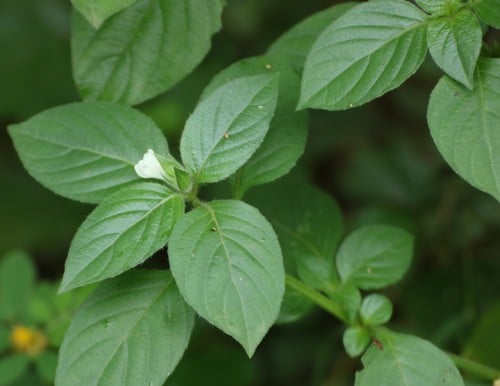
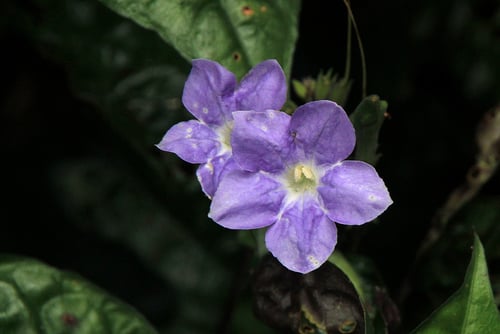
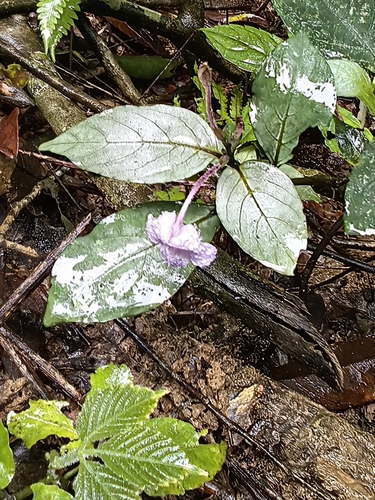
A herb. It keeps growing from year to year. It grows 20-40 cm high. It is softly hairy. The stems have 4-6 stripes along them. The leaves are opposite and oval. They are 4-9 cm long by 2-4 cm wide. They taper to the end and are wedged shaped at the base. The flowers are rose-purple. The fruit is a capsule. It is 1 cm long.
Edible Uses
An extract of its leaves is used as a food dye, and imparts a magenta tone to some Vietnamese foods, particularly in a taro-filled cake called bánh da lợn and glutinous rice dishes such as xôi lá cẩm, a sweet dessert.
Traditional Uses
The leafy shoots, with or without flowers, are used for making soup or tea. The leaves are used to dye sticky cakes. Caution: The leaves should not be used as a medicine by pregnant women.
Medicinal Uses
The plant is used in traditional Chinese medicine. The leaves have been used in water extract decoctions for the treatment of ailments including cough, dysentery, diarrhoea and bronchitis.
Distribution
It is a tropical plant. It is native to southern China. It grows in damp shady valleys.
Where It Grows
Asia, China, Himalayas, India, Indochina, Northeastern India, SE Asia, Vietnam,
Other Uses
A purplish or orange-red dye is obtained from the leaves and twigs. It is used to colour cotton and matting, either on its own or in combination with other plants such as the leaves of Hemigraphis sp. And Symplocos sp.; the root-bark of Morinda citrifolia; or in a mixture with the leaves of Melastoma sp. And the bark of Ceriops sp. When dyeing, the leaves and young stems are cut off, put into water, and boiled with the object to be dyed. The dyeing material is prepared for sale by pounding the leaves and young stems into a pulp and drying it in the sun. A mordant seems to be unnecessary.
Other Information
It is commonly grown as a food dye.
Also Known As
Cam, La cam, Taging-hamang
References (3)
- Gangwar, A. K. & Ramakrishnan, P. S., 1990, Ethnobotanical Notes on Some Tribes of Arunachal Pradesh, Northeastern India. Economic Botany, Vol. 44, No. 1 pp. 94-105
- Hu, Shiu-ying, 2005, Food Plants of China. The Chinese University Press. p 676
- Tanaka, Y. & Van Ke, N., 2007, Edible Wild Plants of Vietnam: The bountiful garden. Orchid books. p 16