Thaumatococcus daniellii
(Benn.) Benth. ex B. D. Jacks.
Miraculous fruit, Supersweet
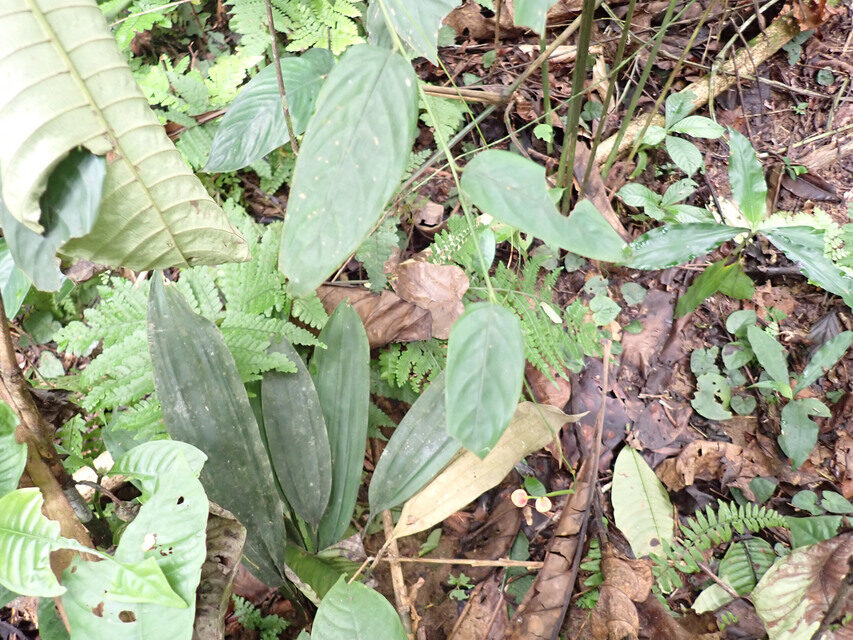
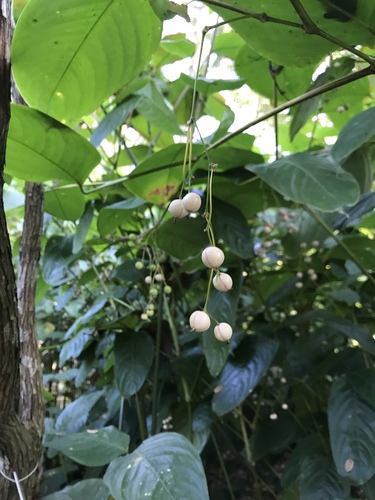
iNaturalist· cc-by-nc-sa
(c) 106611639464075912591, some rights reserved (CC BY-NC-SA), uploaded by 106611639464075912591
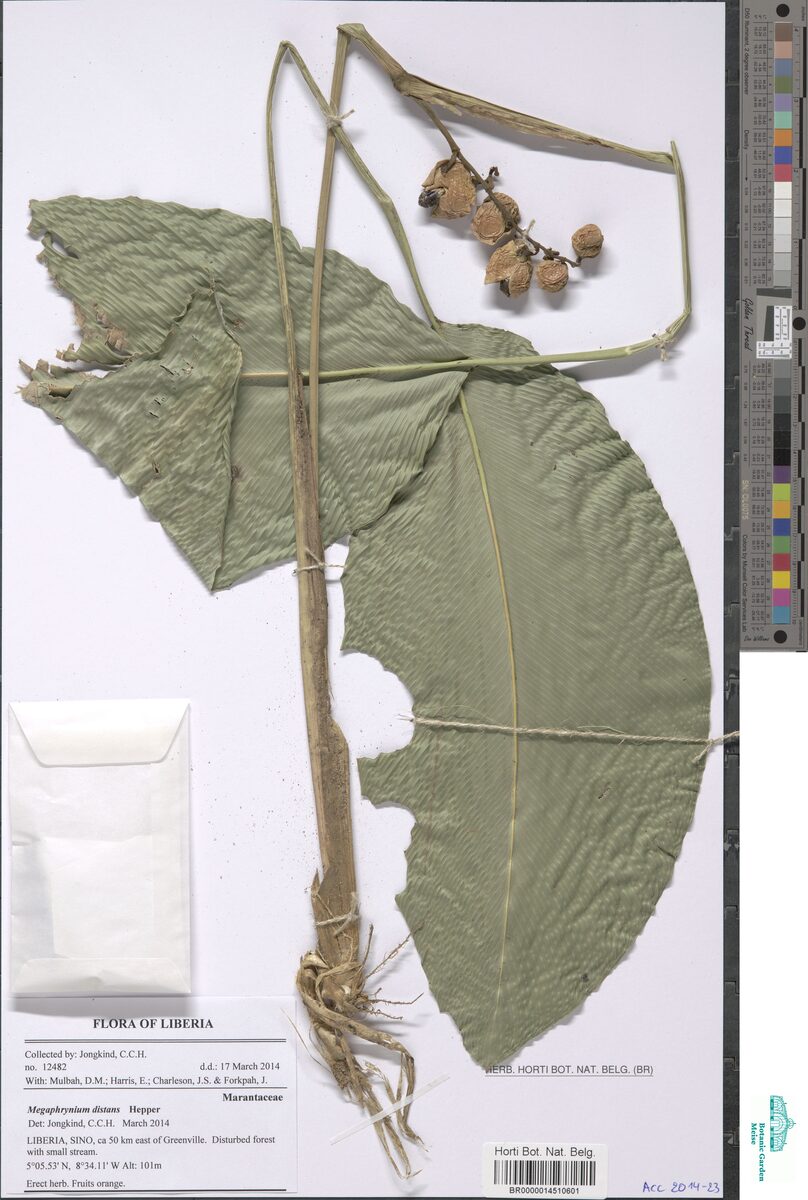
iNaturalist· cc-by-nc
(c) Carel Jongkind, some rights reserved (CC BY-NC), uploaded by Carel Jongkind
Summary
Source: WikipediaThaumatococcus daniellii, also known as miracle fruit, is a plant species from tropical Africa of the Marantaceae (arrowroot and prayer plant) family. It is a large, rhizomatous, flowering herb native to the rainforests of western Africa in Sierra Leone, southeast to Gabon and the Democratic Republic of the Congo. It is also an introduced species in Australia and Singapore. The species is relevant in nutritional studies (similarly to its many edible and useful relatives, including arrowroot, bananas, cannas, cardamom, gingers and turmeric), as it is known for being the natural source of thaumatin, an intensely-sweet protein. The protein is being tested in the creation of possible healthier sweeteners. When the fleshy part of the fruit is eaten, the thaumatin molecule binds to the tongue’s taste buds, triggering a “sweet” sensation that slowly builds, leaving a lingering aftertaste. T. daniellii grows 3-4m (up to 13’) in height, and has large, banana-like leaves, growing up to 46 cm (1’) long. It bears pale, purple flowers and a soft fruit, containing shiny, black seeds. The fruit is covered in a fleshy, red aril, the part that contains thaumatin. In its native range, the plant has a number of uses besides flavoring; the sturdy leaf petioles are used as tools and building materials, the leaves are used to wrap food, and the leaves and seeds have a number of traditional medicinal uses. Common names for this plant include katamfe or katempfe, uma in Igbo, ewe eran in Yoruba, Yoruba soft cane and African serendipity berry; the unrelated species Synsepalum dulcificum is more commonly known by the latter name. As part of an experiment by the Warsaw University of Life Sciences, a gene from T. daniellii was inserted into a cucumber plant to test for an increase in sweet flavor (or perceived sweetness) by humans.
Description
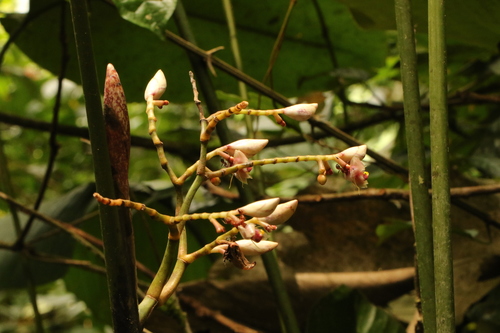
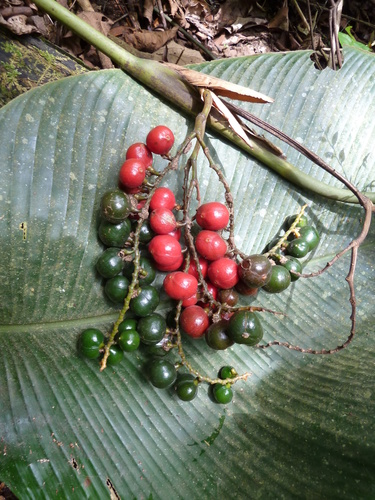
A herb which forms rhizomes. It has a short stem bearing a single leaf. The leaves are 30-60 cm long and 40 cm wide and dark green. They are on leaf stalks up to 75 cm long. These grow from the rhizome. The flowers are in a raceme with branched flowers around a central stalk. This is 10 cm long. The fruit are triangular capsules. The fruit are red. They are produced on 15 cm long stalks which come from the base. The fruit are 3 cm across. They have 3 sections. The seed are 3 sided. They have a white aril or layer around them.
Edible Uses
The seed can be eaten raw or cooked and has a very sweet flavour. When a raw seed is chewed, it affects the taste buds so that sour foods consumed during the following hour seem sweet. The seeds are also used to sweeten bread, fruits, tea, and other foods. The aril of the seed contains a sweet-tasting protein called thaumatin, which can be used as a sugar substitute in low-calorie diets and drinks. Because of its persistent sweet aftertaste, thaumatin also effectively masks bitter or sour flavours. Thaumatin is the sweetest known natural or synthetic substance, rated 2,000–3,000 times sweeter than sucrose. The leaves are used for wrapping food, though it is not specified whether they impart flavour during cooking or are used only for storage wrapping.
Traditional Uses
The fruit are used to sweeten food or drink. It can be used to sweeten bread, palm wine, and tea. They can be eaten raw. The seed are chewed and are very sweet. The leaves are employed as food wrappers. They also add flavour.
Medicinal Uses
None known
Distribution
A tropical plant. It needs warm, sheltered, frost free sites. It grows in lowland tropical rainforest. It suits humid locations.
Where It Grows
Africa*, Asia, Australia, Benin, Burkina Faso, Cameroon, Central Africa, Congo DR, Côte d'Ivoire, Guinea, Guinée, Ivory Coast, Liberia, Malaysia, Nigeria, Sao Tome and Principe, SE Asia, Sierra Leone, Singapore, West Africa,
Cultivation
It can be grown from seed or division of the rhizome. Plants are spaced 1 m apart.
Propagation
Seed. Rhizome cuttings.
Other Uses
The leaves are used as food wrappers, as a packing material, and for roofing.
Production
First flowering starts 3 months after planting. Good fruit develop in plants over 2 years old. Young fruit mature in 13 weeks. In Liberia the fruit are produced from November to April.
Other Information
It is a commonly used food in West Africa.
Notes
It contains a sweetener called Thaumatin. Thaumaton is 2000-3000 times sweeter than sucrose.
Synonyms
Also Known As
Abieba, Etere, Gbayea, Katamfe, Katemfe, Kolo, Kologale, Kor bayea, Lengongo, Likongo, Lokongo, Mangungu, Mrouabo, Ndete, Ngongo, Nzilizili, Okongolo, Poli, Sweet prayer, Wulubedoekway
References (27)
- Ambe, G., 2001, Les fruits sauvages comestibles des savanes guinéennes de Côte-d’Ivoire : état de la connaissance par une population locale, les Malinké. Biotechnol. Agron. Soc. Environ. 5(1), 43-48
- Burkill, H. M., 1985, The useful plants of west tropical Africa, Vol. 1. Kew.
- Burkill, I.H., 1966, A Dictionary of the Economic Products of the Malay Peninsula. Ministry of Agriculture and Cooperatives, Kuala Lumpur, Malaysia. Vol 2 (I-Z) p 2185
- Busson, 1965,
- Davis, S.D., Heywood, V.H., & Hamilton, A.C. (eds), 1994, Centres of plant Diversity. WWF. Vol 1. p 165
Show all 27 references Hide references
- Diop, A. l., et al, 2021, Cultural importance of wild edible plants in three sympatric communities: Agni, Akyé and Gwa in the Department of Alépé (Southeast of Côte d’Ivoire). Ethnobotany Research and Applications 22:35. p 7
- Facciola, S., 1998, Cornucopia 2: a Source Book of Edible Plants. Kampong Publications, p 149
- Gouldstone, S., 1978, Australian and New Zealand Guide to food bearing plants. Books for Pleasure. p 64
- Gouldstone, S., 1983, Growing your own Food-bearing Plants in Australia. Macmillan p 172
- Grivetti, L. E., 1980, Agricultural development: present and potential role of edible wild plants. Part 2: Sub-Saharan Africa, Report to the Department of State Agency for International Development. p 33
- Hibbert, M., 2002, The Aussie Plant Finder 2002, Florilegium. p 298
- Hwang, L. C., et al, 2020, Traditional Botanical Uses of Non-Timber Forest Products (NTFP) in Seven Counties in Liberia. ACS Symposium Series; American Chemical Society: Washington, DC, 2020.
- Index kewensis 1061. 1895 "danielli" (G. Bentham & J. D. Hooker, Gen. pl. 3:652. 1883, nom. inval.)
- Jardin, C., 1970, List of Foods Used In Africa, FAO Nutrition Information Document Series No 2.p 23
- Liengola, I. B., 2001, A contribution to the study of native edible plants by the Turumbu and Lokele of the Tshopo District, Province Orientale, D. R. Congo. Syst. Geogr. Pl. 71:687-698
- Manvell, A., 2011, Use of Non-Timber Forest Products around Sapo National Park, Liberia (Report B) p 17
- Milow, P., et al, 2013, Malaysian species of plants with edible fruits or seeds and their evaluation. International Journal of Fruit Science. 14:1, 1-2
- Mosango, M., Szafranski, F., 1985, Plantes sauvages à fruits comestibles dans les environs de Kisangani (Zaïre). In: Journal d'agriculture traditionnelle et de botanique appliquée, 32e année, pp. 177-190
- Peters, C. R., O'Brien, E. M., and Drummond, R.B., 1992, Edible Wild plants of Sub-saharan Africa. Kew. p 35
- PROSEA handbook Volume 13 Spices. p 252, 265
- Tanno, T., 1981, Plant Utilization of the Mbuti Pygmies: With Special reference to their Material Culture and Use of Wild Vegetable Foods. Kyoto University Research. African Study Monographs 1:1-54
- Terashima, H., & Ichikawa, M., 2003, A comparative ethnobotany of the Mbuti and Efe hunter-gatherers in the Ituri Forest, Democratic Republic of Congo. African Study Monographs, 24 (1, 2): 1-168, March 2003
- Termote, C., et al, 2011, Eating from the wild: Turumbu, Mbole and Bali traditional knowledge of non-cultivated edible plants, District Tshopo, DRCongo, Gen Resourc Crop Evol. 58:585-618
- Ubom, R. M., 2010, Ethnobotany and Diversity Conservatioon in the Niger Delta, Nigeria. International Journal of Botany. 6(3): 310-322
- Vickery, M.L. and Vickery, B., 1979, Plant Products of Tropical Africa, Macmillan. p 39
- Wiersema, J. H. & Leon, B., 2013, World Economic Plants. A Standard Reference CRC Press. 2nd Ed. p 682
- World Checklist of Useful Plant Species 2020. Royal Botanic Gardens, Kew