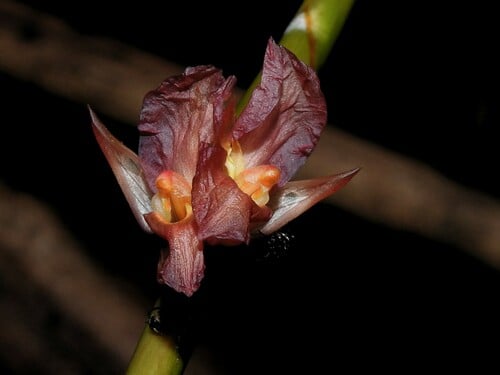
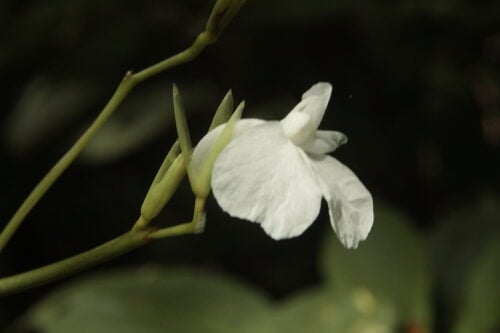
Schumannianthus dichotomus
(Roxb.) Gagnep.
Mohtra reed, Sitalpati plant
Wikipedia· cc-by-sa
Wikimedia Commons - Murta_tree.jpg
wikimedia· cc-by-sa
Wikimedia Commons - Rubel Das
Summary
Source: WikipediaSchumannianthus dichotomus, also known as 'cool mat', is a species of flowering plant first described by Roxburgh, with its current name after Gagnepain. The species belongs to the family Marantaceae and no subspecies are listed. S. dichotomus is typically found in muddy riparian areas; it is known as Pati Doi in Assamese and Murta in Sylheti, Mostak, Pati bet patipata and paitara in Bengali; in Vietnamese it is called lùm nước; in Thai it is called Khla; in Myanmar is called Thin; in Chittagong it is called "Fadirjam (ফাডিরজাম)".
Description
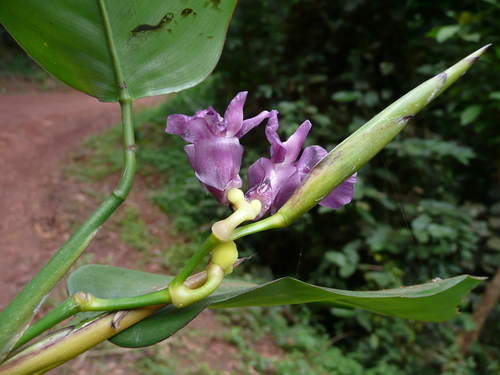
A herb. It has rhizomes or underground stems. The above ground stems are glossy green and erect. They can be 3-5 m tall and 2 cm across. The stems are leafy and branched.
Edible Uses
The plant used for making the Shital pati a traditional bed mat in Bangladesh and East India. Traditional artisans make strips from the outer portion of the stem including the epidermal part. These split strips are processed and plaited into mats. Murta splits are also used for making prayer mats, baskets, bags, novelty items, etc. The strips from the pith portion are used as binding materials. Forestry Master Plan (1982) of Bangladesh estimates that about 8,000 people are employed in sitalpati making in the country. Swampy and marshy lands are suitable for murta cultivation. Traditionally it is propagated through rhizomes, but can be also propagated through branch cuttings. The propagules are planted during the months of May–June. After planting it takes 2–3 years to reach the harvestable size. February–March is the harvesting period. It can also be propagated through seeds. It grows well in partial shade. So, farmers often plant Erythrina trees in murta fields. It needs no special management other than weeding. In the traditional production of Tungrymbai, an Indian fermented soybean food, the leaves are packed together with boiled soybeans.
Traditional Uses
The rhizome is boiled and eaten. The leaves are packed together with boiled soybeans to make a fermented food.
This uses section is brief — help expand it
Distribution
It is a tropical plant. It grows in swamp forests.
Where It Grows
Asia, Bangladesh, Cambodia, India, Indochina, Indonesia, Malaysia, Myanmar, Northeastern India, Philippines, SE Asia, Thailand, Vietnam,
Cultivation
It can be grown from rhizomes. It can also be grown from branch cuttings.
Other Information
Rhizomes are sold in local markets.
Synonyms
Also Known As
Hnah-thial-alu, Hnathel, Hpogimbai, Tha lairu, Thin, Thin-byu, Thin-phyu
References (2)
- Kar, A., et al, 2013, Wild Edible Plant Resources used by the Mizos of Mizoram, India. Kathmandu University Journal of Science, Engineering and Technology. Vol. 9, No. 1, July, 2013, 106-126 (As Maranta dichotoma)
- Lim, T. K., 2015, Edible Medicinal and Non Medicinal Plants. Volume 9, Modified Stems, Roots, Bulbs. Springer p 54