Terminalia sericocarpa
F. Muell.
Damson, Sovereignwood, Damson plum
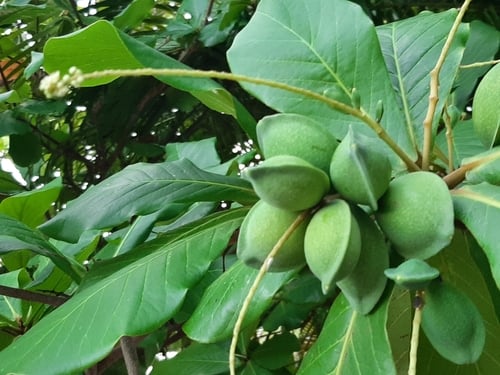
iNaturalist· cc-by-nc
(c) Russell Cumming, some rights reserved (CC BY-NC)
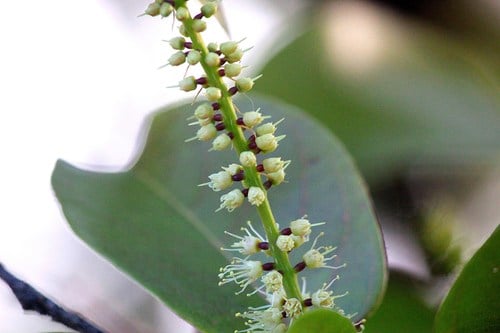
iNaturalist· cc-by-nc
(c) Russell Cumming, some rights reserved (CC BY-NC)
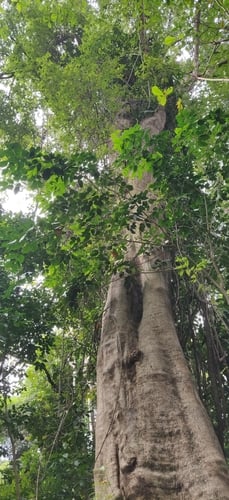
iNaturalist· cc-by-nc
(c) Russell Cumming, some rights reserved (CC BY-NC)
Description
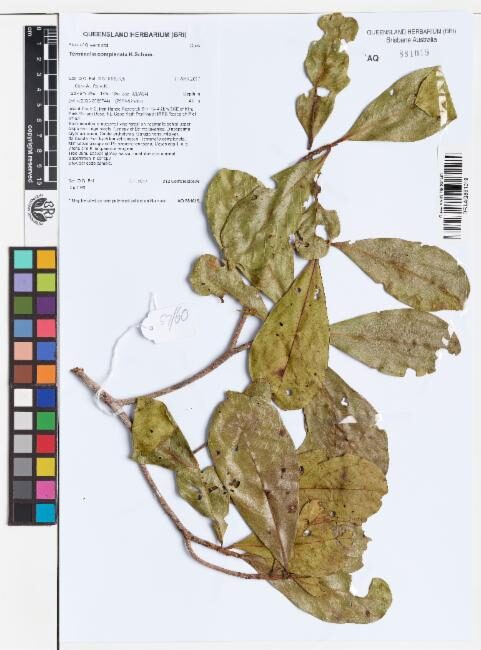
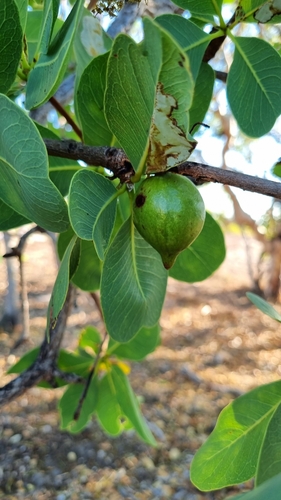
A large spreading tree. It can be 15-30 m tall and spreads to 5 m across. It loses its leaves during the year. It has a dense broad crown. It can have buttresses. The stem is erect and branching. The bark is rough and develops a checkered pattern. It can also have cracks along it. The branches come out in layers. The leaves are arranged in spirals. They are smooth and oval. Leaves are 2-20 cm long by 1.5-8 cm wide. They taper towards the base. They are shiny rich green on the upper surface and paler underneath. The tip has a short point. The leaves turn bright coloured before dropping. The leaf stalk is 1.5 cm long. The flowers are cream and have a long unpleasant scent. They are about 0.5 cm wide and in hairy spikes 5-10 cm long in the axils of leaves near the ends of branches. The fruit are oval, flattened, and fleshy with a hard stone inside. Fruit are silky hairy but become smooth. There is a slight ridge around the edge of the fruit. The fruit are 1.3-1.8 cm long and 0.8-1 cm wide. They are pink or red and become purple when ripe. The flesh layer is thin. The fruit flesh is edible. The seed is 1.4 cm long.
Edible Uses
The fleshy layer around the fruit is eaten. The fruit are highly prized for consumption.
Traditional Uses
The fleshy layer around the fruit is eaten.
This uses section is brief — help expand it
Known Hazards
The tree is damaged by drought and frost.
Distribution
A tropical plant. It occurs naturally in coastal monsoon vine forest and in rainforest in northern Australia. It is often on sandy soils and near streams. The soils need to be well drained. It grows from sea level to 750 m above sea level. It is damaged by drought and frost. In the Cairns Botanical Gardens. In Townsville palmetum.
Where It Grows
Australia*,
Cultivation
It can be grown from fresh seed.
Production
It is a fast growing tree. In Australia flowering occurs in September to December and fruiting from December to May.
Other Information
The fruit are highly prized.
Notes
There are about 200-250 Terminalia species. They are tropical.
Synonyms
Also Known As
Makkulurr
References (21)
- Barwick, M., 2004, Tropical and Subtropical Trees. A Worldwide Encyclopedic Guide. Thames and Hudson p 411
- Beasley, J., 2011, Plants of Tropical North Queensland - the compact guide. Footloose publications. p 88
- Bodkin, F., 1991, Encyclopedia Botanica. Cornstalk publishing, p 971
- Brock, J., 1993, Native Plants of Northern Australia, Reed. p 317
- Cherikoff V. & Isaacs, J., The Bush Food Handbook. How to gather, grow, process and cook Australian Wild Foods. Ti Tree Press, Australia p 201
Show all 21 references Hide references
- Cooper W & Cooper W T, 1994, Fruits of the Rain Forest. RD Press p 284
- Cooper, W. and Cooper, W., 2004, Fruits of the Australian Tropical Rainforest. Nokomis Editions, Victoria, Australia. p 130
- Darley, J.J., 1993, Know and Enjoy Tropical Fruit. P & S Publishers. p 77
- Doran, J.C., & Turnbull, J.W. (Eds), 1997, Australian Trees and Shrubs: species for land rehabilitation and farm plantings in the tropics. ACIAR Monograph No 24. p 342
- Garde, M., et al, 2003, A Preliminary List of Kundedjnjenghmi Plant Names. Northern Land Council. (Arnhem Land, Australia)
- Hardwick, G., 2001, Economically Useful Plants for Northern Australia: Master Species List. Crusader eBooks.
- Hearne, D.A., & Rance, S.J., 1975, Trees for Darwin and Northern Australia. AGPS, Canberra p 113, 36
- Hibbert, M., 2002, The Aussie Plant Finder 2002, Florilegium. p 297
- Holliday, I., 1989, A Field Guide to Australian Trees. Hamlyn. p 304
- Jackes, B.R., 2001, Plants of the Tropics. Rainforest to Heath. An Identification Guide. James Cook University. p 47
- Jones D, L, 1986, Ornamental Rainforest Plants in Australia, Reed Books, p 247, 340
- Lazarides, M. & Hince, B., 1993, Handbook of Economic Plants of Australia, CSIRO. p 235
- Pearson, S. & A., 1992, Rainforest Plants of Eastern Australia. Kangaroo Press p 202
- Townsend, K., 1994, Across the Top. Gardening with Australian Plants in the tropics. Society for Growing Australian Plants, Townsville Branch Inc. p 356
- Wheeler, J.R.(ed.), 1992, Flora of the Kimberley Region. CALM, Western Australian Herbarium, p 559
- Wightman, G. M. & Andrews, M.R., 1989, Plants of Northern Territory Monsoon Vine Forests (Vol 1). Conservation Commission of Northern Territory. p 84