Terminalia petiolaris
A. Cunn. ex Benth.
Marool, Blackberry Tree
wikimedia· cc0
Public domainPublic domainfalsefalse This work has been released into the public domain by its author, Cygnis insignis. This applies worldwide.In some countries this may not be legally possible; if so:Cygnis insignis grants anyone the right to use this work for any purpose, without any conditions, unless such conditions are required by law. (via Wikimedia Commons)
wikimedia· cc-by-sa
AutoGyro at English Wikipedia (via Wikimedia Commons)
wikimedia· cc-by-sa
Michael Somerville (via Wikimedia Commons)
iNaturalist· cc-by-sa
(c) Michael Somerville, some rights reserved (CC BY-SA), uploaded by Michael Somerville
Summary
Source: WikipediaTerminalia petiolaris, commonly known as blackberry tree or billygoat plum, or marool in the local Bardi language, is a species of plant in the family Combretaceae. It is endemic to the coast of the Kimberley region of northern Western Australia.
Description
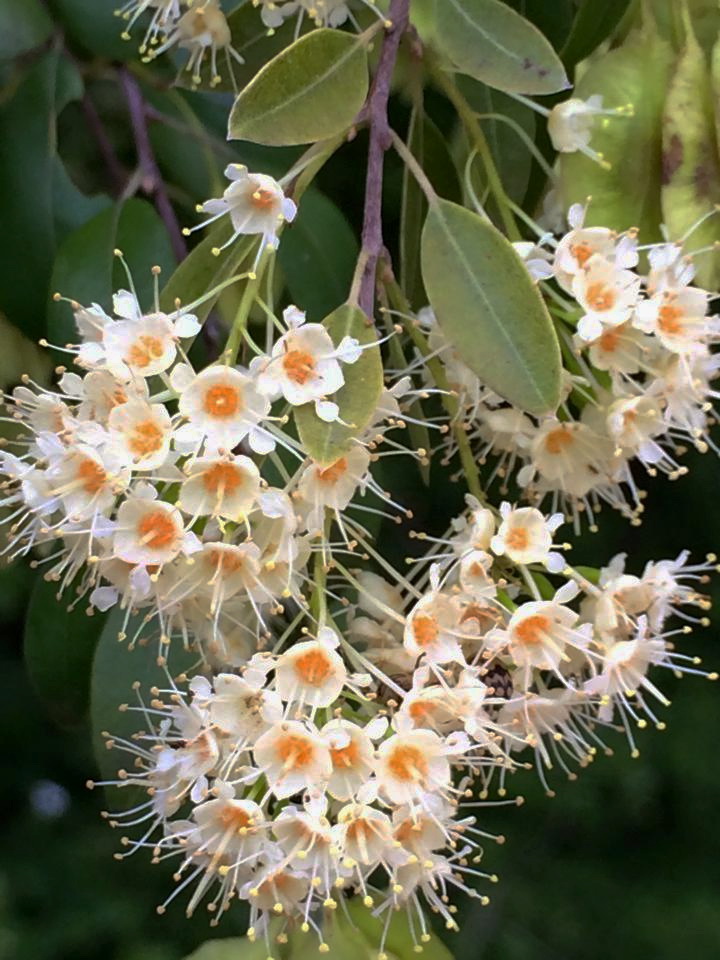
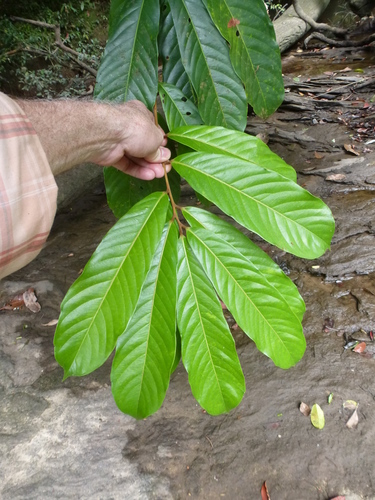
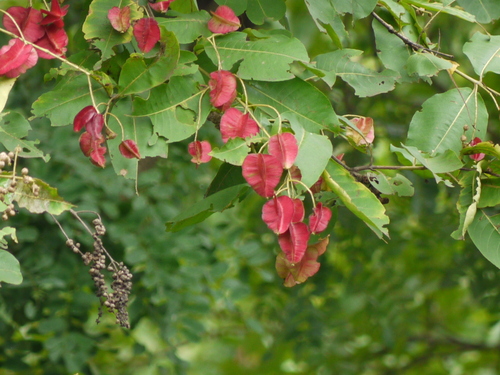
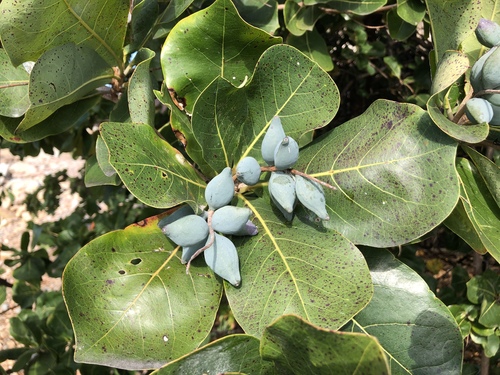
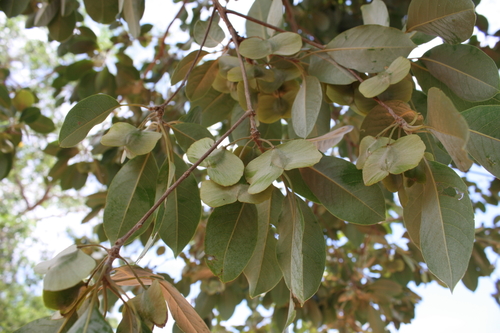
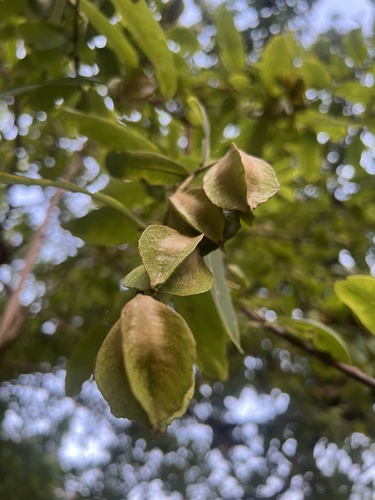
A small tree which loses its leaves during the year. It grows up to 10 m tall. The bark is dark grey and with cracks along its length. The small branches are silky. The leaves are oval and 6.5-14 cm long by 4-7 cm wide. They are green but turn red to purple before falling. They are papery and without hairs but less shiny underneath. The tip is blunt but sometimes with a small point. The base of the leaf is blunt or slightly tapering. The leaf stalk is 3.5-6 cm long and slender. The flower spikes are 11 cm long and hairy. The flowers are creamy white. They smell sweetly of nectar. The fruit is succulent and green and turns red or black when ripe. They are oval and 1-2 cm long by 0.7-0.9 cm wide. They have a short beak. The flesh of the fruit is eaten. Inside there is a large seed.
Edible Uses
The flesh of the ripe fruit is eaten. The gum from the tree is also edible and can be eaten raw or cooked.
Traditional Uses
The flesh of the fruit is eaten. The gum from the tree is edible. It is eaten raw, or cooked.
This uses section is brief — help expand it
Distribution
It is a tropical plant. It grows in coastal areas on sandstone or sandy soils in northern Western Australia. They are often just behind the coastal dunes. It grows from sea level to 100 m above sea level. The tree is resistant to cyclone damage.
Where It Grows
Australia*,
Cultivation
It occurs naturally in the Kimberleys in Western Australia. It grows from seed.
Production
In Australia flowering is December to April and fruiting is March to July. The flowering and fruiting season can be longer than this.
Notes
There are about 200-250 Terminalia species. They are tropical.
Nutrition
| Part | Moisture | kJ | kcal | Protein | Vit A | Vit C | Iron | Zinc |
|---|---|---|---|---|---|---|---|---|
| Fruit | 57 | 837 | 200 | 3.8 | — | — | 1.6 | 0.7 |
Synonyms
Also Known As
Marul, Masroorl
References (8)
- Hardwick, G., 2001, Economically Useful Plants for Northern Australia: Master Species List. Crusader eBooks.
- Kenneally, K.E., Edinger, D. C., and Willing T., 1996, Broome and Beyond, Plants and People of the Dampier Peninsula, Kimberley, Western Australia. Department of Conservation and Land Management. p 89
- Lazarides, M. & Hince, B., 1993, Handbook of Economic Plants of Australia, CSIRO. p 234
- Lands, M., 1987, Mayi: Some Bush fruits of Dampierland. Magabala Books, Broome West Australia. p 19, 23
- Paczkowska, G. & Chapman, A.R., 2000, The Western Australian Flora. A Descriptive Catalogue. Western Australian Herbarium. p 216
Show all 8 references Hide references
- Smith, M & Kalotas, A. C., 1985, Bardi Plants: An Annotated List of Plants and Their Use by the Bardi Aborigines of Dampierland, in North-western Australia. Rec. West Aust. Mus. 1985, 12(3): 317-359
- Vigilante, T., et al, 2013, Island country: Aboriginal connections, values and knowledge of the Western Kimberley islands in the context of an island biological survey. Records of the Western Australian Museum Supplement 81: 145-182
- Wheeler, J.R.(ed.), 1992, Flora of the Kimberley Region. CALM, Western Australian Herbarium, p 557, 558