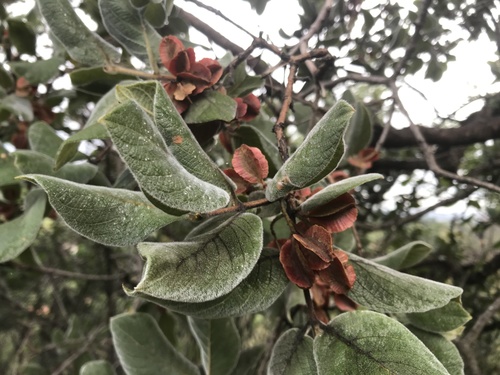
Terminalia melanocarpa
F. Muell.
Black fruit
iNaturalist· cc-by
(c) Forest & Kim Starr, some rights reserved (CC BY)
iNaturalist· cc-by
(c) Lucas Christofides, some rights reserved (CC BY)
iNaturalist· cc-by
(c) Lucas Christofides, some rights reserved (CC BY)
Description
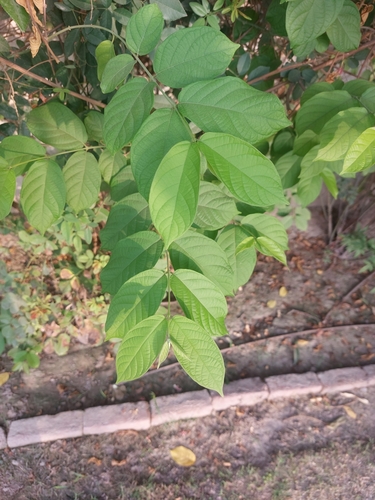
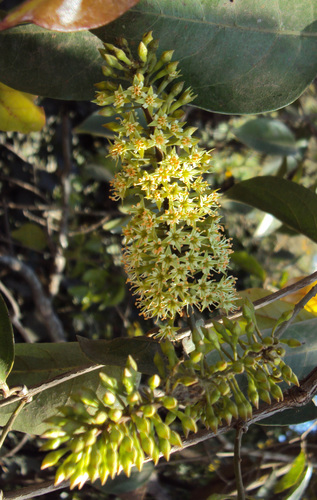
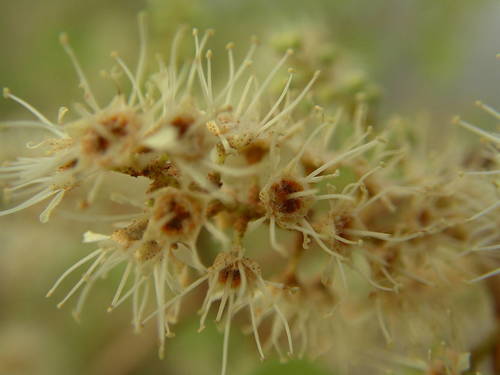
A deciduous tree. It grows 15 m tall. The leaves are simple and alternate or opposite. The leaves are 5.4-12 cm long and 3-7.5 cm wide. The leaf stalks are 0.5-20 cm long. The flowers are clustered in the axils of leaves. Male and female flowers occur near the tip of these spikes and bisexual flowers near the base. The flowers have 5 sepals and no petals. They are cream or white. The flowers are 5-6 mm long. The fruit is fleshy and green to black. They are 2.3-3.3 cm long by 2-2.4 cm wide. They have a beak. The fruit has wings while it is green. There is one seed that is brown and 2.2-2.5 cm long.
Edible Uses
The fruit are edible.
Distribution
A tropical plant. It grows in rainforest and along the edges of rainforest in tropical Queensland. It grows from sea level to 300 m altitude. It can grow along beach fronts. It can tolerate salt spray and wind.
Where It Grows
Australia*, Hawaii, Pacific, USA,
Notes
There are about 200-250 Terminalia species. They are tropical.
Synonyms
References (5)
- Cooper, W. and Cooper, W., 2004, Fruits of the Australian Tropical Rainforest. Nokomis Editions, Victoria, Australia. p 128
- Hardwick, G., 2001, Economically Useful Plants for Northern Australia: Master Species List. Crusader eBooks.
- Isaacs, J., 1987, Bush Food, Aboriginal Food and Herbal Medicine. Weldons. p 73
- Staples, G.W. and Herbst, D.R., 2005, A tropical Garden Flora. Bishop Museum Press, Honolulu, Hawaii. p 244
- Townsend, K., 1994, Across the Top. Gardening with Australian Plants in the tropics. Society for Growing Australian Plants, Townsville Branch Inc. p 355