Terminalia megalocarpa
Exell
To'oma
wikimedia· cc-by
Wikimedia Commons - Forest and Kim Starr
wikimedia· cc-by
Wikimedia Commons - Forest and Kim Starr
Summary
Source: WikipediaTerminalia megalocarpa is a rainforest tree of eastern New Guinea and Bougainville Island. It is in the family Combretaceae. Its common name is to-oma. Its most interesting feature is that its seeds, 5 cm (2.0 in) long, have five cotyledons rather than the two found in almost all other dicot plants.
Description
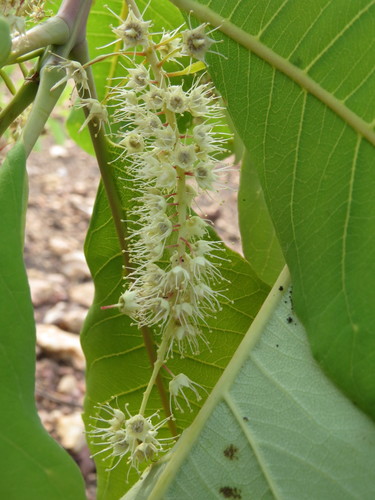
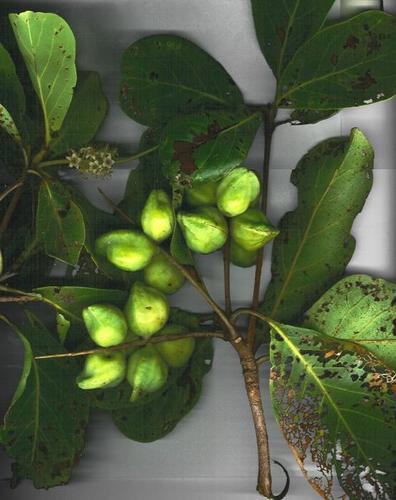
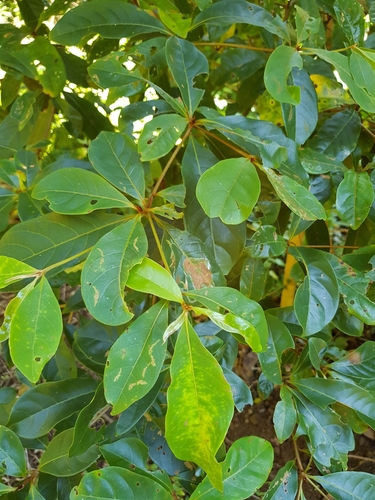
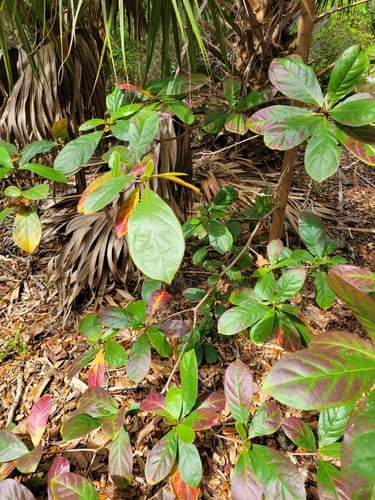
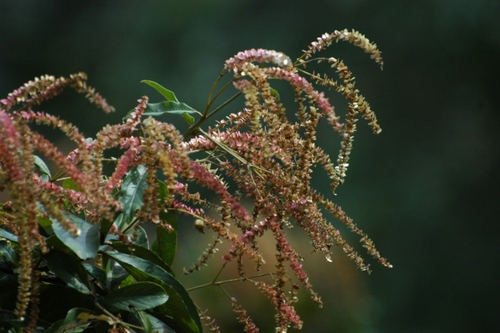
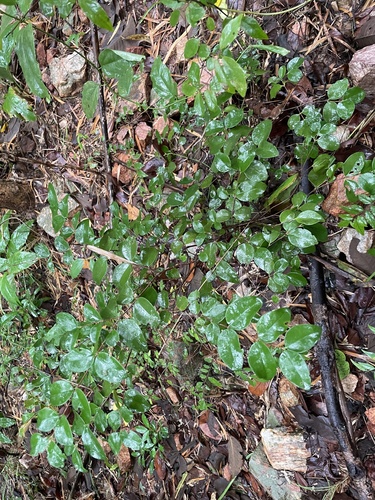
A tree which can be up to 40 m tall. The leaves are at the tips of twigs and tend to hang downwards. The leaf stalks are quite long (3-7 cm). The young plant parts have small hairs. The leaves are broadly oval and 9-18 cm long by 5-9 cm wide. They are wedge shaped at the base. The old leaves turn yellow. The flowers are 2 mm long. The fruit is large and 4-8 cm long. The fruit inside is thin shelled and the embryo inside has 3 or 4 twisted cotyledons. The flesh is green or yellow.
Edible Uses
The outer flesh of the fruit is edible. The seeds are boiled, soaked, and then boiled again before eating. A yellow-fleshed cultivated form is particularly valued in the Solomon Islands.
Traditional Uses
The outer flesh of the fruit is edible. The seeds are boiled, soaked and then boiled again.
This uses section is brief — help expand it
Distribution
A tropical plant. It occurs in lowland forests.
Where It Grows
Pacific, Papua New Guinea, PNG, Solomon Islands,
Cultivation
A selected yellow fleshed form is eaten in the Solomon Islands.
Other Uses
The wood is used for traditional house construction. It is a major exportable hardwood in New Guinea.
Other Information
A selected yellow fleshed form is eaten in the Solomon Islands. It is a cultivated food plant.
Notes
There are about 200-250 Terminalia species. They are tropical.
Also Known As
Dausia, Mo
References (8)
- Borrell, O.W., 1989, An Annotated Checklist of the Flora of Kairiru Island, New Guinea. Marcellin College, Victoria Australia. p 62
- Bourke, M., 1995, Edible Indigenous Nuts in Papua New Guinea. In South Pacific Indigenous Nuts. ACIAR Proceedings No 69, Canberra. p 46
- Coode, M.J.E., in Womersley, J.S., (Ed), 1978, Handbooks of the Flora of Papua New Guinea. Melbourne University Press. Vol 1. p 89
- French, B.R., 1986, Food Plants of Papua New Guinea, A Compendium. Asia Pacific Science Foundation p 172
- French, B.R., 2010, Food Plants of Solomon Islands. A Compendium. Food Plants International Inc. p 187
Show all 8 references Hide references
- Nombo, P. & Leach, J. 2010, Reite Plants: An Ethnobotanical Study in Tok Pisin and English. ANU press. p 111
- Walter, A. & Sam C., 2002, Fruits of Oceania. ACIAR Monograph No. 85. Canberra. p 282
- World Checklist of Useful Plant Species 2020. Royal Botanic Gardens, Kew