Terminalia hadleyana subsp. carpentariae
W. Fitzg.
Wild peach, Red cement tree
iNaturalist· cc-by-nc
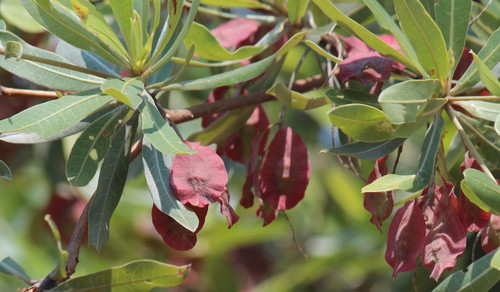
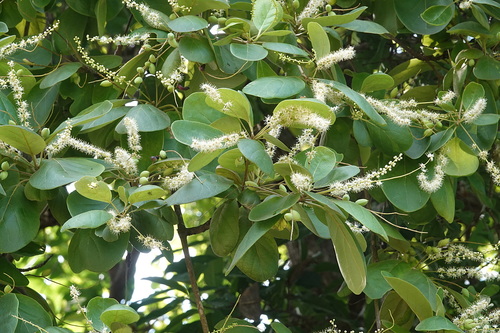
(c) Ryne Rutherford, some rights reserved (CC BY-NC), uploaded by Ryne Rutherford
iNaturalist· cc-by-nc
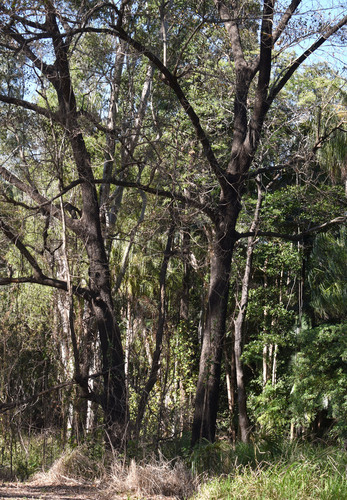
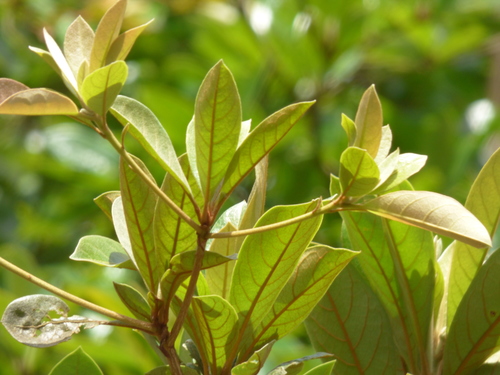
(c) Chris Chadwick, some rights reserved (CC BY-NC)
Summary
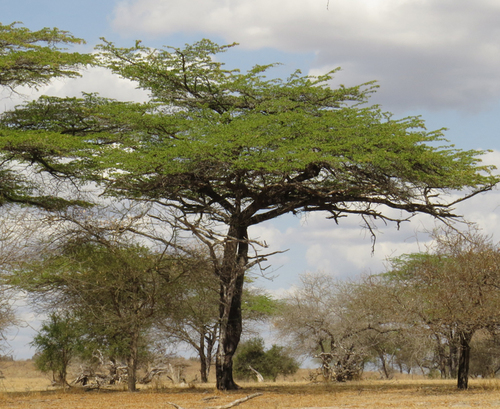
Source: WikipediaTerminalia hadleyana is a tree of the family Combretaceae native to northern Australia. The tree or shrub typically grows to a height of 2 to 10 metres (7 to 33 ft) but can reach up to 15 metres (49 ft) and is deciduous. It blooms between October and December producing cream-yellow flowers.
Description
A small tree. It can be up to 4 m tall. It loses its leaves during the dry season of the year. The bark is grey and rough but not cracked. The leaves are oval and bright green. They are 14 cm long by 10 cm wide. They are hairy. The small flowers are tube shaped and 3 mm long. They are green and occur on spikes. The fruit are pointed and 3-4 cm across. They are covered with soft hairs. (The hadleyana sub species does not have hairs.) The fruit are green when ripe. The seed is flattened and oval. There is a hard shell around a thin layer of flesh. The fruit are edible. Cuts in the bark produce a clear red gum. This gum is edible.
Edible Uses
The fruit can be eaten raw or made into jam. The red gum produced from cuts in the bark is also edible.
Traditional Uses
They fruit can be eaten raw. The gum is edible. The fruit are also used for jam.
This uses section is brief — help expand it
Distribution
A tropical plant. It grows in sandstone areas and on sandy plains. It needs good drainage. It occurs naturally in northern Australia.
Where It Grows
Australia*,
Production
In Australia flowering is September to October.
Other Information
The fruit are enjoyed.
Notes
There are about 200-250 Terminalia species. They are tropical.
Also Known As
Bunjay, Mamaburra, Mamanbu, Mapudumun, Mardangich, Mupan
References (10)
- Bindon, P., 1996, Useful Bush Plants. Western Australian Museum. p 245
- Hardwick, G., 2001, Economically Useful Plants for Northern Australia: Master Species List. Crusader eBooks.
- Kenneally, K.E., Edinger, D. C., and Willing T., 1996, Broome and Beyond, Plants and People of the Dampier Peninsula, Kimberley, Western Australia. Department of Conservation and Land Management. p 88
- Lazarides, M. & Hince, B., 1993, Handbook of Economic Plants of Australia, CSIRO. p 234
- Low, T., 1991, Wild Food Plants of Australia. Australian Nature FieldGuide, Angus & Robertson. p 151
Show all 10 references Hide references
- Milson. J., 2000, Trees and Shrubs of north-west Queensland. DPI p 50
- Paczkowska, G. & Chapman, A.R., 2000, The Western Australian Flora. A Descriptive Catalogue. Western Australian Herbarium. p 216
- Smith, N. M., 1991, Ethnobotanical Field Notes from the Northern Territory, Australia, J. Adelaide Bot. Gard. 14(1): 1-65
- Vigilante, T., et al, 2013, Island country: Aboriginal connections, values and knowledge of the Western Kimberley islands in the context of an island biological survey. Records of the Western Australian Museum Supplement 81: 145-182
- Wheeler, J.R.(ed.), 1992, Flora of the Kimberley Region. CALM, Western Australian Herbarium, p 556