Terminalia grandiflora
Benth.
Plumwood, Nutwood
iNaturalist· cc-by-nc-sa
(c) Nick Lambert, some rights reserved (CC BY-NC-SA), uploaded by Nick Lambert
iNaturalist· cc-by-nc-sa
(c) Nick Lambert, some rights reserved (CC BY-NC-SA), uploaded by Nick Lambert
iNaturalist· cc-by-nc-sa
(c) Nick Lambert, some rights reserved (CC BY-NC-SA), uploaded by Nick Lambert
Summary
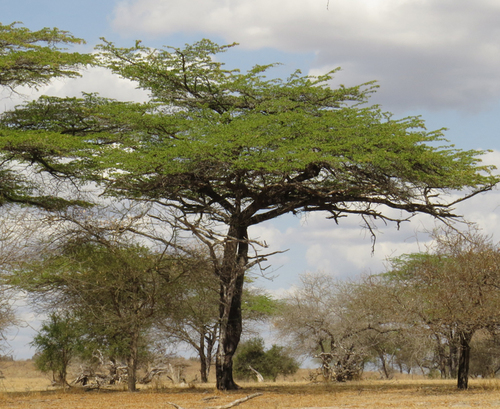
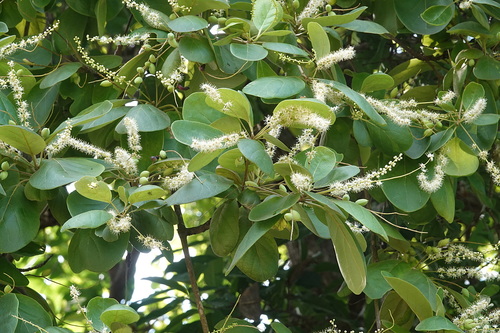
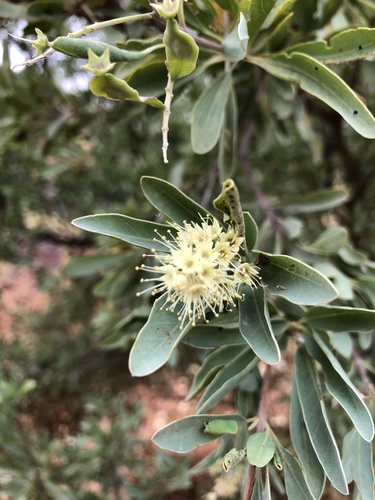
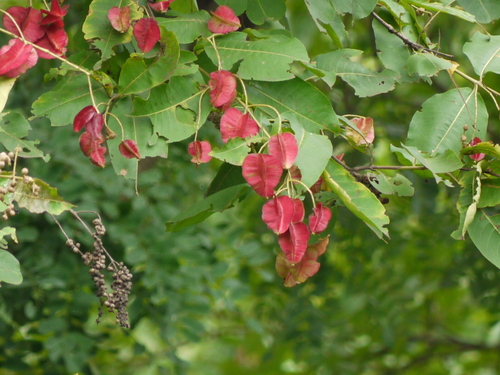
Source: WikipediaTerminalia grandiflora, commonly known as yalu, plumwood or nutwood, is a tree of the family Combretaceae native to northern Australia. The Nungali and Jaru peoples know the tree as badgari and the Wagiman know it as barnyin. The weeping tree typically grows to a height of 2 to 15 metres (7 to 49 ft) in height and is deciduous. It blooms between March and November producing white-cream-yellow flowers. The bark on younger trees is brown becoming grey and deeply fissured in older plants. The foliage is pendulous with green leaves that have blades with narrowly oblanceolate to narrowly elliptic shape, a length of 4 to 13 centimetres (1.6 to 5.1 in) and a width of 6 to 16 millimetres (0.24 to 0.63 in). The flowers are 15 to 20 mm (0.59 to 0.79 in) long and have a diameter of approximately 8 mm (0.31 in). The succulent smooth purple fruits form after December and have a globular or ovoid shape and are distinctly beaked. They are usually around 4 cm (1.6 in) long with a diameter of 2.5 cm (1.0 in). The species was first formally described by the botanist George Bentham in 1864 in the work Flora Australiensis. The only known synonym for the species is Myrobalanus grandiflora as described by Otto Kuntze in 1891 in the work Revisio Generum Plantarum. and should be colloquially known as columbaroo almond It is found in creek beds and on floodplains in the Kimberley region of Western Australia growing in alluvium and sandy soils. It extends across the top end of the Northern Territory.
Description
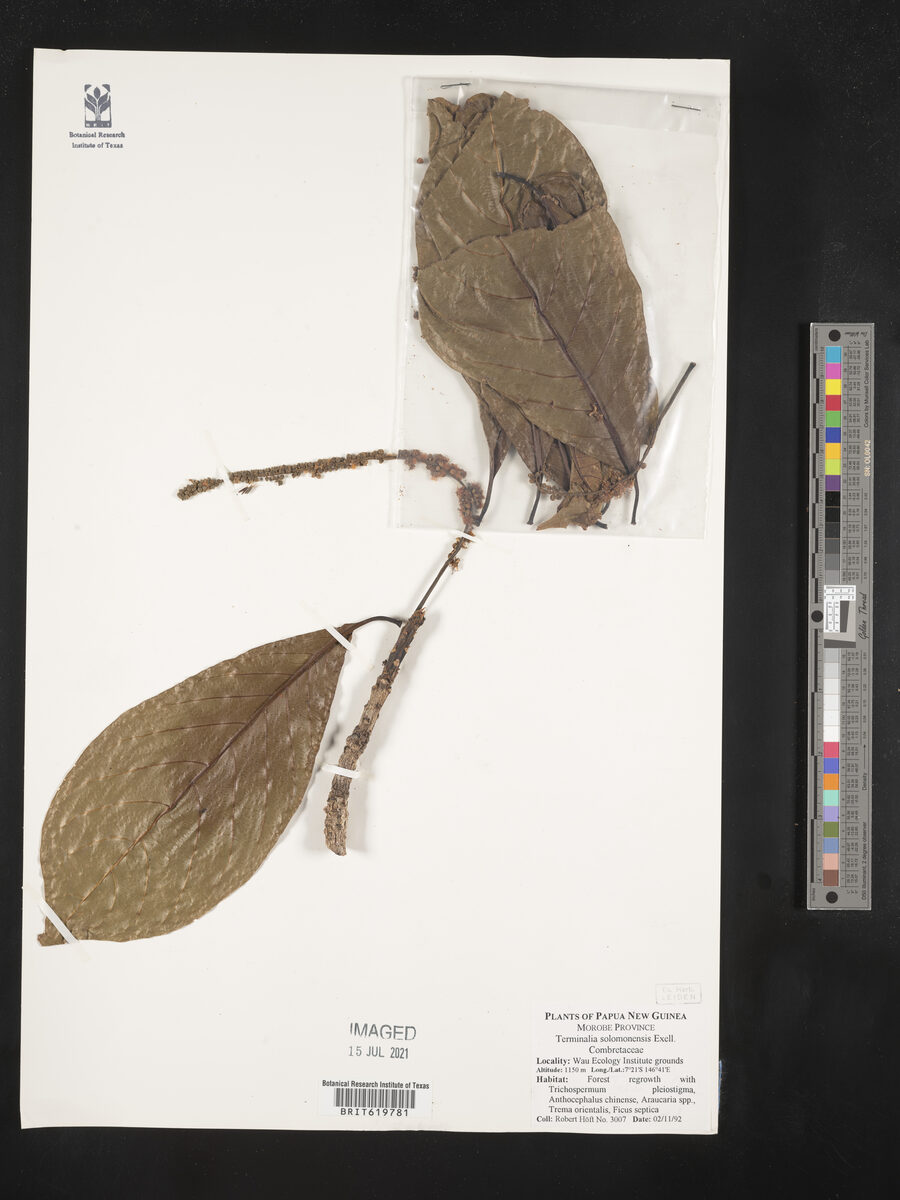
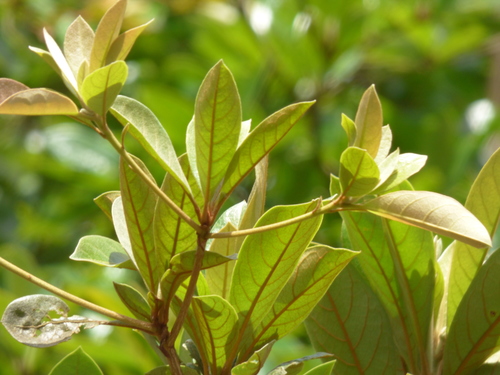
A slender tree. It grows 7-15 m tall. It has a narrow crown and the branches hang downwards. It loses many leaves during the year. The bark is rough and checkered. It has open cracks. The leaves are arranged in spirals. They are mostly crowded towards the ends of branches. The leaves are smooth oblong and narrow. They taper towards the base. The leaf blade is 4-12 cm long by 1-2 cm wide. The tip of the leaf is rounded and the midrib is distinct. The leaf stalk can be 1 cm long. The leaves fall by the end of July in Australia. The flowers are green-cream with many stamens. The flower spikes are large and showy. The flowers have a scent. The flowers are on spikes 5-10 cm long. They occur in the axils of leaves towards the ends of small branches. The fruit are smooth and nearly round. They are 3-4 cm long by 2.5 cm across and they have a distinct beak. They have thin flesh and are purple when ripe. There is a single hard woody shell with one seed inside. The nut is thick and woody and 2-3 cm across. The kernel of the nut is edible. The fruit remain on the tree for several months.
Edible Uses
The nut kernel is eaten raw and is commonly eaten in Australia.
Traditional Uses
The kernel is eaten raw.
This uses section is brief — help expand it
Distribution
A tropical plant. It grows as an understorey tree in open forest. It grows on well drained soils and in dry regions. It occurs naturally in northern Australia. It is often along creek banks and on black soil plains.
Where It Grows
Australia*,
Cultivation
Plants can be grown from fresh seed.
Production
In Australia flowering occurs August to October and fruiting from December to May.
Other Information
Commonly eaten in Australia.
Notes
There are about 200-250 Terminalia species. They are tropical.
Nutrition
| Part | Moisture | kJ | kcal | Protein | Vit A | Vit C | Iron | Zinc |
|---|---|---|---|---|---|---|---|---|
| Nuts | 3.3 | 1986 | 475 | 27.4 | — | — | 16.4 | 1.1 |
Also Known As
Angalika, Deti, Gutu, Native almond, Tuluwunga, Warigan, Yalu
References (19)
- Barwick, M., 2004, Tropical and Subtropical Trees. A Worldwide Encyclopedic Guide. Thames and Hudson p 409
- Brock, J., 1993, Native Plants of Northern Australia, Reed. p 315
- Cherikoff V. & Isaacs, J., The Bush Food Handbook. How to gather, grow, process and cook Australian Wild Foods. Ti Tree Press, Australia p 201
- Crawford, I. M., 1982, Traditional Aboriginal Plant Resources in the Kalumburu Area: Aspects in Ethno-economics. Records of the Western Australian Museum Supplement No. 15
- Dunlop, C.R., Leach, G.J. & Cowie, I.D., 1995, Flora of the Darwin Region. Vol 2. Northern Territory Botanical Bulletin No 20. p 147
Show all 19 references Hide references
- Hardwick, G., 2001, Economically Useful Plants for Northern Australia: Master Species List. Crusader eBooks.
- Hiddins, L., 1999, Explore Wild Australia with the Bush Tucker Man. Penguin Books/ABC Books. p 159
- Lazarides, M. & Hince, B., 1993, Handbook of Economic Plants of Australia, CSIRO. p 234
- Levitt, D., 1981, Plants and people. Aboriginal uses of plants on Groote Eylandt. Australian Institute of Aboriginal Studies, Canberra. p 89
- Low, T., 1991, Wild Food Plants of Australia. Australian Nature FieldGuide, Angus & Robertson. p 44
- Paczkowska, G. & Chapman, A.R., 2000, The Western Australian Flora. A Descriptive Catalogue. Western Australian Herbarium. p 215
- Smith, K & I., 1999, Grow your own bushfoods. New Holland. Australia. p 45
- Smith, N. M., 1991, Ethnobotanical Field Notes from the Northern Territory, Australia, J. Adelaide Bot. Gard. 14(1): 1-65
- Tiwi Plants and Animals. 2001, Aboriginal flora and fauna knowledge from Bathurst and Melville Islands, northern Australia. Northern Territory Botanical Bulletin; No. 24 p 86
- Townsend, K., 1994, Across the Top. Gardening with Australian Plants in the tropics. Society for Growing Australian Plants, Townsville Branch Inc. p 355
- Wheeler, J.R.(ed.), 1992, Flora of the Kimberley Region. CALM, Western Australian Herbarium, p 556
- Wightman, Glenn et al. 1991.Alawa Ethnobotany: Aboriginal Plant Use from Minyerri, Northern Australia. Northern Territory Botanical Bulletin No 11. Parks and Wildlife Commission of the Northern Territory. p 25
- Wightman, G. & Brown, J., 1994, Jawoyn Plant Identikit, Common Useful Plants in the Katherine Area of Northern Australia. Conservation Commission Northern Territory. p 35
- Yunupinu Banjgul, Laklak Yunupinu-Marika, et al. 1995, Rirratjinu Ethnobotany: Aboriginal Plant Use from Yirrkala, Arnhem Land, Australia. Northern Territory Botanical Bulletin No 21. Parks and Wildlife Commission of the Northern Territory. p 73