Combretum erythrophyllum
(Burch.) Sond.
Bush-willow, River bushwillow
iNaturalist· cc-by-nc
(c) Tony Benn, some rights reserved (CC BY-NC), uploaded by Tony Benn
iNaturalist· cc-by-sa
(c) JMK, some rights reserved (CC BY-SA)
iNaturalist· cc-by-nc
(c) Rouxne Botha, some rights reserved (CC BY-NC), uploaded by Rouxne Botha
Summary
Source: WikipediaCombretum erythrophyllum, commonly known as the river bushwillow, is a medium-sized, spreading tree found in bush near or along river banks in southern Africa. It is planted as a shade and ornamental tree in South Africa and the United States, and is propagated by seed.
Description
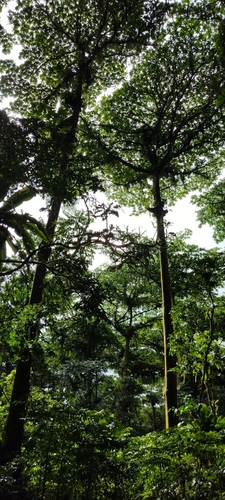
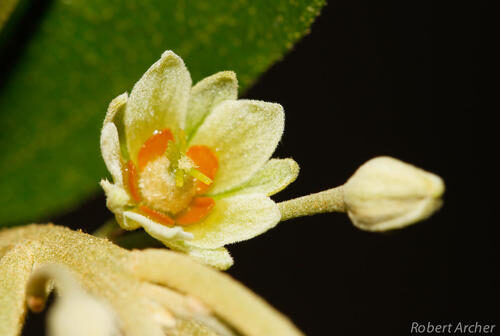
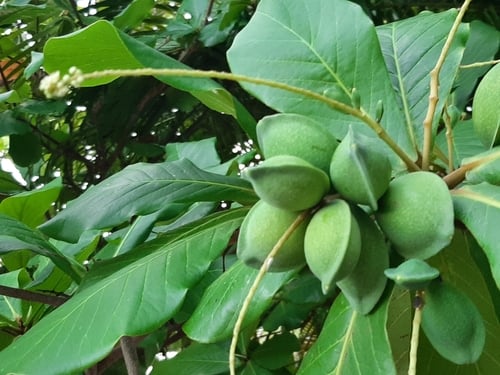
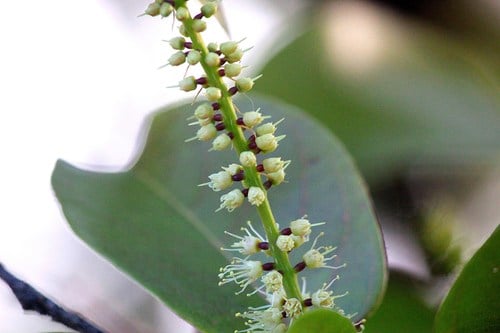
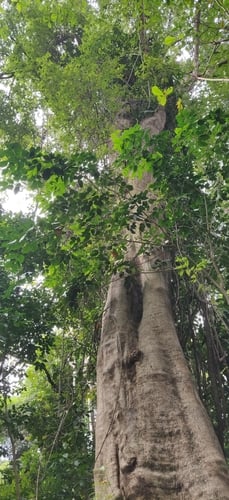
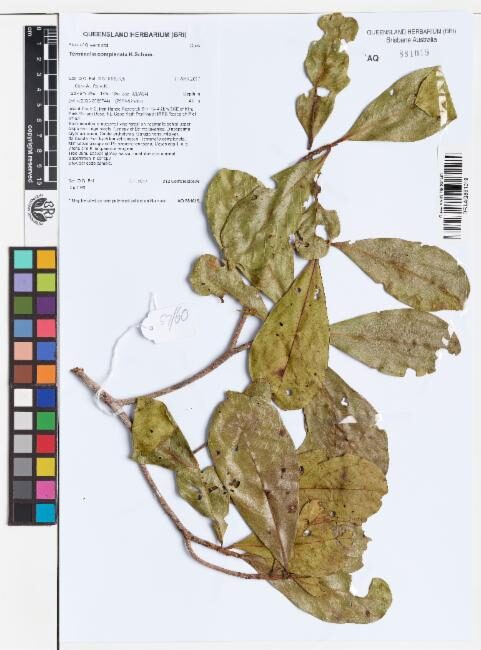
A medium sized tree. It is spreading. It grows to 12 m high. The crown is densely covered with leaves. There are often several stems from the base. The trunk can recline and overhang the water. The bark is pale grey and smooth and flaking. As it flakes paler patches are exposed giving it a mottled appearance. The leaves can be in rings of 3. They are oval and 10 cm long by 5 cm wide. The lower surface is hairy. The young leaves are yellowish while the mature leaves are green. They can turn red in autumn. They taper to both ends. The flowers are yellow and in dense spikes in the axils of leaves. They almost form round heads and are 10 mm across. The fruit have 4 wings. They are 1-1.5 cm long and with a peg at the end. The young fruit are shiny but dry to a brown colour.
Edible Uses
The gum is eaten as a snack.
Traditional Uses
Caution: The fruit and seeds are poisonous. The gum is eaten as a snack.
This uses section is brief — help expand it
Medicinal Uses
The roots (regarded as poisonous) are used as a purgative and to treat venereal diseases. The bark is mixed with other herbs to make a decoction that is drunk in the morning and evening, quarter of a cup for sores. The fruit are regarded as poisonous and reputedly cause hiccups.
Known Hazards
The fruit and seeds are poisonous.
Distribution
A tropical plant. It grows along river banks and can form thick stands. It is drought resistant. It will grow in most soils. It needs a sunny position. It is damaged by frost. It grows between 15-1,525 m above sea level. It can grow in arid places. It suits hardiness zones 10-11. In Brisbane Botanical Garden.
Where It Grows
Africa, Australia, Botswana, East Africa, Eswatini, Lesotho, Mozambique, Namibia, South Africa*, Southern Africa, Swaziland, Zimbabwe,
Cultivation
Plants can be grown from seeds. The seeds germinate easily. It can also be grown from cuttings.
Propagation
Seed - It grows easily from fresh, unparasitized seed which should be soaked for some hours before sowing. The seedlings appear 7 - 13 days after sowing. The seedlings are frost resistant after two years. The tree often self-sows freely in gardens The seed of most, if not all, species can be stored inside the fruit for several years without losing viability.
Other Uses
A gum is obtained from the stem. Used as a substitute for Gum Tragacanth (obtained from Astragalus spp.). The gum is non-toxic, elastic, producing a non-cracking varnish. A dark, rich brown dye is extracted from the roots. The wood is used to make ornaments, cattle troughs and grain mortars.
Production
The plants grow quickly.
Other Information
It is cultivated.
Notes
There are about 255 Combretum species.
Synonyms
Also Known As
Chitiswati, Modibo, Moduba, Mudhuvu, Mudiki, Mupuma, Mutepe, River combretum, Umdubu
References (16)
- Bodkin, F., 1991, Encyclopedia Botanica. Cornstalk publishing, p 274
- Drummond, R. B., 1981, Common Trees of the Central Watershed Woodlands of Zimbabwe, National Herbarium Salisbury. p 156
- Etherington, K., & Imwold, D., (Eds), 2001, Botanica's Trees & Shrubs. The illustrated A-Z of over 8500 trees and shrubs. Random House, Australia. p 222
- Grivetti, 1976, 1979,
- Grivetti, L. E., 1980, Agricultural development: present and potential role of edible wild plants. Part 2: Sub-Saharan Africa, Report to the Department of State Agency for International Development. p 79
Show all 16 references Hide references
- Linnaea 23:43. 1850
- Lord, E.E., & Willis, J.H., 1999, Shrubs and Trees for Australian gardens. Lothian. p 217
- Palgrave, K.C., 1996, Trees of Southern Africa. Struik Publishers. p 667
- Peters, C. R., O'Brien, E. M., and Drummond, R.B., 1992, Edible Wild plants of Sub-saharan Africa. Kew. p 85
- Royal Botanic Gardens, Kew (1999). Survey of Economic Plants for Arid and Semi-Arid Lands (SEPASAL) database. Published on the Internet; http://www.rbgkew.org.uk/ceb/sepasal/internet [Accessed 10th April 2011]
- Ruiters-Welcome, A. K., 2019, Food plants of southern Africa. Ph.D. thesis. Univ. of Johannesburg p 45
- Swaziland's Flora Database http://www.sntc.org.sz/flora
- Welcome, A. K. & Van Wyk, B.-E., 2019, An inventory and analysis of the food plants of southern Africa. South African Journal of Botany 122 (2019) 136–179
- Wiersema, J. H. & Leon, B., 2013, World Economic Plants. A Standard Reference CRC Press. 2nd Ed. p 193
- World Checklist of Useful Plant Species 2020. Royal Botanic Gardens, Kew
- www.zimbabweflora.co.zw 2011