Vangueria parvifolia
(Sond.) Robyns
Mountain medlar, Small wild medlar
iNaturalist· cc-by-nc
(c) magdastlucia, some rights reserved (CC BY-NC), uploaded by magdastlucia
iNaturalist· cc-by-nc
(c) Troos van der Merwe, some rights reserved (CC BY-NC)
Description
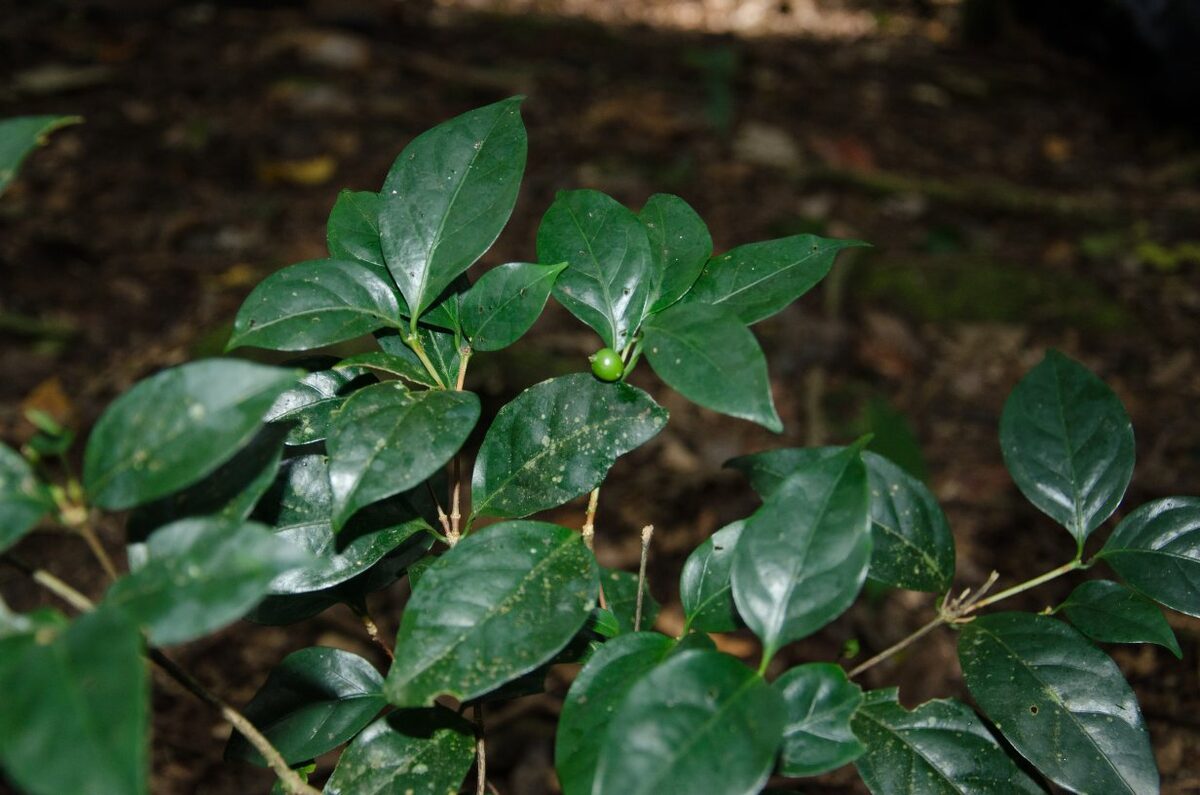
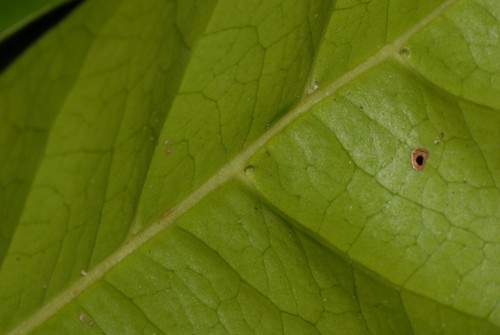
It is a small sturdy shrub or small tree. It usually loses its leaves during the year. It grows 3-8 m tall. It is often branched from the base. It has a rounded crown. The branches and twigs are crooked and twisted. The leaves are simple and almost stalkless. They are opposite or in clusters often near the ends of twigs. They are 1.9-3.8 cm long and egg shaped. The tips are rounded but often with a jutting point. The leaves are soft and pale green. The flowers are small, hairy, greenish and bell-shaped. They have 5 spreading lobes. The fruit is round. It is 1.3 cm across. It is green and turns light brown or red. It is edible. There is a stone inside.
Edible Uses
Fruit - raw. It can be dried for later use. The dark brown fruit splits easily into segments, like those of an orange.
Traditional Uses
The fruit are eaten raw. They can be dried for future use.
This uses section is brief — help expand it
Distribution
It is a subtropical plant. It grows in rocky hills. It is in woodland and wooded grassland. It is usually on rocky outcrops.
Where It Grows
Africa, Botswana, Eswatini, Namibia, South Africa, Southern Africa, Swaziland,
Synonyms
Also Known As
Sikhwakhwane, Small velvet leaf, Umntulu
References (19)
- Facciola, S., 1998, Cornucopia 2: a Source Book of Edible Plants. Kampong Publications, p 213 (As Tapiphyllum parvifolium)
- Fox, F. W. & Young, M. E. N., 1982, Food from the Veld. Delta Books. p 326 (As Tapiphyllum parvifolium)
- INFOODS:FAO/INFOODS Databases (As Tapiphyllum parvifolium)
- Jardin, C., 1970, List of Foods Used In Africa, FAO Nutrition Information Document Series No 2.p 164 (As Tapiphyllum parvifolium)
- Long, C., 2005, Swaziland's Flora - siSwati names and Uses http://www.sntc.org.sz/flora/
Show all 19 references Hide references
- Mason, 1971, (As Tapiphyllum parvifolium)
- Palgrave, K.C., 1996, Trees of Southern Africa. Struik Publishers. p 874 (As Tapiphyllum parvifolium)
- Palmer, E and Pitman, N., 1972, Trees of Southern Africa. Vol. 2. A.A. Balkema, Cape Town p 2085 (As Tapiphyllum parvifolium)
- Peters, C. R., O'Brien, E. M., and Drummond, R.B., 1992, Edible Wild plants of Sub-saharan Africa. Kew. p 176 (As Tapiphyllum parvifolium)
- Rodin, 1985, (As Tapiphyllum parvifolium)
- Ruiters-Welcome, A. K., 2019, Food plants of southern Africa. Ph.D. thesis. Univ. of Johannesburg p 98
- Schmidt, E., Lotter, M., & McCleland, W., 2007, Trees and shrubs of Mpumalanga and Kruger National Park. Jacana Media p 656
- Swaziland's Flora Database http://www.sntc.org.sz/flora (As Tapiphyllum parvifolium)
- Tanaka, (As Tapiphyllum parvifolium)
- Van Wyck, B., & Van Wyck, P, 1997, Field Guide to Trees of Southern Africa. Struik. p 274 (As Tapiphyllum)
- van Wyk, Be., & Gericke, N., 2007, People's plants. A Guide to Useful Plants of Southern Africa. Briza. p 58 (As Tapiphyllum parvifolium)
- Wehmeyer, A. S, 1986, Edible Wild Plants of Southern Africa. Data on the Nutrient Contents of over 300 species (As Tapiphyllum parvifolium)
- Welcome, A. K. & Van Wyk, B.-E., 2019, An inventory and analysis of the food plants of southern Africa. South African Journal of Botany 122 (2019) 136–179
- World Checklist of Useful Plant Species 2020. Royal Botanic Gardens, Kew