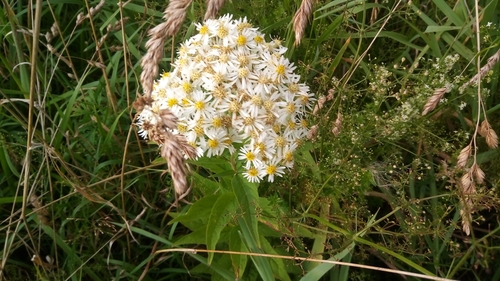
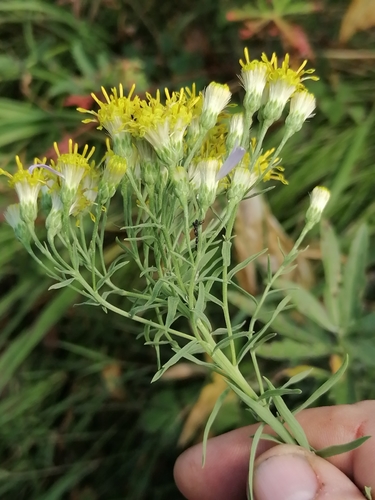
Helianthus maximiliani
Schrad.
Maximillian sunflower
iNaturalist· cc-by
(c) Tom Norton, some rights reserved (CC BY)
iNaturalist· cc-by
(c) Tom Norton, some rights reserved (CC BY)
iNaturalist· cc-by
(c) Tom Norton, some rights reserved (CC BY)
Description
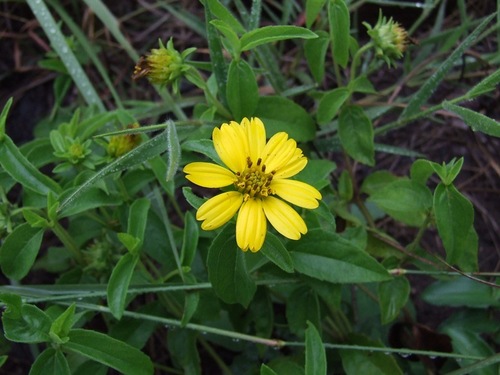
A plant which keeps growing from year to year. It grows 2-3 m tall and spreads 60-90 cm wide. The leaves are blue green and sword shaped. They are 20 cm long near the bottom and have shallow teeth. The leaves are about 5 cm long near the top. The flower heads are yellow and 10 cm wide.
Edible Uses
The tubers can be eaten raw or cooked and have a flavour similar to Jerusalem artichokes, though yields are lower. The seeds are also edible raw or cooked, and an edible oil is obtained from them.
Traditional Uses
The tubers are eaten raw or cooked. They can be roasted or boiled.
This uses section is brief — help expand it
Medicinal Uses
None known.
Distribution
It is a temperate plant. It grows best in rich, loamy soil. It suits hardiness zones 4-9.
Where It Grows
Australia, Canada, North America, USA,
Propagation
Sow seed in spring in a cold frame. When seedlings are large enough to handle, prick them out into individual pots and grow on in the greenhouse through their first winter. Plant out into permanent positions in late spring or early summer, after the last expected frosts. Divide plants in spring or autumn — larger clumps can go directly into permanent positions, though smaller clumps are best potted up in a cold frame until rooting well, then planted out in spring. For basal cuttings in spring, harvest shoots when about 10–15cm long with plenty of underground stem, pot into individual pots, and keep in light shade in a cold frame or greenhouse until rooting well before planting out in summer.
Other Uses
None known.
Notes
Almost all Helianthus (60 species) in N and S America are edible.
References (11)
- Beckstrom-Sternberg, Stephen M., and James A. Duke. "The Foodplant Database." http://probe.nalusda.gov:8300/cgi-bin/browse/foodplantdb.(ACEDB version 4.0 - data version July 1994)
- Cundall, P., (ed.), 2004, Gardening Australia: flora: the gardener's bible. ABC Books. p 684
- Facciola, S., 1998, Cornucopia 2: a Source Book of Edible Plants. Kampong Publications, p 39
- Ind. sem. hort. acad. goetting. 1834 (Ann. Sci. Nat. Bot. ser. 2, 6:101. 1836)
- Jackes, D. A., Edible Forest Gardens
Show all 11 references Hide references
- Kermath, B. M., et al, 2014, Food Plants in the Americas: A survey of the domesticated, cultivated and wild plants used for Human food in North, Central and South America and the Caribbean. On line draft. p 409
- Lim, T. K., 2015, Edible Medicinal and Non Medicinal Plants. Volume 9, Modified Stems, Roots, Bulbs. Springer p 45
- Loughmiller, C & L., 1985, Texas Wildflowers. A Field Guide. University of Texas, Austin. p 63
- Moerman, D. F., 2010, Native American Ethnobotany. Timber Press. p 258
- onecommunityglobal.org
- Plants for a Future database, The Field, Penpol, Lostwithiel, Cornwall, PL22 0NG, UK. http://www.scs.leeds.ac.uk/pfaf/