Tamus communis
L.
Black Bryony, Mandrake
iNaturalist· cc-by-nc
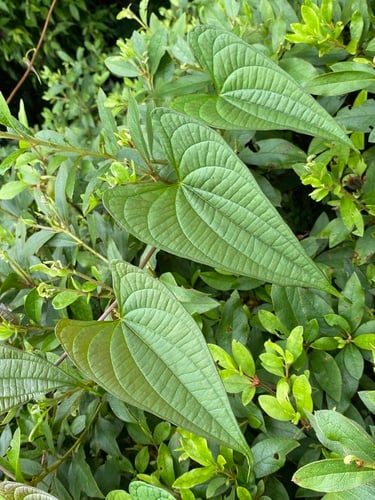
(c) Matthieu Gauvain, some rights reserved (CC BY-NC)
iNaturalist· cc-by-nc
(c) Matthieu Gauvain, some rights reserved (CC BY-NC)
iNaturalist· cc-by
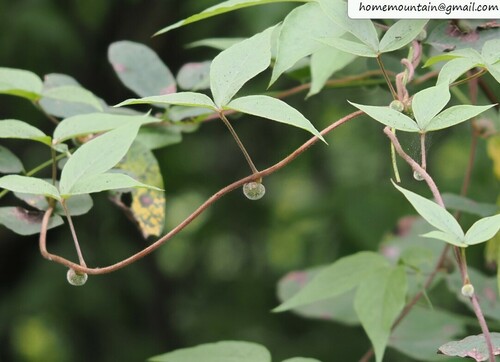
(c) zebedeugalinha, some rights reserved (CC BY)
Summary
Source: WikipediaPerennial climbing vine reaching 3.5m, growing at medium rate. Flowers May to July; seeds ripen September to November. Dioecious requiring both male and female plants for seed production; pollinated by bees and flies. Tolerates light sandy, medium loamy, and heavy clay soils with good drainage preference and heavy clay capability. Adapts to mildly acidic, neutral, and basic pH. Grows in semi-shade or full sun, preferring moist soil. Resists strong winds but not maritime exposure. Hardy to UK zone 5.
Description
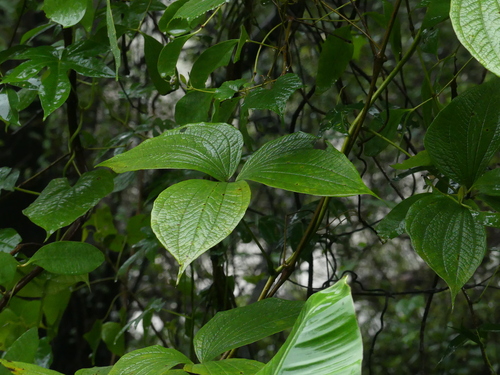
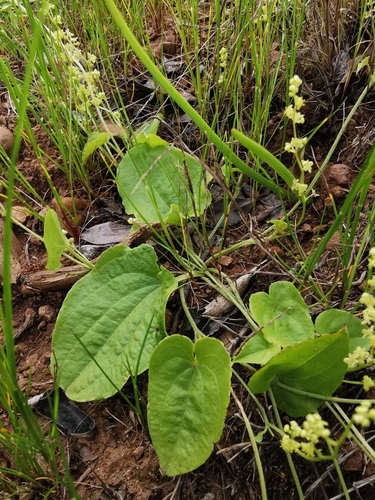
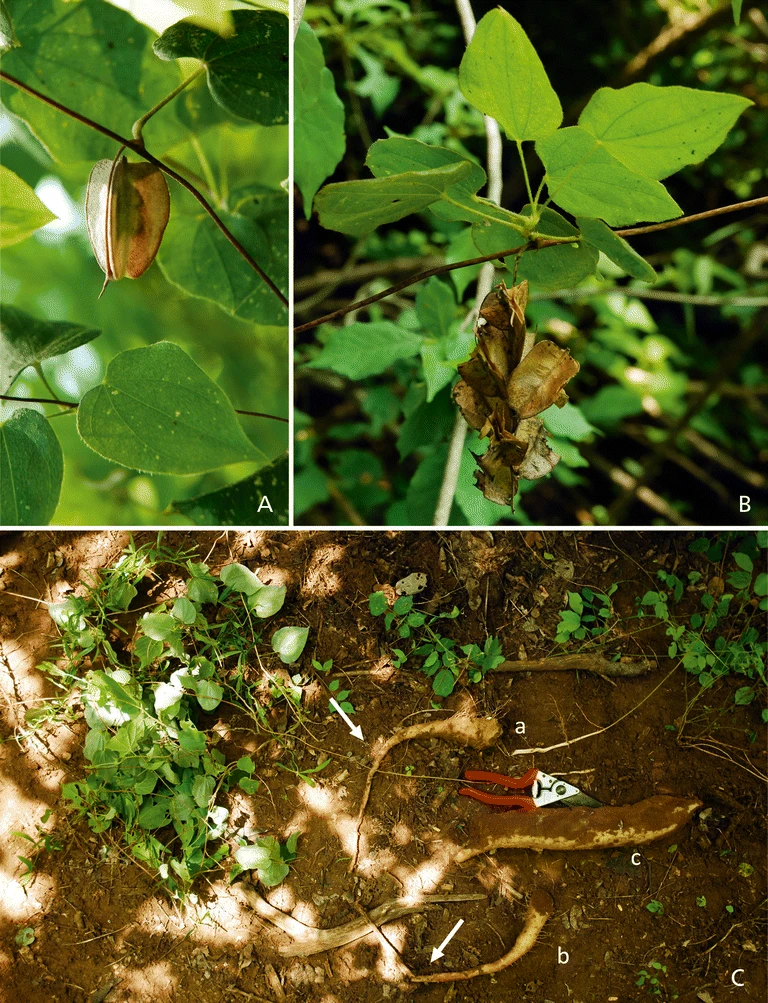
A tall twining climber. It keeps growing from year to year. It grows 4 m high and dies down to the underground tuber in autumn. The leaves are glossy green and oval or heart shaped. They have long stalks. The edges do not have teeth. There are 3-9 curved primary veins. The flowers are reddish-green. They are 3-6 mm long and in loose branched stalks with flowers developing from the bottom upwards. The male flowers have 6 broad lobes and 6 stamens. The female flowers have small lobes and a distinct ovary. The male and female flowers are on separate plants. The fruit is a round or oval shiny berry. It turns bright red when ripe.
Edible Uses
Young shoots can be eaten cooked. They have a decidedly bitter flavour and work as an asparagus substitute; changing the water once during cooking helps reduce the bitterness. See notes regarding possible toxicity before use.
Traditional Uses
The shoots are eaten after boiling and changing the water. The young shoots are added to pistic in Italy. They are stewed and also added to omelettes or salads. CAUTION: The berries are poisonous. The shoots must be cooked. The roots can contain calcium oxalate.
Medicinal Uses
The root is antiecchymotic, diuretic, emetic, haemolytic, and rubefacient. Use with caution — the plant is rich in saponins, has a very powerful cathartic effect, and ranks as a dangerous irritant poison. It is not normally used internally. The macerated root can be applied externally as a poultice to bruises and rheumatic joints, but this should not be done without expert advice as it can cause painful blisters. The root can be used fresh or harvested in autumn and dried for later use.
Known Hazards
All components of the black bryony plant, including the tubers, are poisonous due to saponin content, so it is not typically used internally. An exception is only reported for young shoots, which are harvested when saponin content is still low and consumed as vegetable. However, it has been used as a poultice for bruises and inflamed joints. It has been suggested that black bryony be used topically with caution, due to a tendency for the plant to cause painful blisters. Studies have isolated calcium oxalate deposits and histamines in the berry juice and rhizomes, which may contribute to skin irritation and contact dermatitis associated with black bryony.
Distribution
It is a Mediterranean and temperate plant. It grows in fences and along hedgerows and in open woodland and beside streams.
Where It Grows
Africa, Albania, Balkans, Bosnia, Britain, Crete, Croatia, Europe, France, Greece, Iran, Italy, Luxembourg, Macedonia, Mediterranean, Middle East, North Africa, Serbia, Sicily, Slovakia, Slovenia, Spain, Turkey, Türkiye,
Cultivation
Requires a moist well-drained fertile soil. A climbing plant, the weak stems support themselves by twining around other plants and are capable of growing quite high up into shrubs and trees. Dioecious. Male and female plants must be grown if seed is required.
Propagation
Sow seed in a cold frame in early spring, or as soon as seed ripens in autumn. Prick seedlings out into individual pots once large enough to handle, and plant out in summer or in late spring of the following year.
Other Uses
None known.
Notes
There are 5 Tamus species.
Synonyms
Also Known As
Bljust, Certlemik, Esparrago, Esparraguilla, Kir sarmasigi, Kukljar, Lupios, Sarmasik, Tamoro, Tarla sarmasigi, Yerba raposera
References (28)
- Aceituno-Mata, L., et al, 2021, The Persistence of Flavor: Past and Present Use of Wild Food Plants in Sierra Norte de Madrid, Spain. Front. Sustain. Food Syst., 11 January 2021
- Blamey, M and Grey-Wilson, C., 2005, Wild flowers of the Mediterranean. A & C Black London. p 492
- Blanco-Salas, J., et al, 2019, Wild Plants Potentially Used in Human Food in the Protected Area “Sierra Grande de Hornachos” of Extremadura (Spain). Sustainability 2019, 11, 456
- Cerne, M., 1992, Wild Plants from Slovenia used as Vegetables. Acta Horticulturae 318.
- Dogan, Y., et al, 2004, The Use of Wild Edible Plants in Western and Central Anatolia (Turkey). Economic Botany 58(4) pp. 684-690
Show all 28 references Hide references
- Dogan, Y., 2012, Traditionally used wild edible greens in the Aegean Region of Turkey. Acta Societatis Botanicorum Poloniae 81(4): 329-342
- Dogan, Y. et al, 2013, Wild Edible Plants sold in the Local Markets of Izmir, Turkey. Pak. J. Bot. 45(S1): 177-184
- Ertug, F., 2004, Wild Edible Plants of the Bodrum Area. (Mugla, Turkey). Turk. J. Bot. 28 (2004): 161-174 (subsp. cretica)
- Facciola, S., 1998, Cornucopia 2: a Source Book of Edible Plants. Kampong Publications, p 91
- Gonzalez, J. A., et al, 2011, The consumption of wild and semi-domesticated edible plants in the Arribes del Duero (Salamanca-Zamora, Spain): an analysis of traditional knowledge. Genetic. Resour Crop Evolution 58:991-1006
- Hedrick, U.P., 1919, (Ed.), Sturtevant's edible plants of the world. p 640
- Irving, M., 2009, The Forager Handbook, A Guide to the Edible Plants of Britain. Ebury Press p 312
- Kayabasi, N. P., et al, 2018, Wild edible plants and their traditional use in the human nutrition in Manyas (Turkey). Indian Journal of Traditional Knowledge. Vol. 17(2), April 2018, pp 299-306
- Lentini, F. and Venza, F., 2007, Wild food plants of popular use in Sicily. J Ethnobiol Ethnomedicine. 3: 15
- Luczaj et al, 2013, Wild vegetable mixes sold in the markets of Dalmatia (southern Croatia). Journal of Ethnobiology and Ethnomedicine. 8:2
- Luczaj, L. et al, 2013, Wild food plants used in the villages of the Lake Vrana Nature Park (northern Dalmatia, Croatia). Acta Societatis Botanicorum Poloniae, 82(4): 275-281
- Luczaj, L. et al, 2014, Wild Food Plants of Dalmatia (Croatia). in A. Pieroni, C. L. Quave (eds.), Ethnobotany and Biocultural Diversities in the Balkans, p 138
- Menendez-Baceta, G., et al, 2012, Wild edible plants traditionally gathered in Gorbeialdea (Biscay, Basque Country) Genetic Resources and Crop Evolution 59:1329-1347
- Paoletti, M.G., Dreon, A.L., and Lorenzoni, G.G., 1995, Pistic, Traditional Food from Western Friuli, NE Italy. Economic Botany 49(1) pp 26-30
- Pasta, S., et al, 2020, An Updated Checklist of the Sicilian Native Edible Plants: Preserving the Traditional Ecological Knowledge of Century-Old Agro-Pastoral Landscapes. Frontiers in Plant Science. Volume 11|Article 388
- Plants for a Future database, The Field, Penpol, Lostwithiel, Cornwall, PL22 0NG, UK. http://www.scs.leeds.ac.uk/pfaf/
- Purseglove, J.W., 1972, Tropical Crops. Monocotyledons. Longmans p 97
- Redzic, S. J., 2006, Wild Edible Plants and their Traditional Use in the Human Nutrition in Bosnia-Herzegovina. Ecology of Food and Nutrition, 45:189-232
- Rivera, D. et al, 2006, Gathered Mediterranean Food Plants - Ethnobotanical Investigations and Historical Development, in Heinrich M, Müller WE, Galli C (eds): Local Mediterranean Food Plants and Nutraceuticals. Forum Nutr. Basel, Karger, 2006, vol 59, pp 18–74
- Sanchez-Mata, M. C., et al, 2010, Wild vegetables of the Mediterranean area as valuable sources of bioactive compounds. Genet. Resourc. Crop Evol. 59:431-443
- Skoula, M & Sarpaki, A., 2005, Traditional knowledge on the uses of wild plants in Crete, Greece.
- Sp. pl. 2:1028. 1753
- Tardio, J., et al, Ethnobotanical review of wild edible plants in Spain. Botanical J. Linnean Soc. 152 (2006), 27-71